







News Analysis
By: Said Arikat, July 21, 2026
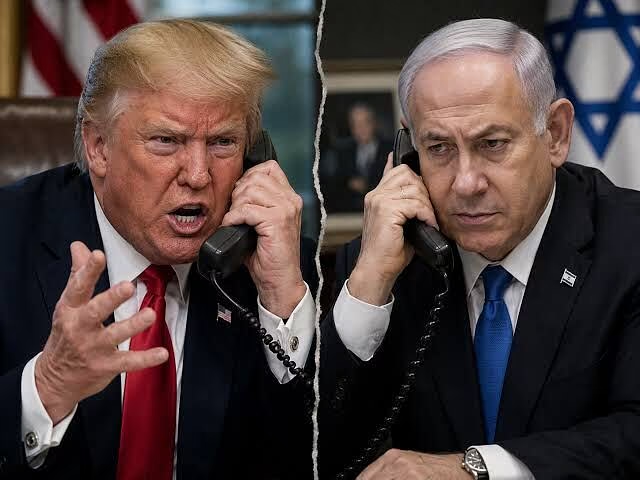
Washington – Wars rarely begin with a single decision. More often, they arise from a series of decisions not made, warnings ignored, and opportunities deliberately squandered. David Kirkpatrick's striking investigation in The New Yorker, published on July 20, offers perhaps the clearest explanation yet of how the United States failed to curb the Israeli war on Gaza, and how this failure ultimately contributed to dragging Washington into the ongoing war with Iran.
Based on classified documents and interviews with senior officials, Kirkpatrick dismantles the comforting narrative that President Joe Biden's administration lacked leverage over Israel. The evidence suggests the exact opposite; the administration possessed extraordinary influence but repeatedly chose not to use it.
The pivotal document in Kirkpatrick's investigation is a confidential letter delivered by Mirjana Spoljaric, President of the International Committee of the Red Cross (ICRC), to President Joe Biden on March 5, 2024. The ICRC, as the guardian of the Geneva Conventions, rarely addresses heads of state directly in such firm language.
Spoljaric warned that Israeli conduct had become "incompatible" with the laws of armed conflict and condemned the denial of ICRC access to Palestinian detainees. According to Kirkpatrick, Israel's suspension of legal dialogue with the ICRC placed it in the company of North Korea and Eritrea.
More importantly, she called on Biden to halt the transfer of weapons unsuitable for use in densely populated areas, warning that abandoning "minimum standards of humanity" would constitute a moral failure that history would not forgive.
This appeal came at a time when the U.S. administration possessed broad legal authority to act. Biden had already issued a policy prohibiting the transfer of U.S. weapons if it was "more likely than not" that they would be used to commit war crimes. The "Leahy Law" also prohibits providing assistance to military units credibly implicated in gross violations of human rights. Furthermore, "National Security Memorandum 20" obligated Secretary of State Antony Blinken to certify Israel's compliance with international humanitarian law, failing which military aid could be suspended.
The legal framework was already in place. But, according to Kirkpatrick, what followed was not an application of these safeguards, but a systematic effort to circumvent them whenever they conflicted with Washington's political commitment to Israel.
Years later, senior officials admit that the administration repeatedly allowed itself to be exploited. Former National Security Advisor Jake Sullivan said: "We should have put more pressure on Israel to take a different approach." Secretary of Defense Lloyd Austin likened Israeli Prime Minister Benjamin Netanyahu to a gambler "playing with house money," meaning money he wouldn't personally lose.
Israeli officials constantly reassured Washington that the war would end in "another two weeks," a phrase that became a joke within the administration after Ron Dermer jokingly replaced it with "fortnight." Each new promise delayed confrontation with Israel as casualties mounted.
Even Biden's widely publicized decision to suspend shipments of 2,000-pound bombs turned out to be largely symbolic. Kirkpatrick notes that the administration quietly continued to send 500-pound bombs separately, effectively undermining the decision.
The repercussions of this policy were not limited to Gaza. More than seventy thousand Palestinians, mostly civilians, were killed, vast areas of the Strip were destroyed, and most of the population was displaced.
But Kirkpatrick also explains that the U.S. administration's strategy contributed to accelerating the expansion of the conflict at the regional level. Fearing that any public disagreement with Israel would be interpreted as encouragement for Iran and Hezbollah, the White House continued to provide near-unconditional support to Israel, even as Netanyahu expanded the confrontation through operations in Damascus, Tehran, and Beirut.
Deputy National Security Advisor Jon Finer internally warned that this situation created a classic case of "moral hazard," as unconditional American support encouraged Israel to escalate, which Washington claimed it sought to prevent.
Philip Gordon, then National Security Advisor to Vice President Kamala Harris, summarized the problem by saying that Israeli leaders knew that "the United States would defend them no matter what."
This belief proved critically important. U.S. forces twice helped intercept large-scale Iranian attacks on Israel, reducing Israeli losses and solidifying the conviction among Israeli leadership that Washington would ultimately bear the cost of any escalation.
According to Kirkpatrick, Biden's advisors warned the incoming administration led by Donald Trump that Iran was in a strategically vulnerable position, and that Israel would likely seek to exploit this opportunity.
Those warnings became reality. When President Donald Trump later ordered U.S. forces to participate in strikes targeting Iranian nuclear facilities, and then in a surprise joint attack on Iran months later, those decisions were merely an extension of years of accumulated precedents.
Secretary of State Marco Rubio's explanation that Washington acted because Israeli operations would have dragged the United States into the conflict anyway embodies the logic of successive U.S. administrations that chose to follow, rather than guide, Israeli strategy.
Perhaps the most disturbing aspect of Kirkpatrick's investigation is not its revelation of misconduct, but its demonstration of how self-deception became normalized within decision-making institutions.
The State Department's review of National Security Memorandum 20 turned into what one official described as a "complete whitewash," while another considered it an act of bad faith.
Legal objections were raised within the administration, then softened, and ultimately neutralized through careful wording.
Similarly, the application of the "Leahy Law" to suspend aid to an Israeli base accused of mistreating Palestinian detainees stalled because Blinken believed a ceasefire was imminent. However, the ceasefire never materialized, and the recommendation remained unsigned, before Israeli authorities closed the file months later.
Ultimately, Kirkpatrick's investigation is not so much about Israel as it is about the nature of foreign policy decision-making in the United States. It reveals an establishment that confused access to allies with influence over them, loyalty with strategy, and restraint with weakness.
Time and again, Washington postponed difficult decisions, hoping that tomorrow would solve the problems it refused to confront today. But each postponement deepened the humanitarian catastrophe in Gaza and narrowed the strategic options available to the United States itself.
By the time successive U.S. administrations confronted Iran directly, they were no longer shaping the course of events, but reacting to them.
History will judge this period not only by the devastation in Gaza or the regional war now engulfing the region, but also by the lost opportunities that made it all possible.
The United States possessed sufficient influence to change the course of events, but repeatedly chose not to use it. This was not merely a policy failure, but a moral failure with far-reaching strategic consequences.
The most important lesson from Kirkpatrick's investigation is that granting unconditional support does not prevent broader wars; it makes them more likely. When a superpower refrains from using its influence in the service of accountability, it ultimately loses its credibility and its ability to influence the course of history.


Share your opinion
From Gaza to Iran: The Price of America's Inability to Say "No" to Israel