







Washington's Message
Washington – Said Arikat – 28/6/2026
News Analysis
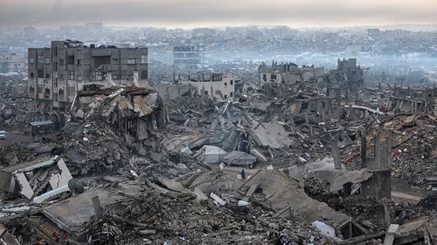
The draft resolution concerning what is known as the "Peace Council" reveals more than just administrative arrangements for the post-war phase in the Gaza Strip; it opens the door to a deeper question related to the nature of the authority intended to be imposed, the limits of Palestinian sovereignty, and the future of accountability itself in one of the world's most destructive and complex environments.
While the project is presented as a framework for reconstruction, stabilization, and disarmament, the document shows a parallel, less obvious but more sensitive trend: the establishment of a transitional governance structure with broad legal immunities, extending from political leaders to contractors, international forces, and even local Palestinian experts who will participate in civil administration. This expansion of the concept of immunity is not only about protecting individuals but about redefining who has the right to accountability and who is exempt from it.
In practice, granting comprehensive immunity to any entity managing the affairs of a devastated sector like Gaza immediately weakens one of the most important principles of public law: that authority is coupled with accountability. When these powers are transferred to an entity not subject to independent judicial oversight within the territory, nor to a clear international mechanism outside it, the question becomes not only how Gaza will be governed, but under what law it will be governed, and who has the right to object when violations or errors occur.
The most dangerous aspect of the draft is not only the broad scope of immunity but the absence of an entity to which Palestinians can appeal for challenge or accountability. The provisions that make the Council itself the investigating body for claims related to damages or losses practically mean merging the positions of "adversary" and "judge" into one institution. This is not just a technical loophole, but a structural flaw in the concept of transitional justice, which usually assumes the existence of a neutral third party.
In this context, the future of Palestinians in Gaza becomes linked to a governance model that is not based on a balance between authority and accountability, but on a broad delegation of power to a transitional body that possesses executive, security, and judicial powers simultaneously. This type of accumulation of power, even if temporary, creates a new political reality that will be difficult to reverse later, especially given the fragility of the Palestinian political structure and the ongoing internal division.
Politically, this formula raises a sensitive question about the meaning of "transition" itself. Are we facing a preparatory phase for the return of Palestinians to actual self-rule, or a long-term international administration model managed from outside and whose priorities are set outside the internal Palestinian context? The broader the powers of the Peace Council and the deeper its immunities, the more the space for Palestinian decision-making shrinks, even within daily civil affairs.
Most tellingly, the document, as revealed by reports, was not fully presented to the Palestinian parties participating in the civil administration. This detail, despite its importance, reflects a flaw in the structure of participation itself: it appears that Palestinians are being called upon to implement a model they did not actively participate in drafting, but rather one that was prepared in narrow external circles and then presented to them as a fait accompli.
Economically and administratively, the clause on the free use of public property for the Council's administration adds another layer of problems. The absence of clear mechanisms for compensation or legal regulation places the future of public resources in Gaza in a gray area, where facilities may turn into operational tools in the hands of an external administration without real sovereign or local guarantees. This reproduces a pattern known in previous international experiences, where reconstruction is mixed with the redistribution of influence rather than being a balanced development process.
As for security, linking the project to the disarmament of factions and creating an environment for the deployment of an international force places Gaza before a deep reshaping of its security structure, but this is happening outside the framework of a comprehensive political agreement with the Palestinians themselves. Here lies one of the most important contradictions: lasting stability cannot be imposed through externally imposed security arrangements without a clear political contract that defines mutual rights, duties, and guarantees.
From the perspective of international law, the draft raises an additional problem related to the nature of the entity itself: Is it an international organization? Or a special political body? Or a hybrid model outside traditional classifications? This ambiguity is not a minor detail, but a crucial element in determining whether the proposed immunities are legally sound in the first place or merely unstable political privileges.
In conclusion, it appears that what is being proposed in Gaza is not just about reconstruction, but about re-engineering the governance model itself. However, any model that is not based on transparent accountability, and does not guarantee the right of Palestinians to oversight, accountability, and objection, carries within it the seeds of a future crisis, even if it appears at the moment to be a tool for stability.
The future of Palestinians in Gaza, in light of this draft, is not determined solely by the success of construction projects or disarmament, but by the ability of any new governing framework to answer a simple but fundamental question: Who holds power accountable when it errs? And who ensures that the "transitional phase" does not turn into a permanent system without accountability?
Without clear answers to these questions, immunities may turn from an administrative protection tool into a political barrier that separates the population from their rights, and makes Gaza more a sphere of external administration than a viable space for Palestinian sovereignty.
Share your opinion
Immunities Over Gaza: Is the Future of Palestinians Being Reshaped Beyond Accountability?