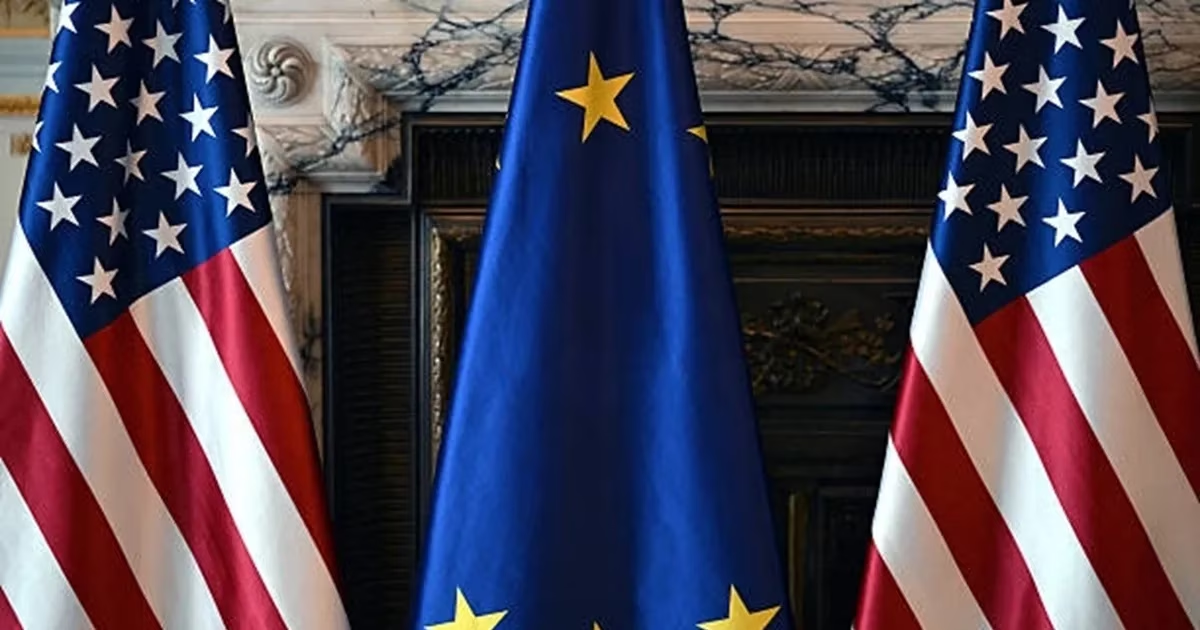







The international political arena is witnessing a remarkable shift in the strategies of traditional US allies, as these partners have begun working behind the scenes to reduce their historical dependence on Washington. These moves come as the United States prepares to celebrate its 250th anniversary of independence, yet its partners are realizing that these relationships no longer provide sufficient protection from the pressure tactics employed by President Donald Trump's administration.
Analytical sources reported that the new political climate has transformed close ties with Washington from a source of strength into a potential weakness, especially after the US administration demonstrated its ability to use economic power against friends and foes alike. This concern was evident in the statements of Italian Prime Minister Giorgia Meloni, who criticized Trump's treatment of democratic allies, which at times exceeded his treatment of authoritarian regimes.
The artificial intelligence sector stands out as one of the most important battlegrounds for national sovereignty, as Washington's decisions to restrict access to advanced models like 'Mythos 5' have caused widespread concern among European capitals. These steps have prompted industry leaders in Europe to warn of the risks of complete reliance on technology that the United States could shut down with a sudden political decision, threatening the stability of emerging digital economies.
In Paris, Arthur Mensch, CEO of the AI company 'Mistral,' warned that technological sovereignty has become an urgent necessity, not just a strategic option. Observers believe that what is known as the 'Mythos moment' served as a wake-up call for European countries to strengthen their own models and reduce their reliance on American companies subject to the political whims of the White House.
The concern is not limited to the technical aspect but extends to the defense and arms sector, where Trump's previous threats regarding sovereign issues like 'Greenland' served as a reminder of the extent of European military dependence. This reality has led American defense companies to fear losing major markets, as European governments seek local alternatives or diversify their arms sources to ensure the independence of their military decisions.
In Asia, India emerges as a model for countries that have begun to re-evaluate their partnership with Washington due to tariffs and American rapprochement with regional adversaries. Research studies have indicated that the 'Trump factor' was a key driver for New Delhi's decision to prefer purchasing French fighter jets over American ones, in an attempt to avoid the political pressures associated with arms deals.
Canada, the closest neighbor to the United States, has adopted a more systematic approach to the issue of national sovereignty, especially after Trump's controversial statements about its political status. The Canadian government identified nine vital economic sectors, including semiconductors and payment systems, and considered them essential pillars that must be protected from any external interference or consequences that Washington might impose.
Despite these efforts, the question remains about the feasibility of complete independence from the American economy, as 70% of Canadian trade is still linked to the United States. Moreover, emerging European companies in advanced technology still face major challenges in competing with American giants who possess enormous financial and technical resources that are difficult to overcome in the short term.
Analysts point out that the Western world faces a dual dilemma: technological dependence on Washington and reliance on China for critical minerals. These deep dependencies make the idea of complete separation almost impossible, but they push countries to seek strategies to mitigate the negative effects of this dependence by building new trade alliances that do not include the two major poles.
The Comprehensive and Progressive Agreement for Trans-Pacific Partnership (CPTPP) is a potential model for this trend, as it includes middle powers such as Japan, Australia, and Britain. Discussions are currently underway between this bloc and the European Union to conclude trade deals aimed at reducing tariffs and enhancing inter-trade, away from American or Chinese dominance.
Some strategic visions suggest that the solution lies not in complete independence, but in possessing economic 'leverage tools' that can be used for deterrence when needed. Experts cite the Chinese model, which used restrictions on critical mineral exports to retaliate against American tariffs, a strategy that proved effective in forcing Washington to review some of its hardline policies.
In this context, India can leverage its position as a global producer of generic drugs as a bargaining chip in any future economic confrontation with the US administration. Similarly, Canada possesses strategic natural resources such as 'potash,' essential for American agriculture, giving it maneuverability if its economic interests are directly threatened by its southern neighbor.
Europe, in turn, possesses strong technical and industrial assets, such as the Dutch company 'ASML,' which controls the most advanced semiconductor production technologies in the world. In addition to its role as a major source of uranium and turbines, these are vital sectors that can be used to ensure a balance of power in any trade dispute that may arise with the United States in the future.
In conclusion, it appears that the world shaped by Trump's policies has forced Western democracies to prepare for scenarios previously considered unbelievable, including economic wars between allies. Despite the bitterness of this reality, it pushes towards the formation of a new world order in which middle powers seek to assert their sovereignty and protect their interests amidst declining trust in traditional American leadership.
The biggest risk for Europe is that its industry becomes entirely dependent on technology that can be shut down if the United States decides to do so.



Share your opinion
Washington's Allies Seek Economic and Technological 'Independence' in the Trump Era