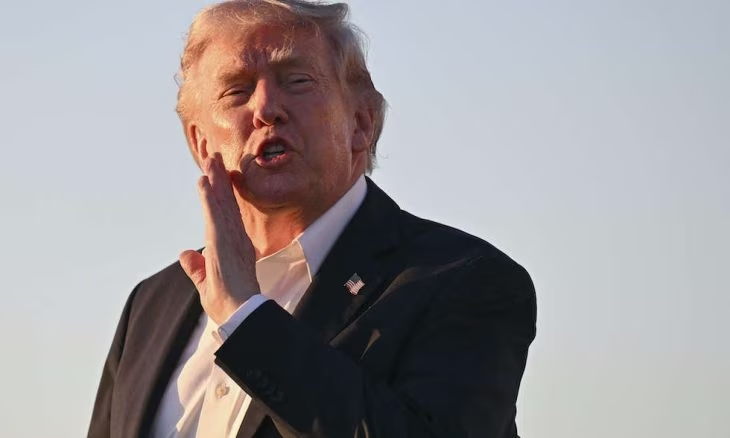







US President Donald Trump sparked a wave of controversy after showing remarkable enthusiasm for being evaluated on par with historical figures associated with dictatorship and power. According to press reports, Trump agreed with an analysis that sees the fundamental difference between him and leaders like Hitler, Stalin, and Mao Zedong as lying in his possession of power and influence that surpasses what they achieved in their eras.
The story began when Trump reposted a short text praising his leadership abilities, in which the author considered that history has known strong men distinguished by conquest and intimidation, but they lacked the comprehensive global impact that Trump enjoys today. The US President commented on this proposition by saying: 'Sounds good to me,' a clear indication of his acceptance of this bold historical comparison.
Trump introduced the author of this analysis, named Dave King, as a 'presidential historian,' but journalistic investigations revealed the man's true identity. It turned out that King is not a historian at all, but a Scottish-born businessman residing in South Africa, who previously served as chairman of Rangers Football Club, which raises questions about the accuracy of Trump's classifications of his sources.
The first meeting between Trump and King occurred in a sporting context far from historical research centers, specifically during a golf match in Florida. It appears that King seized the opportunity to convey his vision of Trump's 'greatness' compared to ancient conquerors like Attila the Hun, Genghis Khan, and Napoleon, which was immediately well-received by the president aspiring to return to the White House.
These details were included in a new book titled 'Change of System,' authored by journalists Maggie Haberman and Jonathan Swan, scheduled for release next week. The book recounts the behind-the-scenes of the first months of Trump's ambitions for a second term, relying on hundreds of interviews conducted with his aides and inner circle over three continuous years.
Press sources reported that Trump boasted about these comparisons to New York Times reporters during an interview in March. When asked about his place in history, he asked his aides to bring a two-page document he received from the alleged 'historian,' and began reciting the names of historical leaders, explaining how their authority did not match that of the President of the United States.
During that interview, Trump claimed that historical leaders maintained their influence by instilling fear in the hearts of their people, asking indignantly who would dare to do that in the modern era. However, his admiration for the document reflected a deep desire to be seen as a pivotal figure whose power transcends the traditional recognized boundaries of democracy.
The new book does not stop at historical comparisons but also reveals political behind-the-scenes related to Trump's potential administration and his thinking about major appointments. Among the surprises reported by the authors is that Trump seriously considered appointing his Republican rival and Florida Governor, Ron DeSantis, to the position of Secretary of Defense, despite their public rivalry.
Regarding foreign policy, the book quoted shocking statements by Trump about the Ukrainian crisis, where he expressed his dislike for the Ukrainian state as a political entity. Trump merely praised Ukrainian women, referring in his usual manner to their repeated success in Miss Universe pageants, which he previously owned the rights to.
The book also highlights Trump's personal and behavioral aspects within the Oval Office, describing unusual scenes of the leader of the superpower. In one account, Trump was seen manually attempting to affix gold ornaments to a marble fireplace mantel using 'super glue,' a scene reflecting his excessive attention to aesthetic details and visual delight.
Trump's comments about his constant winning and his complaints about press coverage were also present in the recorded interviews for the book, where he said: 'Basically I was winning every time, and I'm tired of winning and getting bad press.' These statements reinforce the narcissistic image that his political opponents try to establish about him in election campaigns.
Observers believe that Trump's pleasure in being compared to authoritarian rulers is not new, but rather an extension of years of statements in which he expressed admiration for leaders like Vladimir Putin and Kim Jong Un. This tendency towards the 'strong man' raises concerns among democratic circles in the United States about the form of a potential second Trump term.
The book, based on more than 1000 interviews, paints a complex picture of a president who sees himself in a constant struggle with the 'deep state' and the media, while seeking historical legitimacy that places him above everyone. These leaks come at a sensitive time with the approaching heated presidential race, increasing the intensity of political polarization in the American street.
In conclusion, these narratives remain rich material for discussion about Trump's leadership psychology and how he sees himself as a unique phenomenon in human history. While his supporters see it as evidence of confidence and strength, his opponents see it as a dangerous indicator of authoritarian tendencies that could threaten American constitutional institutions if he returns to power.
The vast difference between these historical leaders and President Trump is their lack of the global influence he enjoys.
Share your opinion
Trump boasts of superiority over Hitler and Stalin in 'global influence'