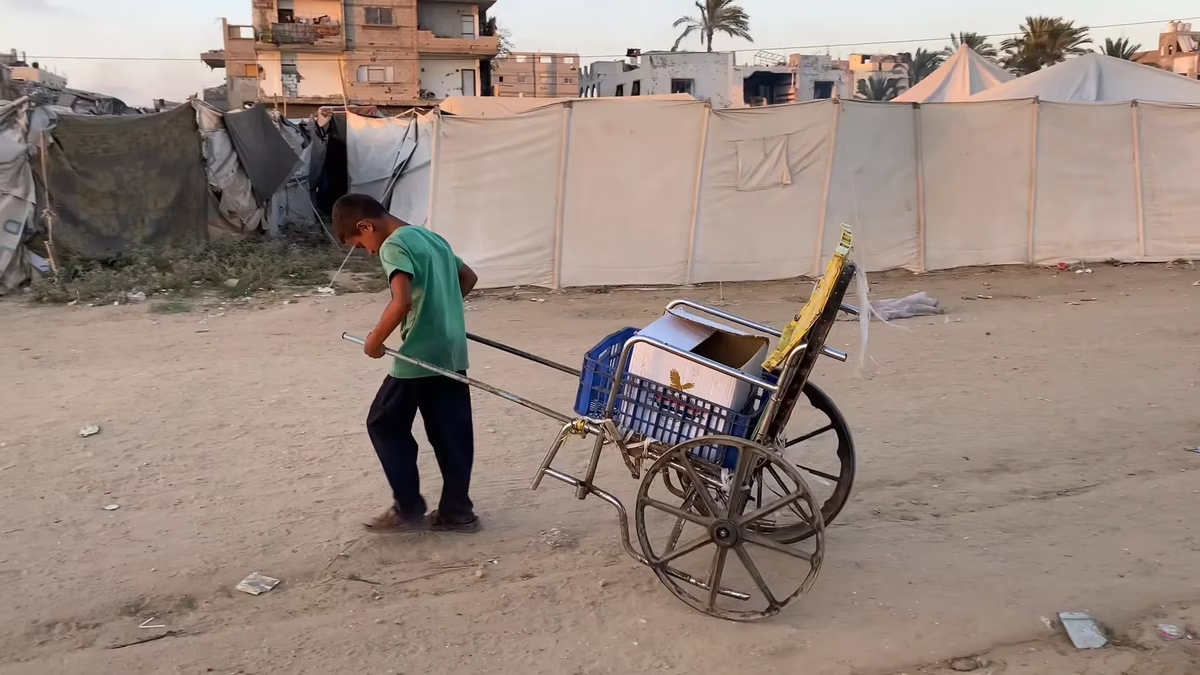







Every morning, Malik Abu Nasr wakes up to begin an arduous journey through the streets of Deir al-Balah, pulling a cart he personally made from the remnants of a dilapidated wheelchair. Malik, who is not yet ten years old, strives to secure daily sustenance for his displaced family, who live in a tattered tent, after his father was killed in an Israeli airstrike that turned their lives into a continuous struggle for survival.
Malik's small dream was to become a dentist in the future, but the war machine forced him to leave school and carry burdens beyond his physical capacity. His family was displaced from Beit Lahia in the northern Gaza Strip after their home was destroyed, settling in a dangerous border area east of Deir al-Balah, where he became the sole support for his mother and three siblings.
Amidst the suffocating transportation crisis and the destruction of infrastructure, Malik's cart has become an essential means of transporting the belongings and needs of displaced people for meager sums. His daily income does not exceed 15 shekels, a very small amount, but it represents the only lifeline for his family, who depend on him to provide the minimum basic necessities amidst exorbitant prices.
His mother, Alaa Abu Nasr, speaks with a mixture of pride and heartbreak about her child, who excelled in his studies and memorized parts of the Holy Quran. She says that worry never leaves her during his hours of absence in the markets, where he faces the dangers of shelling and harsh weather conditions with his tender body, which has been exhausted by hard work prematurely.
The tragedy of early labor is not limited to males; it has extended to girls who find themselves in direct confrontation with the harshness of the streets. Nour Baroud, a thirteen-year-old girl, spends her day behind a stall selling locally produced fuel from burning plastic waste, a job fraught with health and environmental risks.
Nour, who dreamed of studying medicine, is now an expert in alternative fuels that residents resort to due to the fuel blockade and its prevention from entering the Strip. The child confirms that the war has robbed her of her right to play and education, and made her responsible for helping her father secure the family's increasing needs amidst the economic collapse.
From a social perspective, human development specialist Nawal Asqoul believes that child labor in Gaza is no longer just a fleeting phenomenon, but has turned into a forced survival strategy. She explained that children in Gaza have transitioned from being beings who need care to providers for entire families, which creates deep psychological and social gaps whose effects will appear in the future.
Asqoul points to the existence of an 'army of orphans' produced by the war, where thousands of families have lost their primary breadwinners, pushing children into arduous and dangerous professions. This phenomenon affects girls and boys alike, as they roam the streets and rummage through garbage in search of materials that can be sold or used as cooking fuel.
Legally, the director of Al-Dameer Association for Human Rights, Alaa Al-Skafi, describes what is happening as a 'complex crime' committed by the occupation against Palestinian childhood. He affirmed that targeting the educational system and killing fathers forcibly pushes children into the labor market, which falls within policies of destroying Palestinian society entirely or partially.
Al-Skafi explained that depriving children of the right to safety, play, and education is a blatant violation of international conventions, especially given the occupation's deliberate efforts to make life in Gaza impossible. These circumstances force children to perform tasks unsuitable for their age, such as sifting through rubble and working in polluted and dangerous environments.
Official figures issued by the Palestinian Ministry of Social Development reinforce this tragic reality, revealing the presence of more than 64,000 orphans in the Strip. Among these, about 55,000 children have lost one or both parents during the ongoing months of war, placing an enormous burden on already exhausted relief organizations.
These orphaned children live in extremely harsh humanitarian conditions, lacking adequate shelter, healthcare, and regular education. This mass loss of breadwinners has made child labor the only option to avoid hunger and death, amidst the international system's inability to provide them with the necessary protection.
While the world celebrates the International Day Against Child Labor, international slogans seem far removed from the reality of the Gazan child who struggles with death and work simultaneously. The transformation of children's bodies into tools of hardship is the direct result of the policy of siege and systematic shelling that targets the future of coming generations in the Strip.
Malik's and Nour's stories remain examples of thousands of cases that have not been highlighted, where big dreams are lost behind small stalls and handcarts. The continuation of this reality threatens the emergence of an entire generation deprived of education, burdened with psychological and physical scars that may not heal even after the guns fall silent.
Our children have grown up prematurely, bearing responsibilities that will leave long-lasting effects on their mental and physical health; the war has turned their bodies into tools of hardship.

Share your opinion
Children of Gaza: Forced Labor Under the Weight of War and Deferred Dreams Behind Carts and Stalls