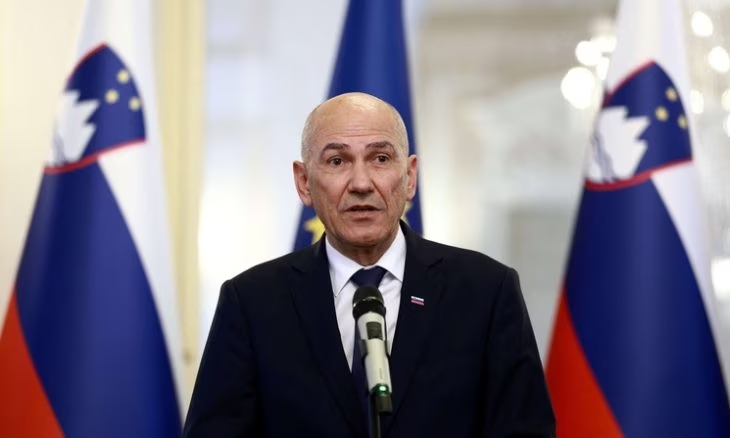







Slovenia's new conservative government, led by Janez Janša, has approved a series of decisions that reflect a complete reversal in the country's foreign policy towards the Israeli occupation. These decisions included lifting the entry ban on Israeli Prime Minister Benjamin Netanyahu, as well as National Security Minister Itamar Ben-Gvir and Finance Minister Bezalel Smotrich, who were previously prohibited from entering Slovenian territory under the previous government's decisions.
Official sources reported that the new direction of Janša's government aims to end the diplomatic coolness that characterized the previous center-left government's era. This was not limited to facilitating the movement of Israeli officials but also extended to lifting trade restrictions imposed on products from Israeli settlements in the occupied Palestinian territories, representing a retreat from previous international commitments.
In a move that drew widespread criticism, Ljubljana decided to resume the export and transit of weapons and military equipment to and from Israel, thereby ending a ban that had been imposed for humanitarian and legal reasons. This step is set to strengthen military cooperation between the two sides at a time when the region is experiencing escalating tensions, indicating the new government's desire to build a close alliance with Tel Aviv.
In 2025, Slovenia had taken a firm stance by linking the ban on Netanyahu's entry to arrest warrants issued by the International Criminal Court, a position that the current government has overturned. The new authorities justified this shift by the necessity of opening direct political communication channels, considering that the previous punitive measures hindered Slovenia's diplomatic role in the European Union.
On a symbolic level, the Slovenian capital witnessed sharp tensions after Janša's government removed the Palestinian flag from above the government building immediately upon taking power. Observers considered this move a clear political message expressing the end of the explicit support for the Palestinian cause pursued by former Prime Minister Robert Golob, who was a staunch critic of Israeli practices.
In contrast, a division emerged within Slovenian state institutions, as the liberal President, Nataša Pirc Musar, responded to the government's actions by re-raising the Palestinian flag above the presidential building. This divergence reflects an internal struggle over the country's foreign policy identity, especially since Slovenia had officially recognized the State of Palestine in 2024 in a historic move that received widespread international welcome.
Janez Janša's government, which came to power after parliamentary elections held last March, seeks to align itself with right-wing policies in Europe that unconditionally support Israel. These decisions are expected to spark legal and political debate within the European Union, particularly regarding adherence to International Criminal Court decisions and unified policies towards illegal settlements.
The new Slovenian government announced the cancellation of punitive measures to open political communication channels with Israel.

Share your opinion
Radical Shift in Slovenia: New Government Lifts Ban on Netanyahu and Resumes Arms Exports to the Occupation