







Washington Message
Washington – Said Arikat - 12/6/2026
In a development that could redraw the political and security landscape in the Middle East, the United States and Iran are nearing the signing of an interim agreement aimed at establishing a ceasefire between the two parties, reopening the Strait of Hormuz, and paving the way for broader negotiations on Iran's nuclear program. US President Donald Trump describes this step as the end of the war, while Tehran continues to approach it with clear caution, asserting that a final decision has not yet been made.
According to informed diplomatic sources, the two sides have reached a draft memorandum of understanding, the text of which has been almost finalized, awaiting final ratification from Iranian officials. Information indicates that the signing ceremony may take place in Geneva, Switzerland, in the coming days, possibly as early as Sunday.
This development comes as G7 nations prepare for an important meeting next week, amidst increasing international pressure to prevent the region from sliding into a broader confrontation that threatens the global economy and international energy security.
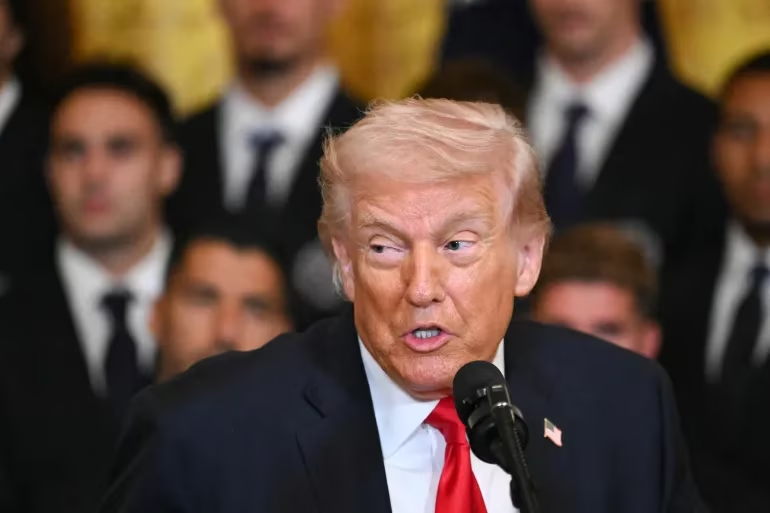
While Trump announced on Thursday evening that he had canceled planned military strikes against Iran after reaching a common understanding, asserting that all concerned parties had agreed to the agreement "in principle and details," the Iranian Foreign Ministry quickly affirmed that no final agreement had yet received the green light from the Iranian leadership.
Leaked information reveals an agreement that goes beyond merely halting direct military actions between Washington and Tehran. According to the Iranian "Mehr" agency, the agreement also includes ending military operations in Lebanon, fully reopening the Strait of Hormuz within thirty days of its signing, in addition to releasing a first installment of frozen Iranian funds amounting to $12 billion out of $24 billion that will gradually be made available to Tehran.
The agreement also includes, according to the same sources, lifting sanctions imposed on Iranian oil and petrochemical exports, granting Iran access to its frozen assets abroad, as well as a US pledge not to interfere in Iranian internal affairs and to remove US forces from areas near the Iranian border.
The nuclear file, which has been the core of tension between the two parties for many years, does not seem to have been resolved yet. The agreement only stipulates the launch of sixty-day negotiations to reach a final settlement on Iran's nuclear program, without referring to details related to uranium enrichment levels or future international monitoring mechanisms.
Notably, Iran's ballistic missile program, as well as Tehran's relationship with its regional allies, including Lebanese Hezbollah, are not included in the proposed negotiations, reflecting the extent of mutual concessions that both parties seem willing to accept to avoid a return to military confrontation.
US sources indicate that Vice President JD Vance may participate in the upcoming signing ceremony in Europe, which would give the agreement additional political weight and reflect the Trump administration's desire to market the agreement as a major strategic achievement before entering a new political phase.
However, despite its promises of de-escalation, the agreement faces numerous challenges, most notably the stance of regional powers who see any easing of pressure on Iran as strengthening its regional influence, in addition to the presence of currents within the United States and Iran that oppose making concessions to the other side after many years of conflict, sanctions, and military threats.
Trump Seeks Political Victory More Than a Historical Settlement
It appears that the primary motive behind Trump's push for the agreement is not solely related to the desire for regional stability, but also to the need to achieve a significant political accomplishment that can be presented to the American public as evidence of the success of the "pressure then negotiate" policy. After months of military escalation and mutual threats, it has become difficult for the US administration to justify the continuation of open confrontation without a clear political horizon. Therefore, the agreement offers Trump an opportunity to appear as the man who avoided a costly war, even if the fundamental issues that sparked the crisis remain unresolved.
Israel the Biggest Loser from Any US-Iranian Rapprochement
If the agreement is signed in its circulated form, Israel may find itself facing a new strategic reality that does not align with the vision advocated by Prime Minister Benjamin Netanyahu for years. The agreement does not address Iran's ballistic missile program or the network of regional allies associated with Tehran, and it opens the door to easing sanctions and the re-flow of financial resources to Iran. This would undermine Israeli efforts to keep Iran under maximum isolation and pressure, and expose the limits of Netanyahu's ability to influence US decisions when Israeli interests conflict with Washington's strategic calculations.
The Middle East Between an Opportunity for De-escalation and the Risks of Postponing Crises
Despite the positive atmosphere surrounding the agreement, the core of the conflict has not yet been resolved; rather, it has been postponed to the negotiating table. Disputes over Iran's nuclear program still exist, and issues related to regional influence and ballistic missiles were not even raised within the framework of the current understanding. This means that the agreement may succeed in buying time and temporarily reducing tension, but it does not guarantee addressing the deep causes of the crisis. Consequently, the region stands before a real opportunity for de-escalation, but it remains a fragile opportunity that could quickly collapse if subsequent negotiations fail to address the most sensitive and complex issues.
Share your opinion
Imminent US-Iranian Agreement: Trump Announces "End of War" Amidst Iranian Skepticism and Questions About the Deal's Price