






Dr. Suhail Diab: The conflict in the region is no longer viewed as a temporary occupation amenable to settlement, but has transformed into a long-term struggle over land, borders, and resources..
Sari Sammour: The 1967 war paved the way for a series of major political transformations in the region, including the peace agreements Israel concluded with a number of Arab countries..
Dr. Reham Odeh: Israel is effectively proceeding with the implementation of its regional project by focusing on establishing buffer zones and security belts within bordering Arab territories..
Maged Hudeib: The most dangerous aspect of this expansion is the reshaping of the region according to the Israeli vision by imposing new balances based on military power and facts on the ground..
Dr. Aql Salah: The region is experiencing a "second setback" and the Israeli expansionist project faces challenges that prevent its completion, most notably the steadfastness of Palestinians and Lebanese..
Hani Abu Al-Siba': Despite signing the peace agreement with Egypt, Israel continued its expansionist policies, and the statements of its leaders currently clearly reflect the "Greater Israel" project..
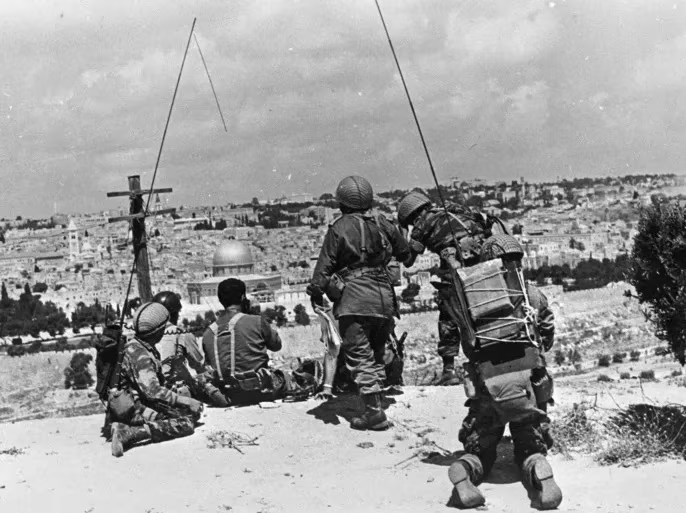
Ramallah - Exclusive to "Al-Quds" - On the fifty-ninth anniversary of the June 1967 war, discussions are renewed about the repercussions of the war that still cast a shadow over the Palestinian and regional scene, in light of the expansion of Israeli military operations, the growth of settlements, and field movements in the occupied Palestinian territories and neighboring Arab areas, amid warnings of attempts to impose new facts on the ground that may affect the future of the conflict and its political settlements.
Writers, political analysts, specialists, and university professors, in separate interviews with "Al-Quds", believe that the developments witnessed in the region, especially since October 7, 2023, until now, reflect the transition of the conflict from the framework of temporary occupation to a long-term struggle over land, borders, and resources, with increasing talk about security belts and buffer zones and declining chances of reaching a political settlement based on the two-state solution, in light of continued settlement expansion and changing balances of field control.
They agree that the results of the 1967 war still constitute a fundamental reference for understanding the current reality, whether through the continuation of the conflict over Jerusalem, borders, and settlements, or through regional transformations that have raised questions about the future of the regional system, and the possibility of reshaping the balance of power in the Middle East in light of accelerating military and political changes.
Long-term conflict over land, borders, and resources
Dr. Suhail Diab, a professor of political science and specialist in Israeli affairs, believes that the current scene on the fifty-ninth anniversary of the June 1967 war confirms that the conflict in the region is no longer viewed as a temporary occupation amenable to settlement, but has transformed into a long-term struggle over land, borders, and resources, in light of the expanding scope of Israeli influence and military control in more than one regional arena, including the Gaza Strip, the West Bank, southern Lebanon, and border areas within Syria.
Diab explains that the 1967 war still casts its shadow over various fundamental issues in the Arab-Israeli conflict, as the issues of Jerusalem, settlements, borders, the Golan, and the Palestinian state have their direct roots in the results of that war, which led a number of researchers and analysts to consider that the war has not ended politically despite the cessation of military operations decades ago, and that its repercussions are still unfolding today.
Consolidating permanent facts
Diab points out that over the past decades, Israel has moved from a model of direct military occupation to more complex forms of control, based on consolidating permanent facts through settlement expansion, infrastructure networks, and legal or de facto annexation, thereby strengthening its influence on the ground and making any future change more difficult.
Diab emphasizes that the developments following October 7, 2023, brought the demographic dimension of the conflict back to the forefront, after many years in which this factor had relatively declined, to return again as one of the central challenges in the relationship between Israelis and Palestinians.
Diab notes that the ongoing military operations in Gaza, Israeli movements on the Lebanese border, and military presence in some Syrian areas reflect a trend towards establishing security belts and buffer zones outside traditional borders.
According to Diab, while Israel justifies these measures on security grounds and to prevent threats, Palestinian and Arab parties, along with international bodies, view them as a form of expanding control and imposing new geographical realities on the ground.
Crisis facing the two-state solution
Diab stresses that one of the most prominent repercussions of these policies is the deepening crisis facing the two-state solution, as continuous settlement expansion in the West Bank makes the establishment of a geographically contiguous Palestinian state more complex over time, and reduces the chances of reaching a sustainable political settlement.
1967.. The beginning of profound transformations
In his assessment of the conflict's trajectory since 1967, Diab believes that this war represented the peak of Israeli military achievement, but at the same time, it marked the beginning of profound transformations that carried within them factors for the long-term decline of the Zionist project.
Diab points out that the transition from controlling territories under the pretext of security to a settlement project with a replacement and colonial character contributed to the emergence of accumulated internal and external crises, and produced manifestations of international isolation and increasing criticism of Israeli policies.
Reshaping the regional environment
Regarding the escalating talk about the "New Middle East," Diab calls for distinguishing between two different concepts; the first relates to reshaping the regional environment to ensure Israeli security, economic, and military superiority, and the second is related to ideological propositions that speak of "Greater Israel" and clear expansionist borders. Diab explains that, according to academic standards, there is no official declared Israeli plan that defines new future borders for the state, but there is a clear project to reshape the regional environment to serve Israeli interests.
Diab stresses that the future of these perceptions is still linked to a number of crucial variables, including the outcomes of the current war, the development of hot international issues, the nature of the Israeli political system in the coming period, and the trends of American public opinion.
Stage of fluid events
Diab believes that the region is still experiencing a very fluid stage of events, and that talk of a new Middle East remains subject to shifting regional and international balances, emphasizing that any future regional system will not be shaped according to the Israeli or American vision alone, but within a more pluralistic and complex international and regional reality.
1967.. Repercussions still present
Writer and political analyst Sari Sammour confirms that the June 1967 war constituted a pivotal turning point in the history of the Arab-Israeli conflict, not only at the level of geographical control, but also in the nature of conflict management and its political objectives, noting that the repercussions of that war are still present today and affect the regional scene in its various dimensions.
Sammour explains that the war brought about a radical shift in the Arab perception of Israel, as Arab political discourse, after the defeat, shifted from talking about the complete liberation of Palestine and ending Israel's existence to focusing on restoring the territories occupied in 1967 and demanding the implementation of relevant international resolutions, foremost among them Security Council Resolutions 242 and 338. Sammour believes that this shift granted Israel political and strategic gains in addition to the military gains it achieved on the ground.
Sammour points out that the results of the war enabled Israel to expand its regional control by occupying the West Bank, including East Jerusalem, which includes Al-Aqsa Mosque, in addition to occupying the Syrian Golan Heights.
Sammour notes that these developments strengthened Israel's confidence in its ability to impose new realities, leading to the declaration of Jerusalem as its capital, in light of the international community's inability to bring about a fundamental change in this reality.
Paving the way for major political transformations
Sammour believes that the 1967 war paved the way for a series of major political transformations in the region, including the peace agreements Israel concluded with a number of Arab countries, stressing that without the results of that war, the region would not have witnessed agreements such as Camp David, Wadi Araba, and Oslo in the form they later became known.
Sammour points out that expansion represents a fundamental pillar of the Israeli project, which is based on geographical expansion, demographic replacement, and the reshaping of demographic reality in the areas it controls.
Sammour notes that current Israeli policies in the Gaza Strip and the West Bank, in addition to military movements in Lebanon and Syria, reflect the continuation of this vision and an attempt to impose new equations on the ground.
Shifting negotiation lines to a new reality by force
Sammour stresses that Israel constantly seeks to shift negotiation lines to a new reality imposed by force, so that negotiations shift from discussing ending the occupation or removing settlements to discussing the limits of withdrawal from newly occupied areas.
Sammour believes that what is happening in Syria and Lebanon reflects this approach, where demands have focused on returning to previous lines and agreements instead of addressing the roots of the occupation, which reflects the continued impact of the 1967 war results on the course of the conflict to this day.
Fragmenting Palestinian geography
Writer and political analyst Dr. Reham Odeh, in her commentary on the anniversary of the June 1967 war, believes that the continuous Israeli expansion in the occupied Palestinian territories, along with military movements in both Lebanon and Syria, reflects a growing Israeli trend to reshape the geographical and security reality in the region in a way that serves its strategic interests and limits the chances of an independent Palestinian state.
According to Odeh, the settlement expansion and accelerating field measures witnessed in the West Bank, in parallel with Israeli control over key joints in the Gaza Strip, fall within a policy aimed at fragmenting Palestinian geography and preventing geographical contiguity between parts of the future Palestinian state, thereby practically undermining the possibility of establishing an independent state on the 1967 borders.
Imposing a new reality in the Middle East
Odeh stresses that Israeli movements in Lebanon and Syria go beyond immediate security considerations, as Israel seeks to impose a new political and security reality in the Middle East by utilizing its military superiority to force regional countries to deal with it as a dominant regional power that must be accommodated and whose influence must be adapted to.
Odeh points out that targeting forces supporting the Palestinian resistance and attempts to impose control over border areas in southern Lebanon and southern Syria fall within a broader strategy to redraw regional power balances.
Odeh believes that Israel is effectively proceeding with the implementation of its regional project by focusing on establishing buffer zones and security belts within bordering Arab territories, under the pretext of protecting its national security.
Buffer zones as political and security leverage
Odeh believes that these areas may in the future turn into political and security leverage that Israel uses to influence the decisions of regional countries and push them towards security arrangements or normalization agreements, thereby consolidating a new regional reality that gives it a wider margin for military and political maneuver in the Middle East.
Attempt to reshape regional reality
Writer and political analyst Maged Hudeib believes that the expanding scope of Israeli operations and control in the occupied Palestinian territories, along with military movements in Lebanon and Syria, carries a set of political, security, and strategic implications that go beyond the limits of direct military confrontations, to fall within the framework of an attempt to reshape regional reality and impose new equations that affect the future of the region and its political settlements.
Hudeib explains that one of the most prominent implications of this expansion is Israel's ability to impose new field realities by controlling additional areas and redrawing the security geography in more than one arena, which gives it additional leverage in any future negotiations or political settlements.
Israel and investing in war outcomes
Hudeib points out that Israel has historically invested in the results of wars and military operations to transform field gains into political facts that affect the form of future solutions, which is what happened in the June 1967 war.
Hudeib notes that the security dimension represents one of the main drivers of this expansion, as Israel, according to its vision, seeks to establish buffer zones, security belts, and field enclaves that it considers advanced defense lines that prevent the emergence of future threats to its security.
Hudeib believes that this policy is not new, but has been repeated at more than one historical juncture with the aim of strengthening field control and creating facts that are difficult to overcome in any subsequent political arrangements.
Israel's attempt to impose political projects and solutions
Sammour believes that what is happening in Syria and Lebanon reflects this approach, where demands have focused on returning to previous lines and agreements instead of addressing the roots of the occupation, which reflects the continued impact of the 1967 war results on the course of the conflict to this day.
According to Hudeib, these combined factors have contributed to strengthening Israeli influence and bringing about tangible shifts in the regional balance of power recently.
Hudeib stresses that the most dangerous aspect of this expansion is the trend towards reshaping the region according to the Israeli vision, by imposing new political and security balances based on military power and the field realities produced by recent wars.
Hudeib warns that these transformations increase the complexity of fundamental issues related to the Palestinian cause, foremost among them issues of borders, sovereignty, security, and the future of the independent Palestinian state, which places additional obstacles in the way of any political efforts for settlement.
Betting on Arab positions
Hudeib stresses that Israeli military successes, despite their field impact, are not sufficient alone to achieve a comprehensive regional political project or impose what is known as the "New Middle East" project.
Hudeib explains that the success of any such project remains contingent on the approval of regional countries and reaching a just and comprehensive political settlement that addresses the roots of the Arab-Israeli conflict.
Hudeib points out that the continued Israeli occupation of Palestinian territories and territories in Syria and Lebanon, and the continuation of the conflict without a clear political horizon, constitute a fundamental obstacle to achieving regional stability.
Hudeib notes that Arab and international positions rejecting the policy of imposing facts by force make it difficult to transform military gains into a permanent political project.
Hudeib points out that peace and stability in the region cannot be achieved through wars or military dominance, but rather through agreements based on justice, ending the occupation, and establishing a Palestinian state in accordance with international legitimacy resolutions, considering this the true gateway to any stable and sustainable regional arrangements.
Stage of geographically and demographically resolving the conflict
Writer, political researcher, and professor of comparative political systems, Dr. Aql Salah, believes that the region is currently witnessing a "second setback" whose effects and repercussions exceed those of the 1967 setback, both in terms of the affected geographical area and the magnitude of political and strategic transformations witnessed in the Palestinian territories and a number of Arab countries.
Salah explains that Israel has moved from the stage of managing the conflict to the stage of resolving it geographically and demographically, benefiting from the realities imposed by the ongoing war since October 7, 2023, and from the structure produced by the Oslo Agreement, which was supposed to lead to ending the occupation, but provided cover for consolidating Israeli control over most of the West Bank territories, especially in areas classified (B) and (C), with the expansion of land confiscation to include areas within classification (A).
Salah points out that the current scene reflects an unprecedented expansion of Israeli control, whether in the Gaza Strip, where Israel now effectively controls about 70% of its area, or in southern Lebanon, in addition to vast areas within Syrian territories, including strategic locations such as Mount Hermon, in parallel with accelerating settlement in the West Bank in all its forms; settlement, pastoral, agricultural, archaeological, and military, leading to the fragmentation of the West Bank and confining Palestinian communities within narrow urban areas.
Exceeding previous border agreements
Salah believes that these developments carry deep strategic implications, most notably the imposition of a new geographical reality through the establishment of buffer zones and permanent control axes, and exceeding previous border agreements and understandings to impose new arrangements by military force, as well as accelerating the de facto annexation of West Bank lands and undermining the chances of establishing an independent and geographically contiguous Palestinian state with Jerusalem as its capital.
Salah stresses that the Israeli military expansion in Gaza, Lebanon, Syria, and the West Bank has led to widespread displacement waves and escalating humanitarian crises, and also reflects an increasing violation of state sovereignty in the absence of international deterrence.
International impotence met by Palestinian and Lebanese steadfastness
Salah believes that what is happening reveals the impotence of the international system and its institutions, including the Security Council and the International Court of Justice, to enforce their decisions or provide protection for civilians, which has strengthened Israel's feeling of having international cover for its continued policies.
Salah believes that the Israeli expansionist project faces a number of challenges that prevent its completion, foremost among them the steadfastness of Palestinians and Lebanese and their adherence to their land despite war and destruction, in addition to regional and international positions rejecting displacement policies.
Salah points to growing international criticism of Israel and its increasing political and moral isolation, in addition to the continuation of forms of resistance and defiance in more than one arena, considering that these combined factors constitute fundamental obstacles to any attempt to impose final facts on the ground or redraw the region according to the Israeli vision.
October 7 reveals the Israeli expansionist approach
Writer, political analyst, and specialist in Israeli affairs, Hani Abu Al-Siba', confirms that the events extending between the June 1967 war and October 7, 2023, reveal the continuation of the Israeli expansionist approach and the absence of any fundamental change in Israeli strategy towards Arab territories, despite the peace agreements and political understandings witnessed in the region over the past decades.
Abu Al-Siba' explains that Israel, despite signing the peace agreement with Egypt in 1979 and the declaration by former Israeli Prime Minister Menachem Begin at the time of the end of the era of wars with Egypt and the Arabs, continued its expansionist policies in various forms, considering that the statements and practices of the current Israeli government leaders clearly reflect the "Greater Israel" project.
Abu Al-Siba' cites in this context a map published by Israeli Finance Minister Bezalel Smotrich that showed Jordan within Israel's borders, in addition to Prime Minister Benjamin Netanyahu's statements about continuing control over large areas of the Gaza Strip.
Abu Al-Siba' points out that Israeli expansion was not limited to Palestinian territories, but extended to the Syrian and Lebanese arenas, explaining that the Israeli army expanded its control in southern Syria after the collapse of Bashar al-Assad's regime, and also continued its military operations in southern Lebanon up to areas near the Litani River, after years of Israeli withdrawal from those areas.
Displacing residents and forcing them to leave
Abu Al-Siba' notes that the recurring pattern in various areas controlled by Israel is the displacement of residents and forcing them to leave, considering that what happened in the Syrian Golan after 1967 is being repeated today in the Gaza Strip and southern Lebanon through policies of destruction and pressure on civilians.
Abu Al-Siba' explains that the current Israeli government adopts a vision based on expanding Israeli influence in the region, either through direct military intervention or by weakening Arab countries and fragmenting their military and security capabilities.
Abu Al-Siba' indicates that Israel exploited the repercussions of October 7, 2023, to accelerate settlement projects in the West Bank, pointing to the establishment of more than 200 new settlement outposts, in addition to the expansion of what is known as pastoral settlement with the aim of controlling vast areas of Palestinian land, especially in areas classified (C).
Abu Al-Siba' points to increasing attempts to control Palestinian historical and archaeological sites, citing settlement activities in the Solomon's Pools area south of Bethlehem.
Importance of international political and legal action
Abu Al-Siba' calls on the Palestinian leadership to intensify its political and legal action on the international stage to confront the accelerating changes imposed by the occupation on the ground, warning that the continued absence of effective international pressure will give Israel a wider opportunity to consolidate new facts that threaten Palestinian rights and affect the future of the entire region.

Share your opinion
On the anniversary of the 1967 war.. the conflict deepens amid fears of regional reality reshaping