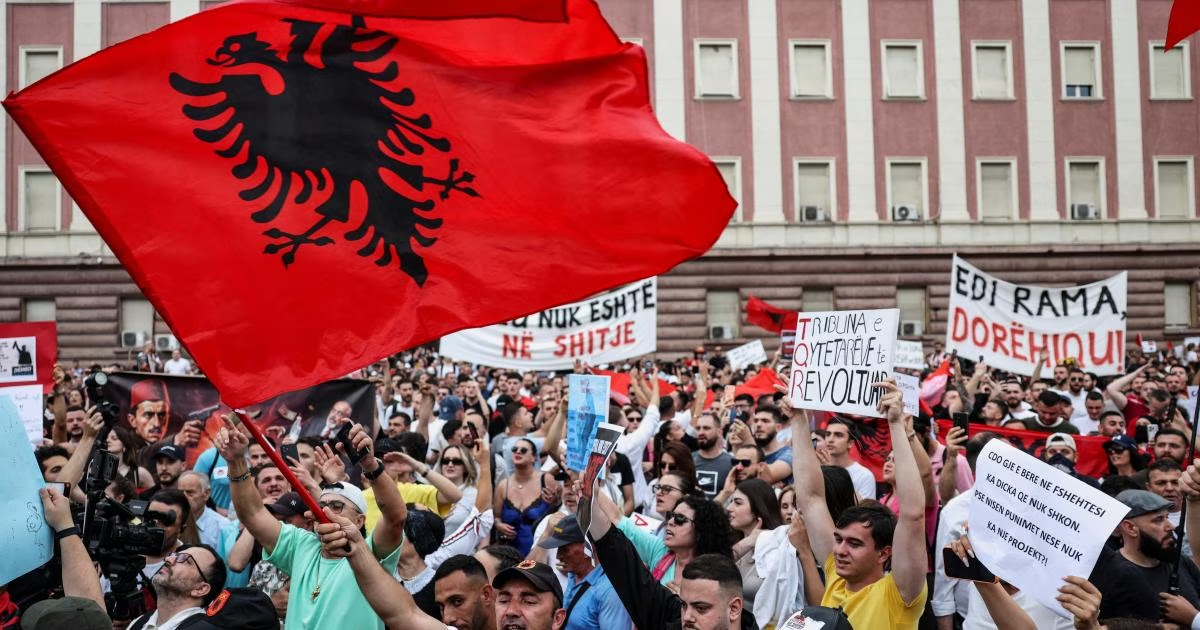







Tensions in the Albanian streets have escalated for the fifth consecutive day, as thousands of demonstrators continue to protest against a massive tourism project led by 'Affinity Partners,' a company owned by Jared Kushner, former US President Donald Trump's son-in-law. The protests are concentrated in the capital, Tirana, and the targeted coastal areas, amidst chants rejecting what protesters describe as the sale of national lands for suspicious foreign investments.
The popular movement, launched under the slogan 'Albania is not for sale,' has adopted the pink flamingo as its symbol, becoming known as the 'Flamingo Revolution.' This symbol expresses absolute rejection of transforming natural reserves and sensitive ecosystems in the Vjosa-Narta region into luxury tourist resorts and residential complexes that threaten the region's biodiversity.
The past few days have witnessed violent clashes between police forces and protesters in front of the Prime Minister's office, where authorities used water cannons to disperse the crowds. Despite government attempts to open channels for dialogue, demonstrators have rejected any partial solutions, demanding the immediate and complete cancellation of the investment project on Sazan Island and the coastal area.
Direct confrontations also occurred in the field between local residents and private security company personnel in the Pishë Poro-Narta area, after companies attempted to erect barbed wire preventing fishermen from accessing the beaches. These clashes resulted in injuries and arrests, prompting authorities later to revoke the licenses of two security companies due to their excessive use of force against civilians.
On the political front, the Albanian opposition fully adopted the demands of the street, leveling harsh accusations against Prime Minister Edi Rama. The opposition considered that the government was making sovereign concessions and unjustified legal facilitations to the Trump family in exchange for international political influence, describing the coastal sites as having become a 'political sacrifice.'
In contrast, the Albanian government strongly defends the project, asserting that it will be a major economic driver for the country with returns that could reach $4.6 billion. Official sources confirm that the investments led by Kushner will create thousands of jobs and place Albania on the map of luxury global tourism, despite all the criticism directed at the project.
The Anti-Corruption and Organized Crime Agency has entered the crisis, announcing the opening of an official investigation into government decisions issued in 2024. The investigations focus on changing the legal status of vast lands previously classified as natural reserves, in addition to suspicions of forgery in land ownership and illegal sales operations.
Under these investigations, judicial authorities ordered the freezing of bank accounts belonging to 'Albania Land Development,' a company linked to the project's investors. This step comes under increasing public pressure demanding transparency and disclosure of the nature of the deals made behind closed doors with the former US President's son-in-law.
The ambitious and controversial project includes the development of Sazan Island, formerly a strategic military base, into a global tourist destination. Technical estimates indicate that the cost of developing the island alone will reach 1.4 billion euros, with plans to build hotels, marinas, and residential complexes with a capacity exceeding 10,000 hotel rooms.
Environmental experts have warned that the project is located in one of the most environmentally sensitive areas on the European continent, as Vjosa-Narta is a major stop for migratory birds. Experts confirm that massive construction work will lead to the destruction of natural habitats for rare species of animals and birds, constituting an irreparable environmental disaster.
Albania's crisis has begun to take on international dimensions, with European Union officials expressing concern about the violation of environmental laws and legal standards in these deals. These officials warned that such violations could pose serious obstacles to Albania's path towards EU accession negotiations in the near future.
This crisis recalls previous experiences in neighboring countries, where large politically backed investment projects led to widespread corruption and conflicts of interest. Observers fear that the project could become a model for cross-border corruption that exploits the national resources of developing countries for the benefit of international political and economic elites.
Despite Prime Minister Edi Rama's offer to form dialogue committees, the gap between the authorities and the street continues to widen significantly. Protesters believe that any dialogue that does not begin with halting work on the project is merely an attempt to absorb public anger and push through deals under new names, affirming their continued escalation in the field.
With protests continuing and expanding to include other cities, Albania remains at a crossroads between economic ambitions driven by massive foreign investments and a popular movement insisting on protecting sovereignty and the environment. The 'Flamingo Revolution' remains poised for further momentum amidst the sharp division over the future of the Albanian coast and national resources.
Albania is not for sale... Transforming sensitive coastal sites into a political sacrifice for family interests is utterly unacceptable.



Share your opinion
"Flamingo Revolution" Sweeps Albania: Widespread Protests Against Trump Family Investment Projects