






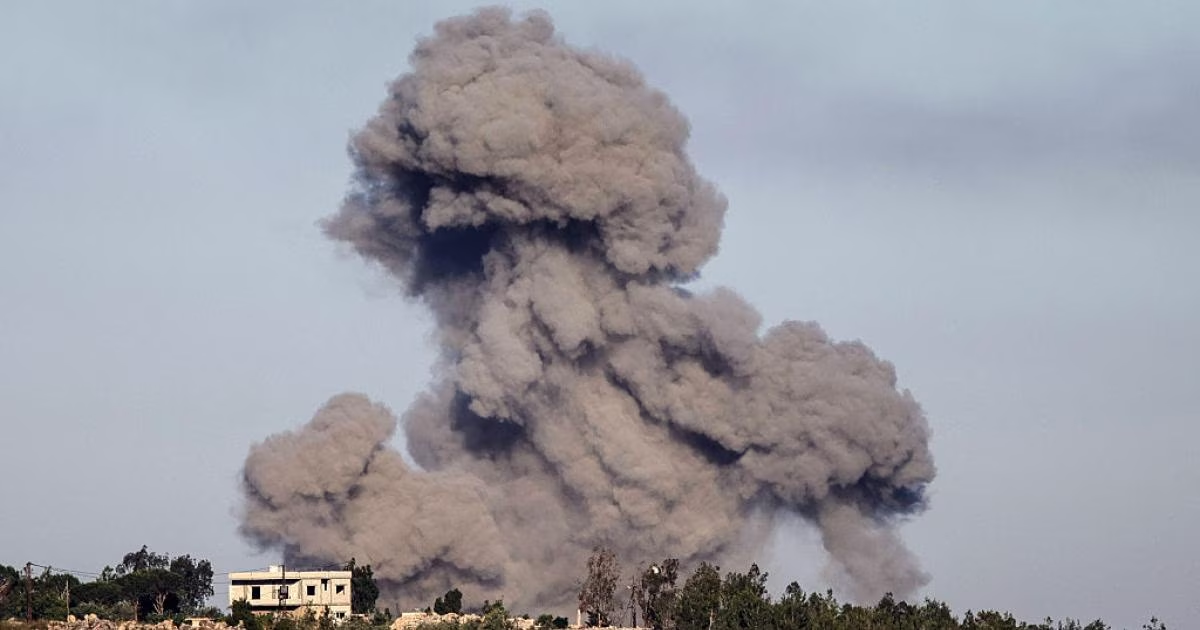
The Israeli occupation army escalated its aerial raids on wide areas in southern Lebanon and the Beqaa in the eastern part of the country today, Thursday, disregarding recent American announcements about reaching a ceasefire agreement. The violent raids included the towns of Sahmar and Qleia in western Beqaa, in addition to Tibnin, Haris, Kafra, Srifa, and Shoukin in southern Lebanon.
Occupation forces committed a massacre in the town of Sahmar in western Beqaa, where field sources reported more than 7 airstrikes in less than half an hour. These intensive attacks resulted in the martyrdom of 5 civilians and varying injuries to others, in an initial toll expected to rise due to the extensive destruction.
In a related context, the Sahmar municipality issued an urgent statement calling on residents to absolutely refrain from heading to the town due to significant security risks. The municipality affirmed that Israeli targeting now affects everyone without exception, targeting civilians, men and women, in their homes and on their roads.
The southern front also witnessed scattered attacks, where an Israeli drone targeted a motorcycle in the town of Maaroub, leading to the martyrdom of one citizen and the injury of another. Raids also targeted a civilian car near the town of Doueir, reflecting the continuation of assassination and field pursuit policies despite talks of de-escalation.
Regarding international forces, the United Nations Interim Force in Lebanon (UNIFIL) announced the death of one of its soldiers due to injuries sustained from mortar shells falling on one of its positions near Marjayoun. The international force clarified that the incident also resulted in the injury of two other personnel, confirming the opening of an official investigation to determine the circumstances of the targeting.
For its part, Hezbollah responded with a series of military operations targeting gatherings of occupation soldiers and vehicles in the areas of Yahmar al-Shaqif and al-Qantara. The party also announced the execution of an attack with suicide drones targeting a command position of the occupation near Beaufort Castle, confirming direct hits among Israeli forces.
Politically, the US State Department sparked widespread controversy after announcing the understandings of the fourth round of ceasefire negotiations. Observers considered that the leaked clauses primarily focus on the commitments of the Lebanese side, without imposing clear restrictions or reciprocal commitments on the Israeli side.
The proposed understanding stipulates the withdrawal of Hezbollah elements north of the Litani River and a complete cessation of military operations by the party. The proposal also includes accelerating the deployment of the Lebanese army in specific experimental areas, and working to dismantle any military structures not affiliated with the Lebanese state and preventing their re-formation in the future.
In contrast, there is a clear absence of any timetable for the withdrawal of occupation forces from the territories they recently infiltrated in southern Lebanon. The American statement also did not clearly address the cessation of Israeli airstrikes or ongoing military operations, leaving the door open for continued aggression.
Israeli Security Minister Yisrael Katz further complicated the scene with statements in which he affirmed that Israel would not withdraw from southern Lebanon at present. Katz indicated that the army would continue its military operations to destroy what he described as Hezbollah's infrastructure, including controlling strategic sites such as Beaufort Castle.
The American statement included a paragraph that raised deep political questions, as it indicated that Lebanon and Israel do not harbor hostile intentions towards each other. Analysts considered that this wording goes beyond temporary security arrangements to hint at future political prospects related to the nature of the relationship between the two states.
Political researchers believe that the proposed understanding lacks the required balance, as it imposes detailed conditions on Lebanon in exchange for the absence of international guarantees to stop the aggression. The success of this path remains linked to the Lebanese state's ability to implement it on the ground, the position of active forces, and the course of broader regional understandings.
The enemy spares no one, including civilians, men and women, and we call on residents not to go to the town due to the imminent dangers.
Share your opinion
Massacre in Sahmar and doubts surrounding the ceasefire agreement in Lebanon