






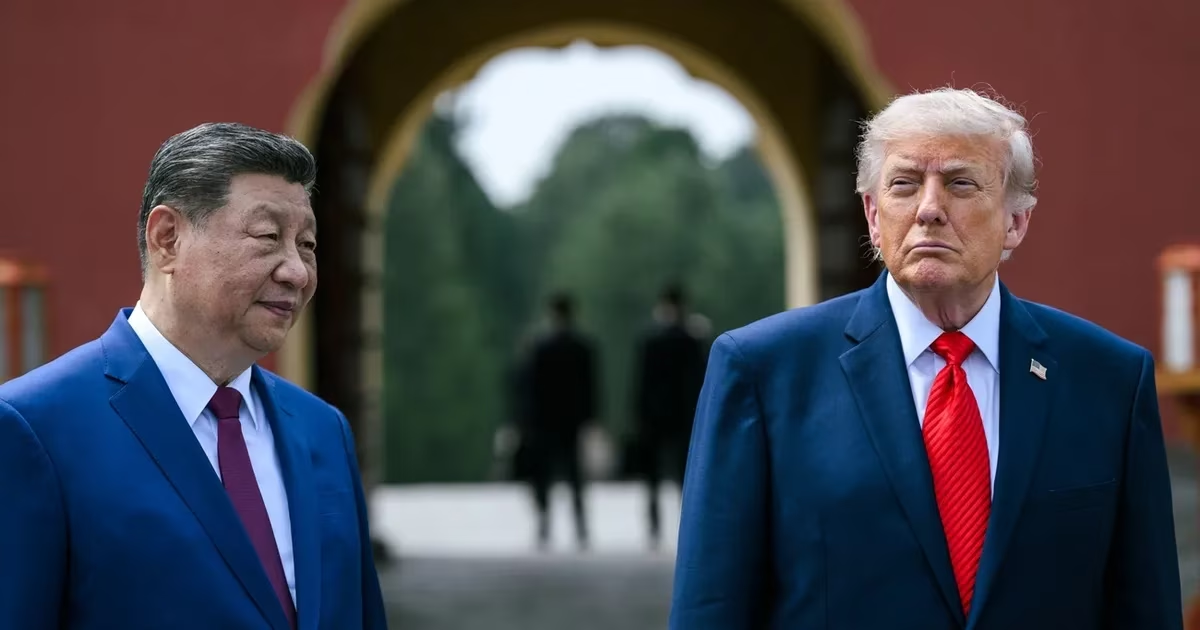
US President Donald Trump's visit to the Chinese capital, Beijing, marked a fundamental turning point in contemporary political history. It was not merely a diplomatic protocol but an implicit declaration of the end of the unipolar era. These meetings solidified the return of international balance between two great powers, bringing to mind the era of bipolarity that previously dominated the world, but this time with an overwhelming economic and commercial character.
After decades of American unipolarity following the collapse of the Soviet Union and the decline of Russian influence, China, with its characteristic calm, managed to climb the ladder of power to reach peer status. The conflict today is no longer ideological between communism and capitalism, as it was in the last century, but has become a fierce competition within the halls of global stock exchanges and the philosophy of the free market, in which everyone has become involved.
The features of this shift were evident in the nature of American demands, as the White House leader stood before his Chinese counterpart requesting trade facilitations and the opening of closed markets, in addition to seeking Beijing's support on thorny political issues such as the Iranian file. This scene summarizes a new reality in which absolute hegemony has faded in favor of a forced partnership imposed by mutual interests and the growing economic power of the East.
While the American and Chinese poles dominate the scene, other traditional powers such as Europe and Russia appear to have receded to the back rows, content to observe the major transformations with diplomatic smiles. In contrast, rising Asian powers from Singapore to India are emerging as future players who refuse to remain in the shadows, reinforcing the hypothesis that the future is now being written with Asian ink.
As for the African continent, it still lives in a state of political stagnation under the weight of regimes, some of which have lasted for half a century without real change that keeps pace with the acceleration of global time. While the world races in the arena of technological and economic development, the question remains about the ability of these regions to catch up with the new bipolarity train, which does not wait for those who are late for the modern imperial transformations.
The leader of the free world came asking for open markets and the demolition of walls from his Chinese counterpart, as if time is witnessing the return of imperial eras.
Share your opinion
The Return of Bipolarity: How the Beijing Summit Redrew the Map of Global Powers?