







Washington – Said Arikat – 20/4/2026
News Analysis
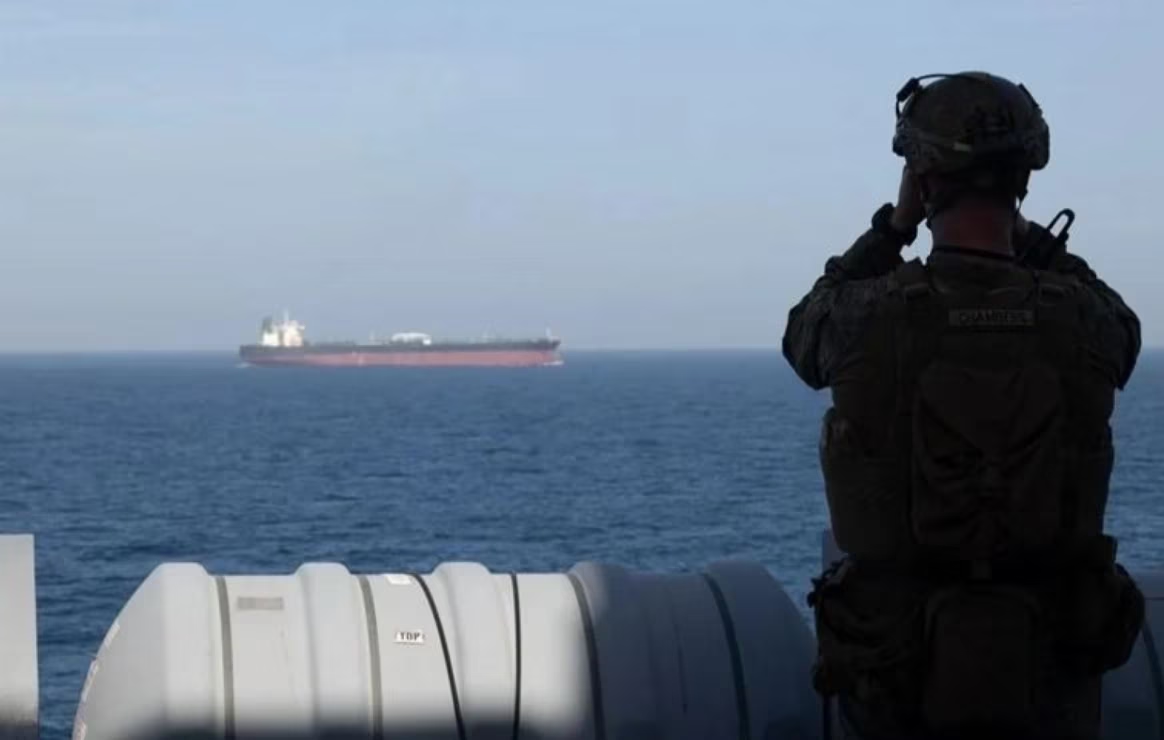
In a field development that threatens to undermine the temporary truce between the United States and Iran, Washington announced on Sunday that a US naval destroyer intercepted an Iranian cargo ship in the Gulf of Oman, after it ignored orders to stop, before US Marine forces seized it. The operation came at a highly sensitive time, with the scheduled ceasefire approaching its end this week, and Washington preparing to send a high-level delegation to Pakistan for new talks with Tehran.
President Donald Trump said that the destroyer USS Spruance fired at the ship's engine room, disabling it, before Marines boarded and seized it. He justified the move by stating that the ship was subject to US sanctions and had a “history of illegal activities,” confirming that US forces were inspecting its cargo.
In contrast, Tehran presented a different narrative, as semi-official Iranian media reported that US forces fired on an Iranian commercial ship, but claimed that naval units of the Revolutionary Guard forced the Americans to retreat. This discrepancy reflects the ongoing war of narratives and indicates the seriousness of the field situation in sensitive maritime passages.
Hormuz Strait at the Heart of the Conflict
The incident occurred south of the Strait of Hormuz, through which about 20 percent of global oil trade passes. Iran had imposed restrictions on navigation in the strait, while Washington responded by imposing a blockade on Iranian ports, turning the maritime passage into a direct confrontation point between the two sides.
Trump had previously accused Iran of violating the truce by attacking two Indian ships that tried to cross the strait, considering it a “complete breach” of the ceasefire agreement. It appears that Sunday's incident was part of the US deterrence policy and an attempt to impose facts on the ground before the next round of negotiations begins.
Negotiations in Pakistan Amidst Conflicting Messages
Coinciding with the military escalation, the US administration announced that it would send a delegation led by Vice President JD Vance, and including Steve Witkoff and Jared Kushner, to Islamabad this week, seeking to revive negotiations with Iran.
However, Iranian media indicated that Tehran has not yet officially agreed to hold the meeting, raising questions about the seriousness of the diplomatic path, or whether Washington is using the announcement of negotiations as a political and media pressure card rather than an actual agreement.
The previous round, held days ago in the Pakistani capital, ended without a tangible breakthrough, despite representing the highest level of direct contact between the two sides in decades.
Trump's Threats Complicate the Scene
Days before the truce ended on April 22, Trump escalated his rhetoric, threatening to strike Iranian civilian infrastructure if the Strait of Hormuz was not opened and the ceasefire was not extended.
He said via his “Truth Social” platform that the United States would target “every power station and every bridge in Iran” if Tehran refused a “fair and reasonable deal,” a speech that reflects a logic of coercion more than negotiation.
Regional and Economic Repercussions
In Pakistan, authorities appeared to be preparing for an imminent round of negotiations, as they imposed strict security measures in Islamabad with the deployment of ten thousand additional personnel. In Lebanon, thousands of displaced families began returning to the south after a separate truce came into effect, while Hezbollah expressed conditional readiness to cooperate with the state to end the war with Israel.
Economically, US Energy Secretary Chris Wright acknowledged that fuel prices in the United States could remain high for months, contradicting Trump's previous promises that the war's effects would be “short-lived.”
What is happening reveals a clear contradiction in US policy: sending a high-level negotiating delegation simultaneously with carrying out a military operation against an Iranian ship. This pattern suggests that Washington does not see negotiations as an alternative to force, but rather as a complement to it. However, using military pressure during negotiations often pushes the adversary to harden their stance, not to concede, and reduces the chances of reaching a sustainable agreement.
The strait has transformed from a global economic passage into a political bargaining chip that threatens the entire international economy. Every escalation there immediately impacts oil prices, inflation, and supply chains. Major powers treat the passage as an arena of influence, while the world pays the cost of this conflict. Continuing this approach makes the global economy hostage to a sudden military decision.
Trump's threat to target Iranian bridges and power stations not only pressures Tehran but also sends a negative message to mediators and allies. Targeting civilian infrastructure is internationally viewed as a dangerous escalation and undermines any image of Washington as a party seeking peace. Ultimately, hawkish language may satisfy the domestic political audience, but it rarely produces successful compromises.
Share your opinion
Washington Escalates in Gulf of Oman, Seizes Iranian Ship: New Threat to Fragile Truce and Vague Negotiations