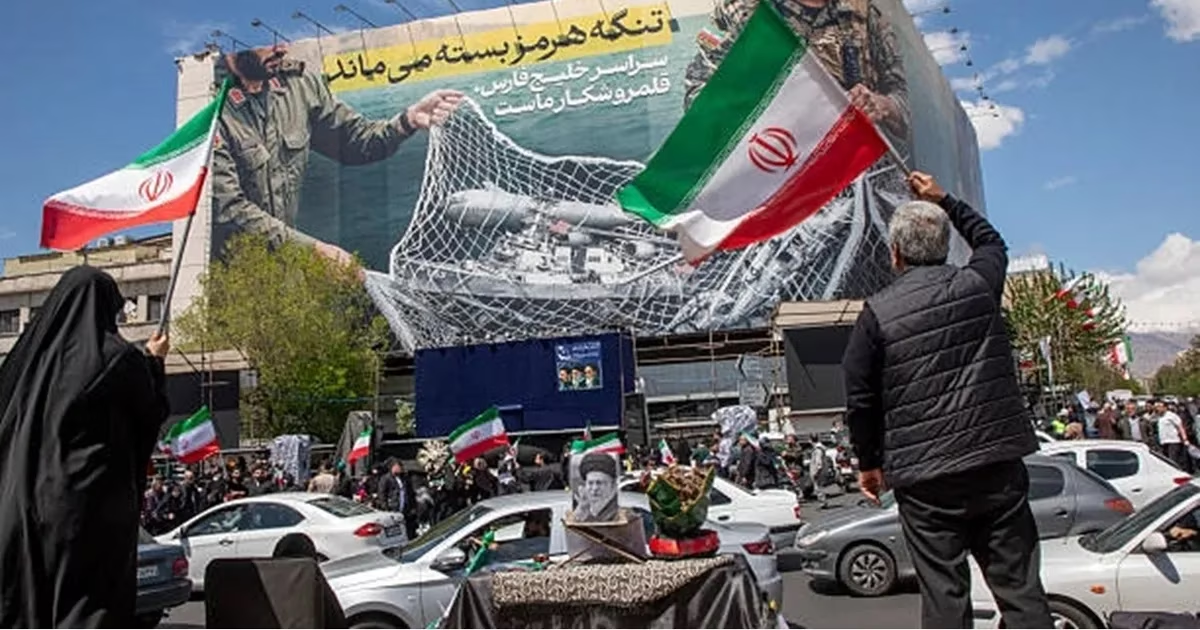







Major events naturally create a state of sharp divergence in political stances and alignments, which was clearly manifested following the recent American-Israeli aggression against Iran. This division in Arab and Islamic public opinion reflects the complexity of the scene, where the threads of military conflict intertwined with complex political and sectarian calculations in the region.
The proliferation of military confrontations and the targeting of civilian facilities and vital installations in Gulf states by Iranian strikes significantly complicated matters. This development prompted broad sectors to re-evaluate their positions, while others remained steadfast in their preconceived convictions governed by political loyalties or historical rivalries with Tehran.
The balanced stance on this crisis rests on three fundamental dimensions, beginning with an unequivocal rejection and condemnation of the American-Israeli aggression. Conversely, strikes targeting civilian facilities in Gulf states cannot be accepted, with the necessity of affirming the Iranian people's right to freedom and a dignified life away from oppression.
The rejection of external aggression against Iran was not merely an emotional state, but rather the result of a precise assessment of the situation and its repercussions on the entire nation. The project led by Washington and Tel Aviv explicitly aims to redraw the region's maps and form a 'new Middle East' in which absolute sovereignty belongs to the Zionist entity.
This Zionist project resonated with some fragile Arab regimes that rushed towards normalization, considering it a lifeline for their survival. Christian Zionist ideology plays a pivotal role in guiding current American policy, where support for Israel is viewed as a sacred religious duty that transcends traditional political interests.
Iran was targeted not because of its sectarian or ethnic identity, but because it represented a model that resisted American subjugation since 1979. Despite observations on its policies, it remains a stumbling block to full Zionist expansion in the region, which explains the Western insistence on curbing its influence and capabilities.
The failure of the aggression to achieve its strategic goals, namely the destruction of the nuclear program and the overthrow of the regime, is not a gain for Tehran alone but for the region as a whole. This failure obstructs the Zionist hegemony project and gives the peoples of the region hope in their ability to confront the schemes of fragmentation and dependency imposed by major powers.
Iran, like other countries, has a legitimate right to possess nuclear technology for peaceful purposes in accordance with international treaties. Despite religious fatwas prohibiting nuclear weapons, the American desire to prevent any Islamic country from possessing technical knowledge remains the primary driver of repeated aggressions.
Western powers previously succeeded in destroying Iraq's peaceful nuclear program and exerted immense pressure that forced Libya to abandon its technical ambitions. Pakistan remains the only exception that escaped this strict oversight thanks to complex regional and international circumstances that enabled it to build its own nuclear deterrent.
The danger of the Zionist project will not stop at Iran's borders but extends to include other countries such as Syria, Turkey, Egypt, and Saudi Arabia. Therefore, condemning the aggression is a 'duty of the hour' to defend the collective self of the nation, regardless of deep disagreements with Iranian internal policies or regional interventions.
Serious and sincere dialogue must remain the only way to resolve existing problems with Iran, paving the way for building a unified Islamic force. Continued discord only serves external powers that seek to drain the region's resources and keep it in a state of perpetual conflict and absolute dependency.
Iranian strikes targeting infrastructure in the Gulf were a political misstep that contributed to widening the rift with neighboring peoples. These actions reinforced the fears of neighbors and prompted some to lean more into American protection, a trend that facts have proven ineffective in moments of real crisis.
Arab and Gulf states must seriously consider building a common defense system based on diversifying weapons sources and self-reliance. Relying on American bases has proven to be a failure, as Washington left its allies to face their fate alone during the peak of the recent military escalation.
In conclusion, the real bet remains on the Iranian people, who proved their patriotism by rejecting the aggression despite suffering from internal oppression. The authorities in Tehran must repay this people through real political and economic reforms, otherwise, waves of popular anger will return strongly once the cannons of war fall silent.
Condemning the aggression was not an endorsement of Iranian policies, but rather a duty of the hour to defend ourselves and our nation and to confront conspiracies targeting everyone.
Share your opinion
Multiple Readings and Positions on the Aggression Against Iran: A Vision of Regional and Local Repercussions