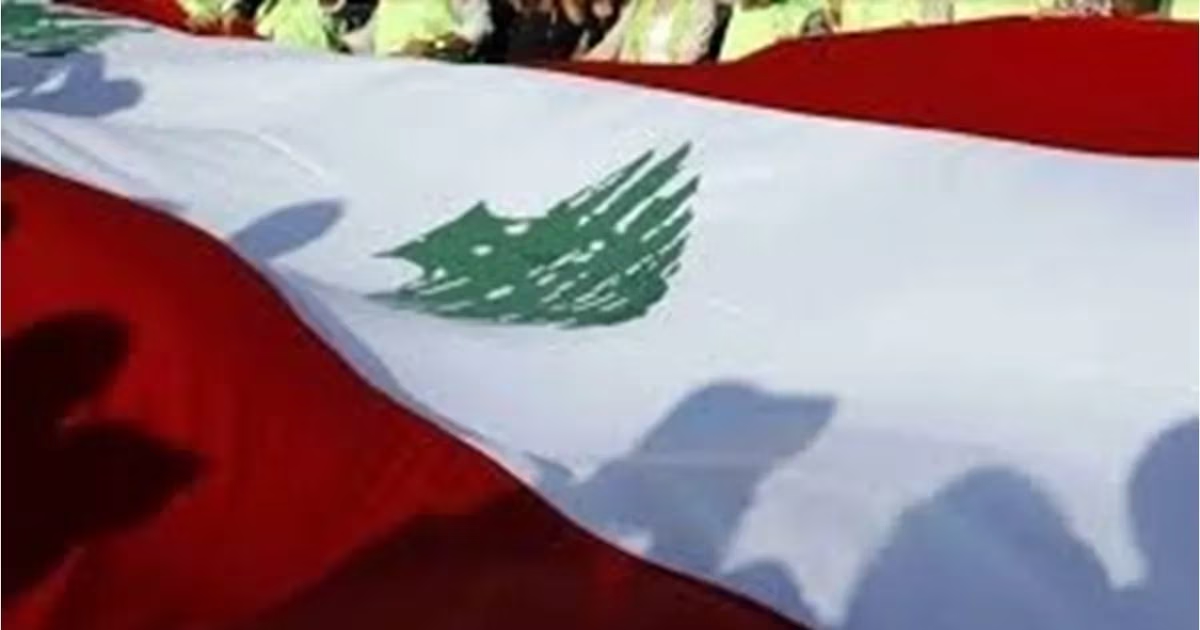







Lebanon today stands on the edge of a historical precipice, bringing back memories of major divisions, where geographical and political complexities intertwine with the legacy of the civil war that still casts its shadow over the general scene. These developments come amidst a turbulent regional climate, where the fires of open wars intersect with efforts to reach political settlements whose features have not yet been fully defined.
Recently, significant political signals emerged in the speech of Lebanese President Joseph Aoun, which focused on the mechanisms for managing the phase following the recent war. Speculation is growing about international arrangements that may include meetings with active parties, including the US administration led by Donald Trump, to discuss ways to close the military front that has drained the country.
Recent military operations have left a heavy toll of blood and destruction, with hundreds of martyrs and wounded, and hundreds of thousands of Lebanese forced to flee their homes. This tragic reality places the state before humanitarian and social challenges that exceed its current capabilities, and deepens the wounds of a national memory burdened by displacement.
At the heart of this scene, the issue of weapons not subject to state authority stands out as one of the most complex and sensitive files within Lebanon. Hezbollah's weapons are seen not only as a military tool but as a political equation that touches the core of the balances that have stabilized the Lebanese system since the Taif Agreement.
Lebanese are divided in their vision of this file; while one group believes that the state's monopoly on weapons is the essential condition for building true sovereignty, another group fears that disarmament may upset the balance of deterrence against external threats. This division transforms the file from a regulatory security measure into an existential knot linked to identity and destiny.
Historically and socially, the Shiite component represents an integral part of the Lebanese fabric, with its presence in Jabal Amel, Beqaa, and the South extending for many centuries. The links between Lebanese Shiites and the regional environment cannot be reduced to transient political dimensions; rather, they are an extension of a deep-rooted intellectual and doctrinal interaction.
Intellectual readings indicate that the scholars of Jabal Amel played a pioneering role in formulating and developing Shiite thought in previous historical stages, reflecting the depth of Lebanese influence in the region. However, this historical dimension is sometimes used in current political debates to deepen the gaps between different sectarian components.
Concerns are escalating in political circles about Lebanon sliding towards a 'state of diminished sovereignty' model, which some liken to the experience of the Palestinian National Authority. This model reduces the state's role to managing daily crises and providing services, while major sovereign and security decisions remain hostage to external agreements and pressures.
The arrangements related to ceasefire agreements and regional settlements may reshape the function of the Lebanese state instead of strengthening it. Observers fear that these grey formulas will lead to a fragile stability that temporarily manages contradictions without offering radical solutions to the structural crises afflicting the country.
Lebanon today faces a fateful test that goes beyond the limits of material reconstruction of destroyed areas, reaching the necessity of redefining national identity. The fundamental question remains about the ability of Lebanese institutions to monopolize decision-making and weapons, or whether the country will remain an arena for the tug-of-war of international and regional wills.
Despite the bleak political scene, Lebanon's cultural and artistic memory remains a safety valve that preserves identity from disintegration, as committed art played a prominent role in documenting resistance. The voices of Fairouz, Marcel Khalife, and Ahmed Kaabour were not mere luxuries, but living documents that preserved the names of the absent and rephrased pain as an act of steadfastness.
Lebanon, which withstood the siege of Beirut and the massacres of Sabra and Shatila, proves each time that it is resistant to breaking or forgetting. When the memory of blood turns into collective consciousness, it becomes the true identity that transcends narrow political calculations and transient settlements that try to abbreviate the homeland.
The Lebanese wound is organically linked to the Palestinian cause, as southern Lebanon represents a natural and geographical extension of occupied northern Palestine. This overlap transcends artificial borders, manifesting in the unity of pain and destiny between Gaza and Beirut, and in the stories of mothers awaiting the return of the absent.
Ultimately, the Lebanese scene remains open to all possibilities, between stability imposed by settlements or an explosion brought back by anxieties. But the only constant is that what was written in blood in the history of this country cannot be erased by days, and that national memory will remain the compass in the face of the abyss.
Lebanon today faces not only the test of reconstruction after a devastating war, but the test of redefining itself as a sovereign state.
Share your opinion
Lebanon Between the Hammer of Regional Settlements and the Anvil of National Identity