






Washington – Said Arikat – 17/4/2026
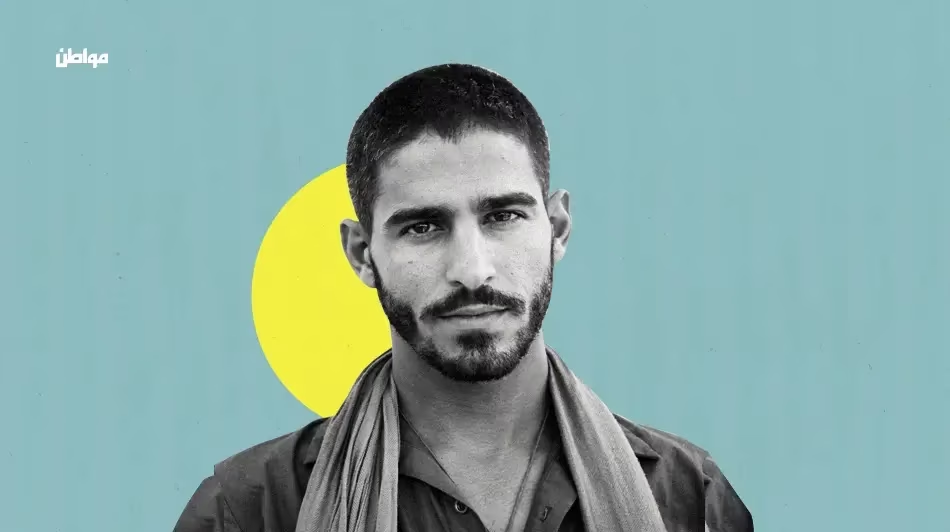
The US State Department stated that it is aware of reports of the arrest of American-Kuwaiti journalist Ahmed Shihab-Eldin in Kuwait early last March, confirming that it is following the case and working to investigate its circumstances.
This statement came in response to an inquiry from Al-Quds newspaper's correspondent in Washington regarding the US administration's position on Shihab-Eldin's detention. A ministry official said in an email that “the safety and security of American citizens abroad is a top priority,” adding that the ministry “is dealing with reports regarding the detention of an American citizen in Kuwait.”
The official explained that the ministry provides consular assistance to American citizens detained abroad “in accordance with the powers defined by American and international law,” noting that privacy considerations prevent providing additional details at this time.
In contrast, the “Committee to Protect Journalists” announced, in a statement issued early this week, that Shihab-Eldin was detained over comments related to videos and photos addressing the war in Iran. Kuwaiti authorities have not officially confirmed the arrest to date.
According to the committee, the charges against the journalist include “spreading false information, harming national security, and misusing communication methods,” charges it described as “vague and frequently used to restrict the work of independent journalists.” It also indicated that Shihab-Eldin has not appeared publicly since early March, and that his social media accounts have disappeared.
The committee noted that among Shihab-Eldin's last posts was a location-specific video, verified by CNN, showing the crash of an American fighter jet near an air base in Kuwait, which may explain the sensitivity of the issue in the context of regional tensions.
The committee called on the Kuwaiti authorities to immediately and unconditionally release the journalist, stressing that his detention falls within a broader pattern of restricting freedom of expression in the region.
This comes in the context of a noticeable tightening of media censorship in a number of Gulf countries, where governments seek to limit the circulation of information related to the repercussions of the war in Iran, especially those that may affect internal stability or the economic and tourism image. Reports indicate that countries such as the UAE and Qatar have arrested hundreds of people since the outbreak of the war, on the grounds of publishing or sharing content related to the attacks.
Kuwait ranked 128th out of 180 countries in the World Press Freedom Index issued by Reporters Without Borders last year, at a time when concerns are growing about the use of national security legislation to restrict journalistic work and control the media narrative.
The declared American position reveals a chronic paradox in foreign policy, as Washington affirms its commitment to protecting its citizens and press freedom, but in practice it contents itself with cautious statements and limited consular measures when it comes to strategic allies. This pattern reflects the prioritization of security and economic interests over declared values, and weakens the credibility of American discourse globally. Moreover, the deliberate ambiguity in statements leaves the impression that actual diplomatic pressure is limited, which may encourage Washington's partners to continue with media restriction policies without fear of serious consequences.
The Shihab-Eldin case falls within a broader regional context witnessing an escalation in the use of national security laws to control the media space, especially in times of crisis. However, what is striking is the intersection of this approach with relative international silence, including from the United States, which adopts a discourse supporting freedom of expression. This contradiction reflects a shift in the priorities of the international system, where issues of freedoms recede before considerations of stability and alliances. In light of this reality, independent journalists become the weakest link, vulnerable to targeting in opaque legal and political environments.
Share your opinion
US State Department follows up on the arrest of journalist Ahmed Shihab-Eldin and studies the circumstances of his arrest