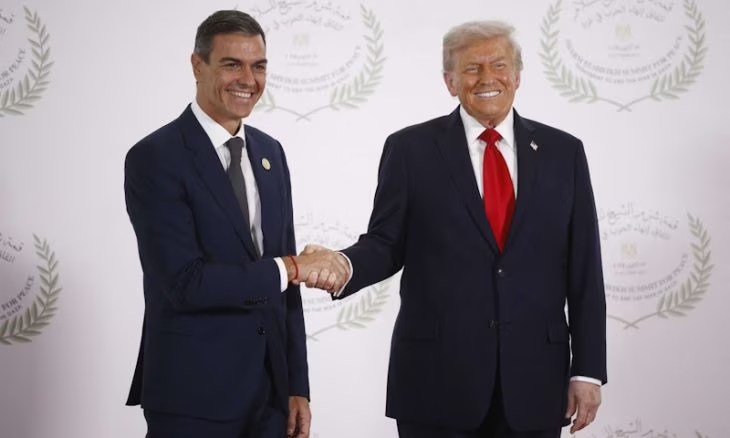







Spanish Prime Minister Pedro Sánchez has cemented his position as one of the most prominent political figures in the global left, benefiting from a series of sharp diplomatic confrontations with US President Donald Trump. This standing comes as Barcelona prepares to host a major international summit for progressives, aimed at strengthening a united front against the rise of the far-right in Europe and worldwide.
Sánchez stands out as an exceptional case in a European continent that has seen a noticeable shift to the right in recent years, as he adopts open immigration policies and progressive social stances. His repeated clashes with the current US administration have transformed him into a symbol of political resistance against the approach represented by Trump on the international stage.
In the latest chapter of tension with Washington, Sánchez expressed categorical opposition to any military action against Iran, refusing to allow US forces to use military bases on Spanish territory. This stance led Trump to threaten to impose trade sanctions on Madrid, but the Spanish government adhered to its sovereign decision rejecting military escalation in the region.
Regarding the Palestinian issue, Sánchez is one of the few Western leaders who has used the term 'genocide' to describe Israeli military operations in the Gaza Strip. His positions have gone beyond media statements to practical diplomatic steps, most notably the official recognition of the State of Palestine in May 2024, a move that shook European political circles.
Observers believe that Spain, thanks to its membership in NATO and the European Union, has given its positions a strategic weight that surpasses other countries that have taken similar steps. Experts at the 'Real Elcano' Institute in Madrid confirmed that this bold foreign policy has given Spain tangible leadership and influence, especially in the Arab world and Latin America.
International press reports indicate that Sánchez has become known in global journalistic circles as 'Trump's arch-nemesis in Europe,' a description that reflects the extent of the ideological gap between the two sides. Sánchez has used his presidency of the 'Socialist International' to disseminate his political vision through major international newspapers, warning of the repercussions of populist policies on global stability.
Barcelona's 'Global Progressive Mobilization' summit is expected to see high-level attendance, including Brazilian President Lula da Silva and Mexican President Claudia Sheinbaum. This summit aims to formulate a common strategy for left-wing parties to confront economic and environmental challenges, and to offer a humane alternative to the hard-right policies sweeping the world.
During his recent visit to China, Sánchez stressed the need for progressive governments to unite and present a vision that transcends narrow national interests and champions shared human values. He considered that current challenges require unprecedented international coordination to protect democratic and social gains that are now threatened by the current global polarization.
Despite external successes, Sánchez faces sharp criticism from the right-wing opposition within Spain, which accuses him of using foreign policy as a tool to escape domestic crises. The opposition Popular Party accuses the Prime Minister of trying to divert attention from corruption investigations involving some of his close associates by instigating diplomatic battles with Washington.
Local opinion polls indicate that the majority of the Spanish people, including segments of opposition voters, support Sánchez's anti-war stances and his support for Palestinian rights. In a recent poll, more than two-thirds of Spaniards expressed their support for the government's decision not to engage in any military conflict against Iran, which strengthens Sánchez's popular standing.
Academics at the University of Barcelona believe that Sánchez is playing the foreign policy card intelligently, as he realizes that this area gives him room for maneuver away from the complexities of the divided Spanish Parliament. Since taking power in 2018, Sánchez has suffered from the absence of a comfortable majority, making his international achievements a means to enhance his political legitimacy at home.
However, some analysts warn that this strategy could isolate Spain from its traditional allies in Europe led by right-wing governments, such as Italy and Germany. Nevertheless, prevailing estimates within the Spanish government suggest that the political and diplomatic gains from leading the progressive movement far outweigh the potential risks.
Madrid's transformation into a center of gravity for the global left reflects Sánchez's ambition to reshape Spain's role as a pivotal player in major international issues. It is no longer limited to European affairs but has extended to formulating firm positions on Middle Eastern issues and relations with major powers, making him a formidable force in the international equation.
In conclusion, Pedro Sánchez's experience remains a model for how to leverage international crises to build cross-border political leadership, despite significant internal challenges. The results of the upcoming Barcelona summit will play a crucial role in determining the ability of this progressive movement to withstand the right-wing wave led by Trump and his allies globally.
We, progressive parties and governments, must unite and carry a positive and humane vision that transcends our borders and internal policies.



Share your opinion
Pedro Sánchez.. How did Spain's Prime Minister become the 'spearhead' of the global left against Trump?