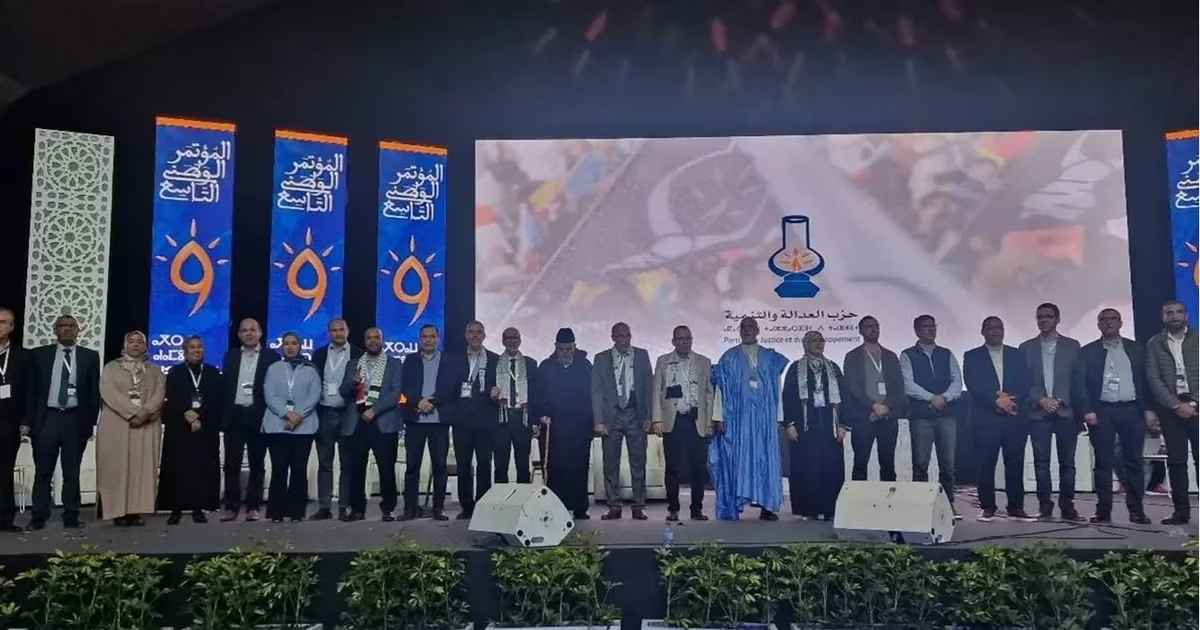







The Moroccan political scene has witnessed remarkable movements by the Justice and Development Party since February 2026, movements that fundamentally transcend mere routine activities to reach a deep attempt at party self-reproduction. This movement comes amidst structural transformations in the political field, as the party seeks to overcome the state of confusion in representation and legitimacy that followed the results of the 2021 elections.
The party is currently engaged in a gradual path aimed at repositioning itself, relying on a strategy of quiet accumulation rather than sudden tactical leaps. The first signs of this approach are evident in what is known as 'rationalizing the internal organizational field,' which aims to put the house in order before embarking on any new political venture.
The party leadership has launched the process of organizing regional general assemblies for nominations, a step that not only reflects early preparation for upcoming elections but also indicates an awareness of the need to restore organizational capital. This capital suffered significant erosion due to the pressures of the second governmental term and its repercussions, which negatively impacted the party's base.
These organizational movements are not limited to arranging electoral lists but extend to re-adjusting the dialectical relationship between the center and the geographical area. Through this, the party seeks to ensure a minimum level of internal harmony between the leadership and the base, which is an essential condition for any potential political recovery in the near future.
Restoring political legitimacy in its societal dimension is considered the biggest challenge facing the 'Brothers of Morocco' at the current stage. The party is well aware that the crisis that afflicted it was not merely a decline in the number of seats, but a deep crisis of trust that affected the roots of its connection with the social groups that constituted its electoral reservoir.
As part of attempts to restore social intermediaries, the party's trend towards renewing institutional ties with the National Union of Labor in Morocco emerged. This step carries great significance, as the party seeks to transform from merely a seasonal electoral actor into a true bearer of the demands of affected professional and social groups.
At the level of political discourse, the party's General Secretariat began to adopt a tone reflecting a diligent endeavor to position itself as a structured institutional opposition. This approach moves away from mere protest and tries to focus on producing alternative policies that can convince the public of the feasibility of returning to support the party's political project.
However, this ambition clashes with a structural paradox related to how to build a convincing opposition discourse after spending two full terms at the heart of government management. The party faces a fundamental question about its ability to criticize current policies without falling into the trap of selective disavowal of its previous governmental legacy and the decisions that accompanied it.
The process of transitioning from 'the legitimacy of achievement' to 'the legitimacy of criticism' forces the party to confront internal tensions and gaps in the current political discourse. This stage requires courage in reviewing past mistakes while preserving the political identity that has distinguished the party throughout the past decades in the Moroccan arena.
These movements come in a national context characterized by weak party mediation and an increasing level of political apathy among broad segments of citizens. All representative institutions in Morocco face the challenge of declining trust, making the task of the Justice and Development Party in attracting the masses again more complex and difficult.
Sources following party affairs reported that the party is now facing a 'general mood' structure that is skeptical of the utility of political action as a whole, and not just the performance of parties. This skepticism forces the party to innovate new communication tools that go beyond traditional slogans and directly touch upon the daily concerns of the Moroccan citizen.
What distinguishes the party's movements after its last National Council meeting is the conviction of the limits of political action at the current stage. The sharp escalationist tone and declared major stakes have disappeared, replaced by quiet work focused on building the minimum conditions for returning to the forefront of the political scene.
The party's current work is based on three main pillars: a cohesive organization, a social extension that can be activated, and a credible political discourse. This strategic triangle aims to rebuild trust with society without claiming to possess absolute truth or making unrealistic rosy promises.
In conclusion, the Justice and Development Party is going through a critical transitional phase between a past burdened by the cost of participating in power and a future whose final features are not yet clear. Its success will depend on its ability to produce a new political contract that transcends narrow electoral logic towards a broader reformist horizon from within institutions.
The party realizes that its crisis was not merely representative or electoral, but affected the structure of trust that connected it to its social extensions.


Share your opinion
The Moroccan Justice and Development Party: Paths of Reconfiguration and the Test of Regaining Political Initiative