







News Analysis
Washington – Said Arikat – 14/4/2026
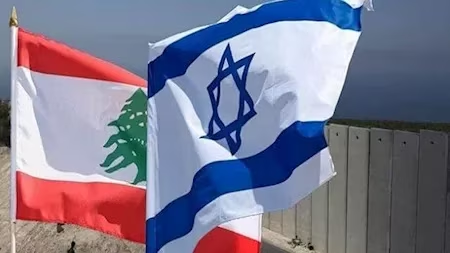
On Thursday, a delegation from Lebanon will meet with a delegation from Israel in Washington to discuss the ongoing Israeli aggression against Lebanon. According to a State Department official who spoke on condition of anonymity, the composition of attendees at the meeting itself underscores the sensitivity and high-level interest surrounding these talks. It includes US Secretary of State Marco Rubio, US Ambassador to Lebanon Michel Issa, Advisor Michael Needham, Israeli Ambassador to the United States Yechiel Leiter, and Lebanon's Ambassador to the United States Nada Hamadeh. While the presence of such high-ranking figures may suggest serious intentions, it also raises the stakes in a process that appears to lack both internal legitimacy and strategic clarity.
At a highly sensitive moment for Lebanon, the government's decision to engage in ambassador-level talks with Israel in Washington raises broad questions that extend beyond the diplomatic dimension to the depth of internal political calculations. Instead of reflecting national cohesion or a clear strategic vision, this move seems to deepen the impression of a gap between the authorities and fundamental components of the Lebanese political scene, at a time when current challenges demand the highest degree of coordination and unity.
The fundamental problem lies in the absence of a comprehensive national consensus on this step. Key Lebanese political forces have expressed their rejection or deep skepticism about the utility of engaging in such talks while Israeli military pressure continues. This divergence does not merely reflect a difference in viewpoints but indicates a deeper flaw in the structure of political decision-making, where a step of a sovereign nature is taken without securing sufficient internal cover. In similar contexts, states tend to unify their positions to enhance their negotiating power, while Lebanon appears to be moving in the opposite direction.
The timing of these talks acquires an even more sensitive dimension, as they come amidst ongoing Israeli aggression. In the absence of clear conditions or reciprocal leverage, engaging in dialogue might be interpreted as a gratuitous concession rather than a calculated political initiative. Critics argue that merely holding the meeting grants Israel a diplomatic gain by legitimizing communication, without offering concrete commitments in return, thus exacerbating the imbalance of power from the outset.
In this context, Israeli Prime Minister Benjamin Netanyahu could utilize the convening of these talks to bolster his political and diplomatic standing, especially amid increasing international criticism. The mere existence of a dialogue channel—even if merely formal—provides political material that can be used to suggest engagement in de-escalation efforts, without having to make real concessions on the ground.
The absence of national consensus on this step not only weakens Lebanon's negotiating position but also undermines the very concept of political legitimacy. Effective diplomacy stems from a solid internal base, allowing negotiators to speak on behalf of a unified state, not a divided arena. In the Lebanese case, this condition appears to be missing, turning the negotiation process into a risky endeavor that could open the door to further questioning of the institutions' efficacy and their ability to represent the collective national will.
Another flaw emerges in the structural disparity between the two parties. While Israel enters these talks within a centralized decision-making system and a clear strategy, Lebanon suffers from sharp political divisions and weak institutions. This imbalance directly reflects on the nature of the negotiation, where the Lebanese side lacks the ability to present a unified position or make enforceable commitments, transforming the process into an unequal path in terms of form and content.
Domestically, concerns about the repercussions of this step are compounded by the suffocating economic crisis Lebanon is experiencing, alongside declining public trust in official institutions. Launching a controversial negotiation process at this time could deepen political divisions and fuel doubts about the motives and limits of the decision, especially if done without sufficient transparency or a clear mandate from political and societal forces.
The timing of these talks reflects a fundamental problem in assessing the balance of power. Entering negotiations under a clear imbalance, and without preconditions, might be understood as a response to pressure rather than a deliberate sovereign choice. In the world of politics, the success of diplomacy is not measured merely by sitting at the table, but by the ability to protect national interests and achieve tangible gains. This remains highly questionable in the current situation.
Complications increase with the absence of a clear mandate defining the scope and objectives of the negotiation. Successful diplomacy relies on internal legitimacy, whether through political consensus or institutional support, which does not appear to be sufficiently available in this case. Without this foundation, any potential outcomes remain subject to challenge or reversal, limiting their effectiveness and weakening their sustainability.
Also prominent is the absence of a clear negotiating framework that defines the issues at hand, implementation mechanisms, and guarantees. In the absence of specific criteria or guaranteeing international sponsorship, the talks appear closer to an exchange of political messages than to a fully-fledged negotiation process, which reduces the chances of achieving tangible results or applicable agreements.
According to observers, these talks cannot be separated from the broader regional context, where Lebanon's calculations intersect with balances involving Iran, Israel, and non-state actors. Ignoring this entanglement makes any bilateral negotiation path limited in impact, because it does not address the roots of the crisis but is limited to its manifestations. Without a comprehensive approach that takes these complexities into account, the chances of success remain slim, and diplomacy becomes merely a tool for managing the crisis, not resolving it.
In conclusion, the Washington talks reflect a deeper problem related to the assessment of timing and tools. Instead of strengthening Lebanon's position, they may weaken it by exposing its internal divisions and giving its adversary a diplomatic advantage. While this step is presented as a path to dialogue, it raises serious questions about whether it truly constitutes an entry point to a solution, or merely an attempt to give a diplomatic appearance to an increasingly complex reality.



Share your opinion
Lebanese-Israeli Talks in Washington Spark Wide Controversy Amid Lack of Internal Consensus