







Washington – Saeed Erikat – 13/4/2026
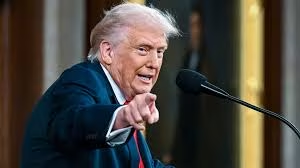
Hopes for a swift diplomatic breakthrough in the crisis between the United States and Iran seemed to fade, with the sharp statements made by US President Donald Trump during a hastily arranged press conference at the White House on Monday, at a politically charged moment where internal calculations intertwine with geopolitical stakes.
Speaking to reporters, Trump emphasized that Iran "will never have a nuclear weapon," a stance reflecting increasing rigidity in the American approach and indicating a shrinking margin for diplomatic maneuver. His statements came moments after an unconventional scene inside the White House, where he received a "McDonald's" meal via "DoorDash" delivery, celebrating the approval of a new tax law exempting tips from taxes—a scene reflecting the overlap between political symbolism and media spectacle in managing the issue.
But behind this image, the rhetoric was sharper and clearer. Trump said: "If they don't agree, there will be no deal… and we will retrieve the nuclear materials, either from them or by force," a clear indication that the military option remains on the table, and may even be closer than ever before.
These statements coincided with the entry into force of the blockade imposed by the US administration on the Strait of Hormuz, one of the most vital arteries for global oil trade, raising increasing fears of widespread disruptions in energy markets and international supply chains. Trump also described Iran as "blackmailing the world," accusing it of seeking to impose gains through threats and pressure.
In a further escalation, the US President went so far as to say that Tehran seeks to acquire a nuclear weapon "to annihilate the world," a description that raises the level of political discourse to unprecedented levels, reflecting a trend towards framing the conflict in an existential context, not merely a negotiable strategic dispute.
When asked about the possibility of issuing an "ultimatum" to Iran, Trump refrained from giving a direct answer, merely saying that "it will not be pleasant," leaving the door open for multiple scenarios, ranging from gradual escalation to a sudden military strike.
Meanwhile, press reports, including those published by Axios, revealed details of recent negotiations in Pakistan, where the United States asked Iran to suspend uranium enrichment for up to 20 years, a demand observers described as far exceeding the red lines previously set by Tehran.
According to sources, Iran responded by proposing a much shorter timeframe, not exceeding a "single digit number of years," in an attempt to maintain the minimum of its nuclear sovereignty, while expressing willingness to reduce enrichment levels under international supervision.
Washington also demanded that Iran remove all its stockpile of highly enriched uranium from the country, a condition Tehran considers a fundamental infringement on its strategic capabilities. This point, along with the duration of restrictions on the nuclear program, remains one of the main obstacles hindering an agreement.
As the gap in differences widens, the negotiation path appears to be facing the risk of collapse, especially in light of the escalating rhetoric and simultaneous field policies, which reinforces fears of the situation sliding towards an open confrontation that may extend beyond the region's borders.
Trump's statements reflect a clear shift from coercive diplomacy to brinkmanship, where military threat is used as a primary tool rather than a last resort. This approach not only weakens the chances of reaching an agreement but also strengthens the position of hardline factions within Iran, which have long warned of the unreliability of the United States as a negotiating partner. In the absence of stable communication channels, the risk of strategic miscalculation increases, which could lead to an uncalculated escalation. Furthermore, linking the nuclear issue to existential rhetoric further complicates the crisis and reduces opportunities for compromise.
The American demands, as leaked, reflect a high negotiating ceiling that is practically difficult to achieve, especially regarding the duration of enrichment suspension and the removal of nuclear materials. These conditions may be interpreted in Tehran not as an attempt to control the nuclear program, but as an endeavor to dismantle it completely, which contradicts the concept of national sovereignty. In this context, negotiations seem closer to imposing dictates than to an equal negotiating process, which reduces their chances of success and increases the likelihood of collapse. The absence of tangible economic incentives also weakens the attractiveness of any potential agreement.
The decision to impose a blockade on the Strait of Hormuz adds a dangerous dimension to the crisis, as it shifts it from a political-diplomatic framework to a level that directly affects the global economy. This measure could push other international powers, such as China and the European Union, to intervene to protect their interests, opening the door to a broader internationalization of the crisis. Any disruption in oil flow will also lead to price increases, negatively impacting the already fragile global economy. Amidst this escalation, it becomes difficult to separate the nuclear path from regional tensions, which complicates the scene and increases the probabilities of an explosion.
Share your opinion
Trump's escalating rhetoric shatters prospects for settlement with Iran and puts the region on the brink of open confrontation