






Regional and international organizations are currently facing unprecedented challenges, finding themselves vulnerable to the fluctuations of American political moods. Although these institutions have historically revolved around major powers, they have not been spared from direct targeting that has affected their structure and functional role on the global stage.
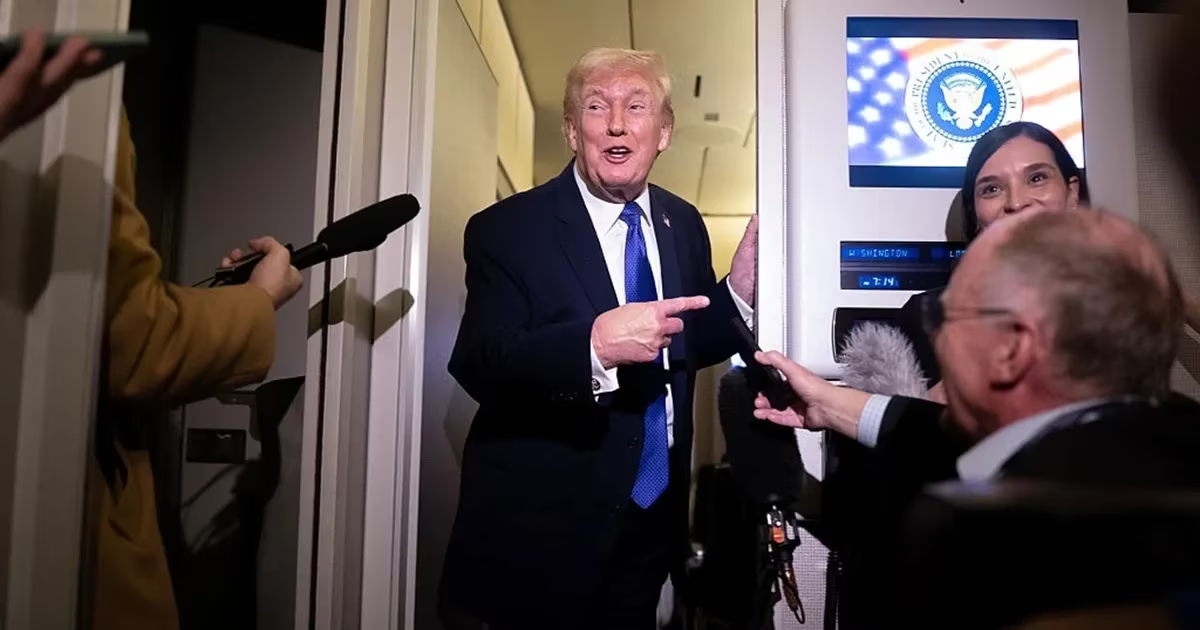
Since President Donald Trump came to power, he has pursued an aggressive policy that has included countries, institutions, and individuals alike. Observers believe that this approach stems from Trump's conviction that these organizations no longer serve the vital interests of the United States, but rather have become a financial and political burden that requires change or abolition.
Trump's 'firing line' included pivotal institutions such as the United Nations and the World Health Organization, in addition to the Human Rights Council and UNESCO. The matter did not stop at verbal criticism, but extended to practical measures such as reducing financial contributions and delaying sensitive administrative appointments to disrupt organizational effectiveness.
The American administration took decisive steps by withdrawing from the World Health Organization and completely freezing its funding at the peak of global need for it. This step came in parallel with ending participation in the UN Human Rights Council, under the pretext of political biases against Washington and its ally Israel.
Regarding the Palestinian issue, the most prominent decision was to permanently cut funding to the United Nations Relief and Works Agency for Palestine Refugees (UNRWA). This decision was not merely a financial measure, but represented an attempt to dismantle one of the most important international symbols of the historical rights of Palestinian refugees.
NATO was not spared from these pressures, as Trump repeatedly threatened to withdraw from it unless member states increased their military spending shares. He also demanded that the alliance take on roles beyond its traditional limits, such as participating in military operations to forcibly open the Strait of Hormuz to ensure energy flow.
These policies raise a fundamental question about the message Trump wishes to convey to the international community. Some analyze these moves as an attempt to build a new international system characterized by absolute 'Americanization,' where the terms of American hegemony are directly imposed, away from multilateral diplomacy.
Supporters of this approach believe that what Trump is doing is a 'rational repositioning' aimed at protecting the American taxpayer. The prevailing logic here is that the United States has borne enormous economic and military burdens for decades without reaping political fruits commensurate with the scale of its sacrifices.
In a striking statement on January 20, 2026, Trump publicly affirmed that the United Nations had not provided him with any significant benefit. He hinted at the possibility of replacing it with a 'World Peace Council,' a new entity he seeks to establish as an alternative to the traditional, dilapidated international system, as he described it.
The 'World Peace Council' proposal is linked to Trump's initiative to end the aggression on Gaza, where he demands countries join and contribute financially with huge sums amounting to one billion dollars. This proposal reflects a desire to privatize international work and make it conditional on financial capacity and political loyalty to the new American vision.
On the other hand, analysts believe that this policy could lead to counterproductive results that accelerate the decline of American influence globally. Weakening international organizations opens the door wide for rising international powers, such as China and Russia, to fill the vacuum and lead institutions with different programs and agendas.
The erosion of Washington's leadership role could negatively impact the lives of American society itself in the long run. Despite the enormous military power that the United States still possesses, internal divisions and the erosion of institutions are reminiscent of the periods of weakness that major empires historically experienced.
Expectations are growing for sharp divisions within international organizations, not only because of American behavior, but also as a result of varying reactions from other members. Some countries are already expressing their discontent through actions and behavior, while others remain silent and wait on 'gray ground' for what comes after the Trump era.
The upcoming challenge remains the international system's ability to withstand these violent shocks in the structure of international relations. The future will reveal whether America will reclaim its traditional role, or whether the world is truly heading towards a multipolar system in which Washington is not the sole player.
The United Nations has never done me any good; my council might replace it.
Share your opinion
Trump and International Institutions: A Strategy of Confrontation and Reshaping American Hegemony