







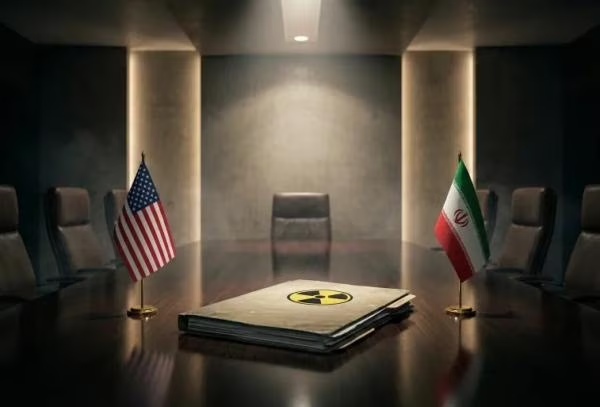
A few days after the announcement of a temporary truce between Iran and the United States, all eyes were on the recent talks between the two parties, which ended in failure. This failure brought tensions back to the surface and fueled speculation about the future of relations between the two powers, but it also revealed a potential new scenario: the possibility that the current truce could become permanent, and that direct hostilities would cease, which is the best scenario for the United States and the worst for Iran.
The current US President, Donald Trump, who declared war on Iran on February 28, 2026, seems determined not to engage in a direct comprehensive conflict, but at the same time, he will not completely close the door to selective hostile actions. This approach allows him to use measured responses against any Iranian action he deems a threat, especially concerning the vital Strait of Hormuz, the most sensitive strategic pressure point in the region.
What confirms Trump's approach to managing the conflict is how he handled the "12-day war," where the US President adopted a strategy of stalemate and selective control: he ceased hostilities without any formal agreements with Iran, maintaining psychological and military pressure in a calculated manner, and demonstrated Washington's ability to control the conflict according to its interests, without sliding into a comprehensive war. This approach reflects Trump's strategic method: leaving the door open for selective threats, demonstrating power without being bound by agreements that might limit freedom of action, and exploiting Iranian psychological and political tension to maintain continuous pressure. The option of withdrawing from negotiations and threatening not to negotiate now constitutes the strongest threatening leverage against Iran, and perhaps the most effective option among all American pressure tactics.
From Washington's perspective, a permanent truce means relative stability and reduced military and economic losses, while maintaining US strategic influence in the region without sliding into a comprehensive war. It also allows Americans to focus on other domestic and international issues, away from the cycle of the ongoing Iranian conflict for decades.
For Iran, a permanent truce represents a real challenge, as it is forced to comply with the limits of this truce to avoid selective American retaliation, but at the same time, it faces internal pressures to maintain its sovereignty and regional interests. This scenario leaves Iran in a state of uncertainty and presents it with a continuous strategic dilemma: every step it takes could face selective American retaliation, while any retreat or concession might be interpreted internally as weakness, increasing political and social pressures within the country.
In this context, Iranian intransigence in demands is not merely political stubbornness, but a calculated strategy to ensure the internal cohesion of the regime and prevent the United States and Israel from achieving strategic goals or gaining any sense of victory. The negotiations themselves are governed by this symbolic conflict over the "victory card," where each party seeks to assert its strength and achieve a moral gain, even under the truce, which makes any agreement fragile and dependent on the delicate balances between the two parties.
Trump's strategy relies on smart containment and flexible deterrence, where the field is left open for all future possibilities. The truce, despite being permanent, is not true peace, but a state of calculated stalemate that allows the United States to control the course of events, while Iran remains facing a continuous threat at every strategic turn. This stalemate keeps the animosity alive, but ensures that a comprehensive conflict does not erupt for now, while maintaining the possibility of using selective pressures to impose American influence.
Ultimately, the political future of the region remains suspended between permanent truces and diplomatic failure, with Trump keeping the option open for selective military action according to Iran's actions, especially concerning the Strait of Hormuz, while Iran struggles to maintain its interests without sliding into a comprehensive confrontation. The permanent truce, in this form, reflects a significant strategic gain for America and a continuous dilemma for Iran, leaving the field open for all possibilities, and confirming that the animosity between the two parties will remain present even in apparent peace, leaving Iran in a state of anticipation and continuous uncertainty, where intransigence in demands ensures the preservation of the regime's cohesion and repels any sense of moral victory for America or Israel, while talks are governed by a constant struggle over the symbolic "victory card" between the two parties.
Share your opinion
Withdrawal from Negotiations as a US Strategic Option and a Tool to Pressure Iran