







Washington — Said Arikat – 4/11/2026
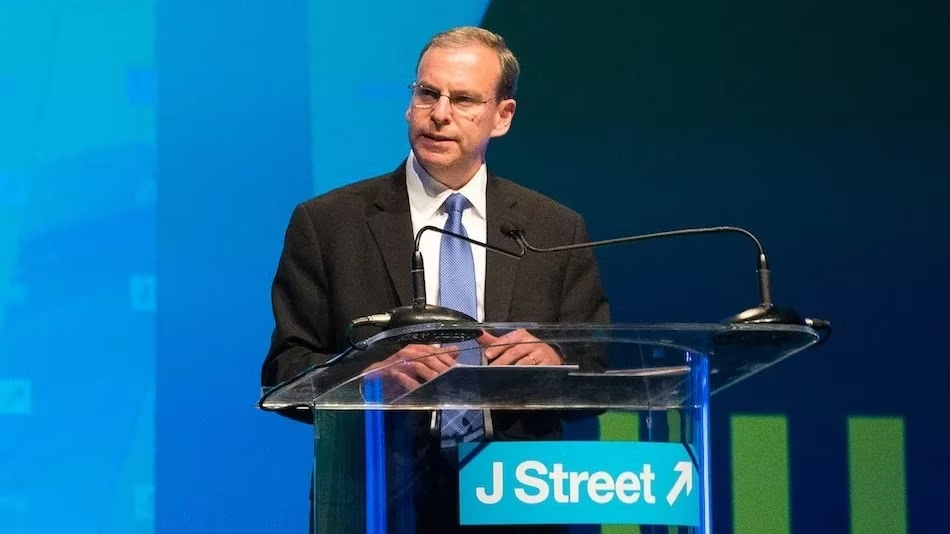
The political debate in the United States is witnessing a remarkable shift regarding the nature and extent of military aid provided to Israel, with parties traditionally considered within the camp of steadfast support entering the escalating controversy. In this context, the American Jewish organization J Street, which defines itself as "pro-Israel and pro-peace," announced its support for the growing calls within progressive circles in Congress to reconsider US funding for Israeli missile defense systems, especially the Iron Dome system.
This stance reflects a growing crack in the traditional consensus that has long governed the American-Israeli relationship, where missile defense programs, unlike other forms of military support, enjoyed almost absolute political immunity due to their direct defensive nature and their role in protecting civilians from missile attacks.
However, J Street's entry into this debate indicates that this politically "forbidden zone" is no longer immune to re-evaluation, in light of rising voices within the Democratic Party, especially from the progressive wing, demanding a redirection of US foreign spending priorities and linking aid to stricter political and moral conditions.
In statements quoted by "Jewish Insider" magazine, a spokesperson for the organization considered that the positions of progressives should not be described as "radical," but rather fall within a legitimate debate that remarkably intersects with statements issued by both Israeli Prime Minister Benjamin Netanyahu, wanted for war crimes before the International Criminal Court, and Republican Senator Lindsey Graham, who affirmed on different occasions that Israel has the economic capacity to finance its defense needs, including its missile systems.
This unexpected intersection in political discourse reflects a complex scene, as the positions of ideologically disparate parties converge at one point, but they stem from contradictory motives. While progressives seek to reduce American support based on financial and ethical considerations, some Israeli leaders and American conservatives put forward the idea of "self-sufficiency" as a sign of strength, not an entry point for redefining the alliance.
J Street's position gains particular importance given its centrist position within the spectrum of pro-Israel lobbying groups, where it has consistently combined support for Israel's security with criticism of its governments' policies, especially under Benjamin Netanyahu. This positioning could give it greater ability to reshape the debate within liberal Jewish circles in the United States, and perhaps influence public opinion trends within the Democratic Party.
This development comes in a broader context of political and diplomatic tensions in American-Israeli relations, where calls are increasing within Congress to re-evaluate US foreign policy priorities, in light of internal challenges and growing financial pressures, as well as broader geopolitical shifts in the Middle East.
Although any radical change in funding policies does not seem imminent, the inclusion of systems such as the "Iron Dome" in the public debate indicates a qualitative shift in the nature of political discourse, and may open the door for deeper reviews in the near future.
The Iron Dome system has long been a red line in the American debate, as a purely defensive tool that enjoys moral and political consensus. However, J Street's position reflects the beginning of the erosion of this consensus, with the rise of a new political generation within the Democratic Party that does not deal with traditional axioms with the same degree of commitment. The debate is no longer about Israel's right to defend itself, but about the limits of the United States' commitment to funding this defense, especially in light of Israel's advanced economic and technological capabilities and increasing internal American pressures.
What is striking in this debate is the invocation of Netanyahu's and Lindsey Graham's positions to justify the progressive proposal, an apparent intersection that conceals a fundamental divergence in motives. While progressives stem from a desire to reduce American military involvement and redirect resources, the other side uses the same argument to highlight Israel's strength and independence. This rhetorical convergence gives the progressive proposal broader political cover, and removes it from the circle of "extremism," but at the same time reflects the fragility of rhetorical alliances in a highly polarized and volatile political environment.
The debate is no longer confined to the cost of support or its strategic feasibility, but rather reflects a remarkable escalation in feelings of resentment and annoyance with Israeli policies, especially in light of what is seen as repeated aggressive actions. This mood is no longer limited to progressive circles, but has begun to spread across wider segments of American society, including sectors of American Jews, some of whom are involved in frameworks such as J Street. In this context, the debate over funding becomes an expression of a deeper shift in public opinion and its trends.
Share your opinion
J Street joins group calling for an end to arms supplies to Israel, including defensive ones