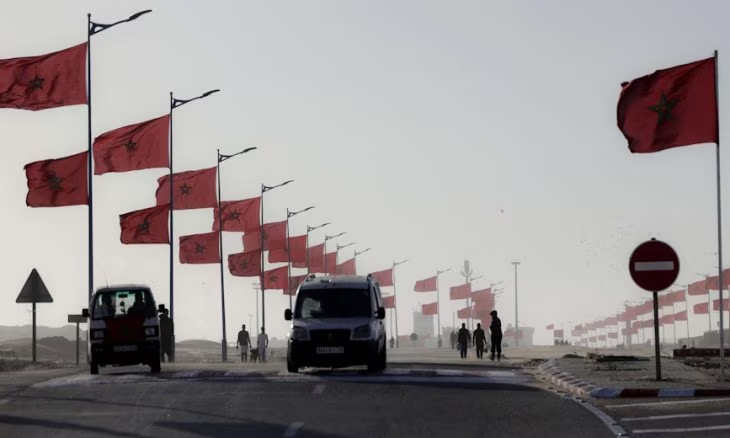







The Republic of Mali, in a prominent diplomatic move, announced its official decision to withdraw recognition of the 'Sahrawi Arab Democratic Republic' overseen by the Polisario Front. This announcement came during an official visit by Malian Foreign Minister Abdoulaye Diop to the Moroccan capital, Rabat, where he met with his Moroccan counterpart, Nasser Bourita, to discuss bilateral relations and regional issues.
The Malian Foreign Minister affirmed that this shift in Bamako's position came after a deep and comprehensive analysis of the Sahara file, given its direct implications for peace and security in the region. Diop explained that his country now sees the Moroccan proposal as the most realistic path to end this protracted conflict, emphasizing the importance of regional stability at this sensitive stage.
The official declaration of the Malian government stressed Bamako's full support for the autonomy plan presented by Morocco, describing it as the only serious and credible basis for reaching a final settlement. Mali believes that granting autonomy to the Sahara under Moroccan sovereignty represents the optimal solution that aligns with political and on-the-ground realities, and guarantees the rights of all concerned parties.
In a related context, Mali reiterated its commitment to supporting the efforts of the United Nations and the Personal Envoy of the Secretary-General for the Sahara to reach a mutually agreed political solution. Sources indicated that the new Malian position is based on relevant UN Security Council resolutions, particularly the latest Resolution 2797 issued at the end of October last year, which enhances the momentum of the political process.
Malian diplomacy is scheduled to disseminate this new position to all regional and international organizations of which it is a member, in addition to informing diplomatic missions accredited in Bamako. This step reflects Mali's desire to align its foreign policy with the growing international trends that support the Moroccan approach to the Sahara issue.
Reports indicate that Moroccan diplomacy has achieved successive successes in this file over the past two decades, with the number of countries recognizing the Sahrawi entity significantly decreasing. According to official statistics, about 54 countries have withdrawn their recognition of the Polisario over the past 25 years, reflecting a shift in the political convictions of the African continent and the international community.
Current data confirm that more than two-thirds of the member states of the United Nations, exceeding 120 countries, now support the autonomy initiative under Moroccan sovereignty. Observers believe that this widespread support strengthens Rabat's position in international forums and places the Polisario Front in increasing diplomatic isolation, especially with the joining of influential African countries to this trend.
Despite the internal political challenges facing Mali, its recent decision is seen as a strong signal of its desire to strengthen cooperation with Morocco in security and economic fields. Analysts believe that the rapprochement between Bamako and Rabat could open new horizons for cooperation in the Sahel and Sahara region, which faces common terrorist and security threats.
In contrast, the Malian decision sparked mixed reactions, with some considering it a response to political realism, while others saw it as an attempt by the transitional authorities in Mali to break international isolation. Mali faces pressure from regional organizations such as ECOWAS and the African Union, which keeps its diplomatic moves under continuous international scrutiny.
Historically, Morocco suffered from the consequences of dual French and Spanish colonialism, which led to the recovery of its territories in varying stages through a long political and diplomatic struggle. Rabat considers the Sahara file to be 'the lens through which Morocco views the world,' and the primary criterion that determines the sincerity of friendships and the effectiveness of international partnerships.
Negotiations and international efforts continue under UN auspices to find a final solution to this conflict, while Rabat insists that autonomy is the most that can be offered. Major international powers such as the United States, France, and Spain support the Moroccan position, which gives the autonomy initiative strong legal and political momentum in the corridors of the Security Council.
Observers of African affairs believe that Mali's withdrawal of recognition represents a strong blow to the Polisario Front in its African heartland, especially since Mali was previously considered one of the countries that adopted differing positions. This shift proves the ability of Moroccan diplomacy to penetrate traditional alliances and build partnerships based on mutual interests and respect for territorial integrity.
From a legal perspective, the Malian decision strengthens the legitimacy of Moroccan demands in African forums and contributes to changing the balance of power within the African Union regarding this file. Diplomatic sources expect other countries to follow Mali's lead in the near future, given the growing conviction of the futility of separatist options in the region.
In conclusion, the Western Sahara file remains a cornerstone of the foreign policy of the region's countries, where geopolitical interests intertwine with national aspirations. With each new recognition of the autonomy initiative, the region moves closer to resolving one of the oldest conflicts on the African continent, serving the development and stability of all peoples in the region.
Mali supports the autonomy plan proposed by Morocco as the only serious and credible basis for resolving this conflict.

Share your opinion
Mali withdraws its recognition of 'Polisario' and supports Morocco's sovereignty over the Sahara