







Washington – Said Arikat – 8/4/2026
News Analysis
A report by New York Times journalists Jonathan Swan and Maggie Haberman provides a detailed account of Donald Trump's decision-making process to engage in military action against Iran, revealing a complex operation where personal assessments, divergent intelligence data, and divisions within his team intertwined, alongside a clear influence from coordination with Benjamin Netanyahu.
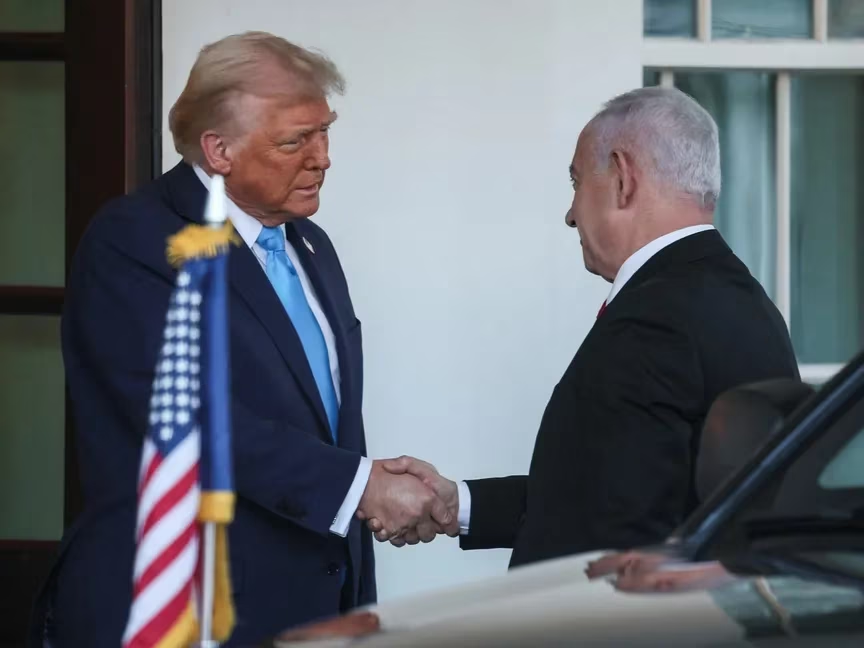
The story begins with a pivotal meeting on February 11 at the White House, where Netanyahu presented Trump with a plan supported by Israeli intelligence, focusing on an "opportune moment" to strike Iran quickly and effectively, while minimizing risks. The plan included destroying Iranian missile capabilities, weakening the regime, and even opening the door to its change. The Israeli side presented Iran as internally fragile and externally containable.
Trump showed clear responsiveness to this proposal from the outset, reflecting a growing convergence in his vision with Netanyahu, especially regarding Iran as an exceptional threat. However, this approach faced scrutiny from US intelligence agencies the following day, where the plan was broken down into four main objectives: targeting leadership, weakening military capabilities, igniting internal unrest, and achieving regime change. While the first two objectives were deemed achievable, the latter two were rejected as unrealistic.
Despite this, Trump focused on the feasible military objectives, ignoring reservations related to broader implications. This selective handling of information reflects a broader pattern in his leadership style, where he tends to adopt what aligns with his preconceived notions.
Within his team, Vice President J.D. Vance emerged as the most prominent opponent, warning of the risks of escalation and regional instability. In contrast, Pete Hegseth supported the military option, while Marco Rubio adopted a middle ground, advocating for limited strikes without sliding into major goals like regime change. Military and intelligence officials, such as John Ratcliffe and General Dan Caine, presented the risks without explicit opposition.
Geopolitical context played an additional role, as previous military successes boosted Trump's confidence, alongside his firm conviction of Iran's danger. At the same time, political efforts led by Jared Kushner and Steve Witkoff failed to achieve a breakthrough, further convincing the administration that the military option was the most viable.
With intelligence emerging about a rare opportunity to target Iranian leadership with a single strike, the pace of the decision accelerated. In a February 26 meeting, advisors reiterated their positions without a serious attempt to obstruct the general direction, leading Trump to finalize his decision to move forward, justifying it by the necessity of preventing Iran from acquiring nuclear weapons.
Ultimately, this trajectory reflects a decision shaped by a delicate balance between personal assessment and institutional evaluation, where presidential inclination outweighed reservations, driven by a strategic opportunity and implicit political consensus, leading to a choice with far-reaching consequences.
This trajectory reveals a structural problem in the US decision-making mechanism, where the president, driven by personal convictions, can reorder intelligence assessment priorities to serve his orientations. Instead of intelligence being a tool to control decisions, it transformed into a selective reservoir used to justify a preconceived choice. This pattern raises questions about the effectiveness of institutional checks and balances, especially when senior officials hesitate to offer explicit opposition, allowing political judgment to override long-term strategic analysis.
Israel's role in this issue stands out as a crucial factor in guiding the decision, not only through providing intelligence but also by shaping an entire framework for strategic thinking. Netanyahu's success in framing Iran as an "easy and available" target reflects the allies' ability to influence Washington's calculations, especially when it intersects with preconceived notions of the American leadership. This raises a question about the extent of the independence of American decision-making and the limits of allies' influence in pushing it towards high-risk military options.
J.D. Vance's limited opposition, despite the clarity of his warnings, reflects a recurring pattern in US administrations, where dissenting voices are contained within the framework of "ultimate commitment" to the president's decision. This behavior reinforces the impression that internal discussions, no matter how sharp, rarely become an actual obstacle to executive decisions. The result is an environment that prefers apparent cohesion over genuine debate, which can lead to underestimating risks, especially in complex issues such as regional wars and their international repercussions.
Share your opinion
How the decision to engage in war against Iran crystallized in the White House under Netanyahu's influence