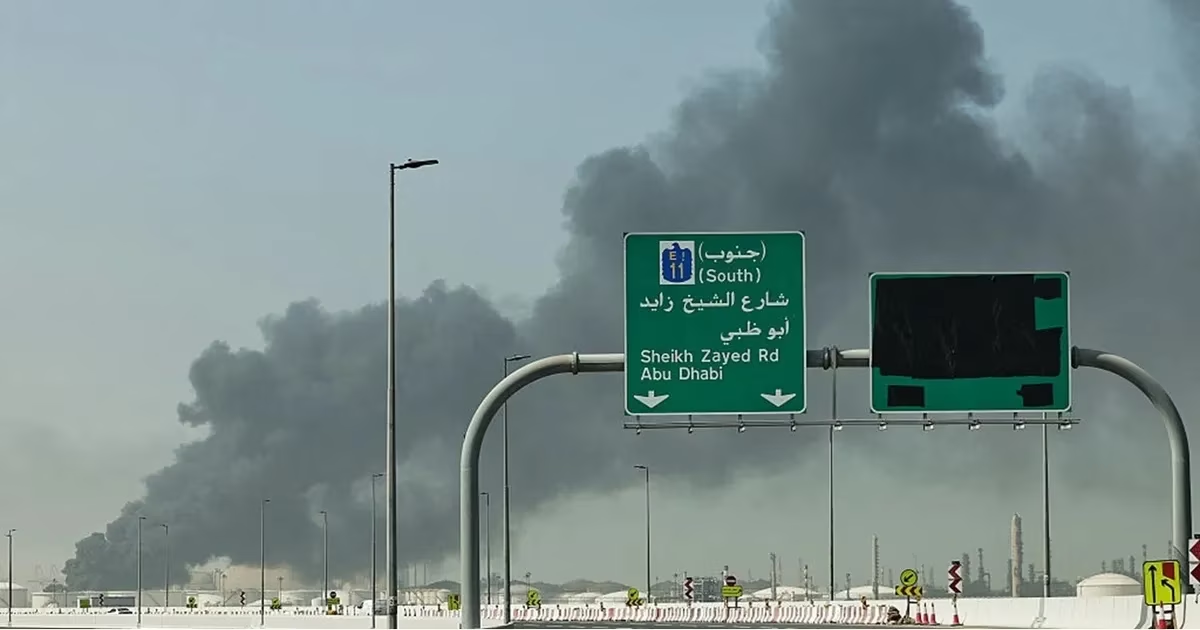







The Middle East is passing through a dangerous historical turning point that goes beyond mere fleeting military clashes, as the features of a wide-ranging confrontation led by the United States and Israel against Iran are crystallizing. Despite the announcement of fragile cease-fire agreements, field indicators confirm that the region is still living on a hot plate, especially with the continued escalation of fronts from Palestine to Lebanon.
What the region is witnessing today represents an embodiment of the concept of 'war without a center,' which geographically extends to include vital waterways from the Strait of Hormuz to Bab al-Mandab. This confrontation is not merely an attempt to dismantle a nuclear program, but rather a forced re-engineering of the region aimed at trapping Arab countries in a systematic bleeding and acute polarization.
A careful reading of the scene reveals the collapse of the hypothesis of a rapid military decisive victory promoted by decision-making circles in Washington and Tel Aviv. The field reality has proven that we are facing a networked war of attrition, which does not recognize traditional borders and makes military bases and economic interests open targets in the absence of a clear political horizon.
American-Israeli strategy moves along paths aimed first at exhausting Iranian regional power and removing it from the sphere of influence while it is heavily wounded. The second path seeks to impose forced alignment on Arab capitals, pulling them from a position of positive neutrality into a furnace of conflict that does not serve their direct national interests.
'Managed chaos' emerges as a tactic to keep the region in a state of continuous turmoil, which justifies the continuation of Western security guardianship and control over global energy routes. This situation places Arab countries before difficult choices, ranging from engaging in international axes at a heavy moral cost, or passive withdrawal that may threaten their internal security.
Returning to history, we find that managing existential crises requires a mixture of political realism and defensive innovation, as happened in major historical junctures. The ability to disengage from hostile alliances and engage in complex diplomatic maneuvers remains the only way to neutralize the numerical and technical superiority of adversaries in moments of breakdown.
Jurisprudence of crisis management calls for the necessity of 'holding back' when fronts overlap and matters are ambiguous, which means refusing to be drawn into proxy wars. Converting national capabilities into fuel for conflicts that serve external agendas represents a direct threat to the future of coming generations and the stability of countries targeted by polarization.
Survival engineering at the present time requires internal fortification based on collective awareness and national sovereignty, away from external dictates. The realization that material balances of power are not absolute gives the Arab decision-maker greater ability to maneuver and take sovereign positions stemming from the supreme interest of the state and the people.
Adherence to the principle of 'sovereign and geographical neutrality' is an urgent necessity to protect Arab lands and airspace from becoming an arena for settling international scores. There must be a collective stance that rejects the use of military bases scattered in the region as a starting point for any hostile action, because that deprives states of their sovereignty and makes them vulnerable to reciprocal retaliation.
Activating 'preventive diplomacy' and building unified regional blocs represents the first line of defense against the military madness threatening the region. Pressure in international forums to stop the escalation must stem from a common regional security vision, which confirms that solutions do not come through foreign gunpowder but through arrangements originating from within.
On the economic front, it has become imperative for Arab capitals to accelerate the pace of inter-integration to secure supply chains and basic needs. In light of the targeting of energy facilities and the threat to maritime passages, food and economic security become an integral part of the comprehensive national security defense system.
The brinkmanship policy currently being practiced aims to scatter the cards and reproduce relations of dependency in the Middle East. The response to these policies is not through momentary emotional reactions, but by adopting long-term strategies that ensure the independence of Arab decision-making and prevent the depletion of wealth in endless wars.
Arab countries today have a historical opportunity to impose a rational balance that protects their future from projects of hegemony and systematic destruction. Drawing lessons from history confirms that strong will and complete awareness are the real tools for achieving survival in an era of major geopolitical transformations and political earthquakes.
In conclusion, the current scene confirms that the region is living in the heart of an earthquake aimed at forcibly reshaping the political map. Survival from this earthquake requires a vision that combines conscious caution and deliberate practical action, to ensure that Arab geography does not turn into merely a 'mailbox' for the messages of competing great powers.
Survival from major traps requires flexible minds capable of defensive and diplomatic innovation, and not just emotional reactions.

Share your opinion
Arab Survival Engineering: A Reading of the Repercussions of Regional Confrontation and the Dangers of Polarization