







Washington - Said Arikat - 8/4/2026
News Analysis
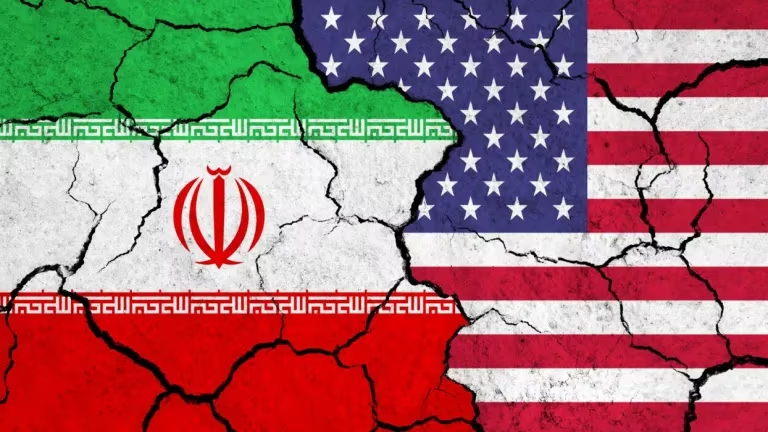
In a critical moment that nearly pushed the Middle East into a widespread military confrontation, US President Donald Trump announced his approval of a two-week temporary ceasefire with Iran, an agreement reached shortly before imminent US military strikes against targets within Iranian territory were to be carried out. This dramatic development did not occur in isolation from a rapidly escalating context; rather, it reflects a delicate balance between military pressure and emergency diplomacy, opening the door to a potentially pivotal negotiation phase in the crisis.
The agreement stipulates a mutual cessation of military operations, including air strikes and direct and indirect hostile activities, in exchange for an Iranian commitment to fully and immediately reopen the Strait of Hormuz to international shipping. This strait is considered one of the most strategically important waterways in the world, through which a large percentage of global oil exports pass, making its closure during the recent escalation a step with serious economic repercussions internationally.
In a post on "Truth Social," Trump stated: "I have agreed to give Iran a two-week grace period in exchange for immediately reopening the Strait of Hormuz. We do not seek war, but we are fully prepared for it. This is a real opportunity for peace if they make good use of it."
This statement reflects a mix of firmness and openness, within a policy based on maximum pressure coupled with the possibility of negotiation.
Background of the Agreement: Last-Minute Diplomacy
Data indicates that this agreement was not spontaneous but resulted from intensive behind-the-scenes communications over the preceding days, with the participation of regional and international mediators, most notably Pakistan. Islamabad played a pivotal role in bridging viewpoints, leveraging its balanced relations with both parties and seeking to avoid the outbreak of a war whose effects could extend beyond the region.
International pressure, especially from major energy-consuming countries, also contributed to pushing both parties towards de-escalation, amid growing fears of rising oil prices and global market disruption. Reports indicate that US forces were already on high alert, reinforcing the hypothesis that the agreement came within the framework of "brinkmanship" diplomacy, where direct military threat is used as a means to force quick concessions.
Iran's Ten-Point Plan
The Iranian ten-point proposal forms the basis upon which negotiations will be built during the ceasefire period. Although its full details have not been officially announced, diplomatic sources have revealed its main provisions, which reflect an Iranian vision for a comprehensive settlement:
Guaranteeing freedom of navigation in the Strait of Hormuz in exchange for an international commitment not to target Iran.
Comprehensive cessation of direct and indirect military operations in the region.
Launching a gradual and deliberate process to lift economic sanctions imposed on Tehran.
Returning to specific nuclear commitments within a new or modified agreement.
Establishing a multilateral international monitoring mechanism to ensure mutual compliance.
Launching a regional dialogue on collective security involving Gulf states.
Recognizing Iran's regional role within agreed-upon balances.
Cessation of mutual cyberattacks and cooperation in cybersecurity.
Implementing humanitarian steps such as prisoner and detainee exchanges.
Setting a clear timeline for broader negotiations towards a long-term agreement.
These provisions show that Iran is not merely seeking a temporary de-escalation but rather a redefinition of the rules of political and security engagement in the region, ensuring its internationally recognized position.
Potential Regional Expansion: Lebanon within the De-escalation
In a notable development, the Israeli newspaper "Yedioth Ahronoth" reported that the understanding is not limited to the US-Iranian arena but may extend to include a ceasefire in Lebanon, indicating a potential containment of escalation on Israel's northern front. According to this proposition, any de-escalation between Washington and Tehran could directly impact Iran's allies in the region, especially the active forces in Lebanon, which could contribute to reducing tensions and preventing the confrontation from expanding to additional arenas. However, no independent official confirmation of this information has been issued, keeping it within the framework of media estimates that reflect an Israeli reading of the agreement's implications.
Between Tactic and Potential Transformation
Strategically, this agreement reflects a temporary convergence of interests between two parties that still harbor deep mistrust. The United States can claim to have achieved an immediate goal of reopening the Strait of Hormuz without entering a costly war, while Iran has gained an opportunity to halt escalation, alleviate economic and military pressures, and persuade the US President to accept its terms, or points, while its position in controlling the Strait of Hormuz is better than it was before the United States and Israel waged war on it on February 28th.
Nevertheless, the nature of the agreement remains fragile, as it is based on conditions that are susceptible to collapse in the event of any field violation or indirect escalation. Furthermore, the multiplicity of parties indirectly involved in the conflict, such as regional allies and armed groups, complicates the scene and makes controlling the course of events more difficult.
Regional and International Dimensions
Regionally, several countries welcomed this development, given the opportunity it presents to avoid a potentially devastating war. Global markets also reacted positively, with oil prices experiencing a relative decline immediately after the agreement's announcement, signaling a reduction in fears of supply disruption.
Internationally, this truce is seen as a test of the major powers' ability to manage crises through diplomacy rather than military confrontation. It also places mediators, especially Pakistan, in an influential position that could be strengthened if negotiations succeed.
Scenarios for the Next Phase
Expectations regarding the future of this agreement range between three main scenarios. The first is the success of negotiations that will begin on Friday between Iran and the United States in Islamabad, with the participation of US Vice President J.D. Vance, and the transformation of the truce into a longer-term agreement, and perhaps a comprehensive framework addressing contentious issues. The second, and most likely, is the continuation of the truce for a limited period without achieving a decisive breakthrough, keeping the crisis in a temporary freeze. The third scenario involves the possibility of the agreement collapsing due to a field incident or indirect escalation, which could bring the region back to the brink of confrontation.
The temporary ceasefire between the United States and Iran represents a delicate moment in a complex crisis, where military calculations intersect with economic and diplomatic pressures. While the agreement offers a real opportunity to contain escalation, it remains a difficult test of both parties' willingness to transition from a logic of confrontation to a logic of settlement. The coming days will be crucial in determining whether this truce will mark the beginning of a new political path, or merely a fleeting truce in
Although the ceasefire agreement opens a rare window to contain escalation, its chances of endurance remain dependent on a fragile balance between the political and military calculations of the parties involved. On the one hand, mutual exhaustion and international pressure may push towards consolidating and gradually expanding de-escalation. On the other hand, the history of ceasefire violations in the region, especially by Israel in previous contexts, raises serious doubts about long-term commitment. Any limited field incident could quickly turn into a pretext for collapse, making the agreement more of a temporary test of intentions than a stable path towards lasting peace.
Share your opinion
Temporary Ceasefire Between the United States and Iran—Agreement Details, Background, and Prospects for Endurance