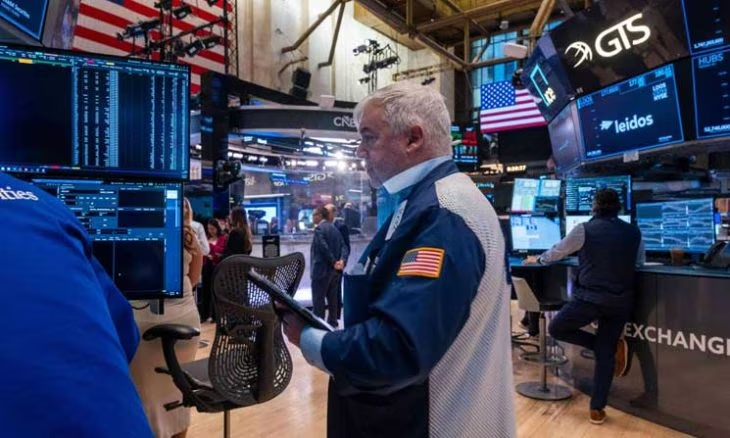







Questions are escalating in global financial circles about movements described as 'suspicious' on Wall Street, as these fluctuations coincided with the rapid developments of the war waged by the United States and Israel against Iran. Data indicates that some investors were able to achieve huge profits by exploiting price fluctuations resulting from sudden political and military decisions.
The announcement by US President Donald Trump on March 23 regarding the postponement of bombing Iran stands out as a stark example of this phenomenon, as financial sources observed a massive surge in buying just ten minutes before the statement was issued. This precise timing enabled these investors to reap enormous gains immediately after stock prices jumped following the official announcement, reinforcing the hypothesis of information leakage.
For its part, the news website 'Axios' confirmed the existence of abnormal phenomena in financial markets accompanying the military escalation, pointing to the possibility of trading based on leaked insider information. The site explained that some financial 'whales' may have had prior knowledge of escalatory or de-escalatory steps, which gave them an unfair advantage in the energy and arms markets.
In a related context, the shares of major American defense companies witnessed historical jumps in their market value during a single day of trading in early March. According to data, the market value of 'Northrop Grumman', 'Lockheed Martin', and 'RTX' increased by a total of more than $28 billion, driven by the continuation of military operations against Iranian targets.
The Iranian leadership entered the warning line, with Parliament Speaker Mohammad Bagher Ghalibaf urging investors to be wary of news preceding market openings. Ghalibaf described such news as mere misleading tools aimed at preparing the ground for quick profits, advising traders to make decisions contrary to what these leaks promote.
Suspicions were not limited to unknown investors but also extended to officials in the American administration, as British press reports quoted informed sources saying that Defense Secretary Pete Hegseth made investment attempts in defense companies before the outbreak of the confrontation. Despite the Pentagon's denial of this news, controversy still surrounds the conflict of interest amidst the war.
Observers believe that the 'trader' mentality with which Trump manages international crises contributes to these sharp fluctuations, where political statements are used as economic tools. This policy causes a state of uncertainty in global energy markets, leading to rising oil and gas prices and increased inflation rates that have burdened the global economy.
Economic experts confirm that every war has beneficiaries called 'war whales,' who seize opportunities from the suffering of peoples and the destruction of infrastructure. Experts explained that the current war has revealed a naked economic face, where financial motives are no longer hidden but have become a primary driver of military and political decisions in the region.
In Morocco, economic analyst Mohamed Jadri pointed out that some major powers are pushing for conflicts to increase their arms sales and ensure the flow of profits to their major companies. Jadri considered that the ordinary consumer in various countries around the world is the one who pays the final bill for these conflicts through high living costs and deteriorating purchasing power.
Academic Mohamed Yaouhi also noted that Trump prioritizes the interests of his country and its companies, regardless of the accuracy of his statements. He added that negotiations with Tehran may not begin until Washington feels that its direct economic interests are seriously harmed by the continuation of the conflict.
The United States faces increasing international pressure, especially from Asian countries affected by energy supply disruptions, which may seek alternatives to the dollar in their trade dealings. Analysts believe that continued market manipulation could push Washington's allies, such as Japan, to re-evaluate their strategic alliances to protect their economic security.
The military field has remained ablaze since late February, with parties exchanging missile strikes that hit vital facilities and civilian targets. While operations rooms are busy with military planning, trading rooms in New York are busy monitoring numbers and turning blood and destruction into green figures on stock market screens.
The link between political statements and stock movements reveals an ethical gap in the global financial system, where secret military information becomes a commodity bought and sold. This phenomenon puts the credibility of financial regulatory institutions on the line, given their inability to control trading that precedes major events.
In conclusion, the war on Iran remains an open arena not only for military confrontation but also for settling economic scores and making illicit gains. As the escalation continues, the world awaits what the coming days will bring in terms of surprises that may change the map of economic and political powers in the Middle East and the world.
Beware of what is called news before the market opens, as it is often just preparation for profit-taking... Do the opposite.



Share your opinion
War Whales on Wall Street: Suspicious Profits and Trades Preceding Military Decisions Against Iran