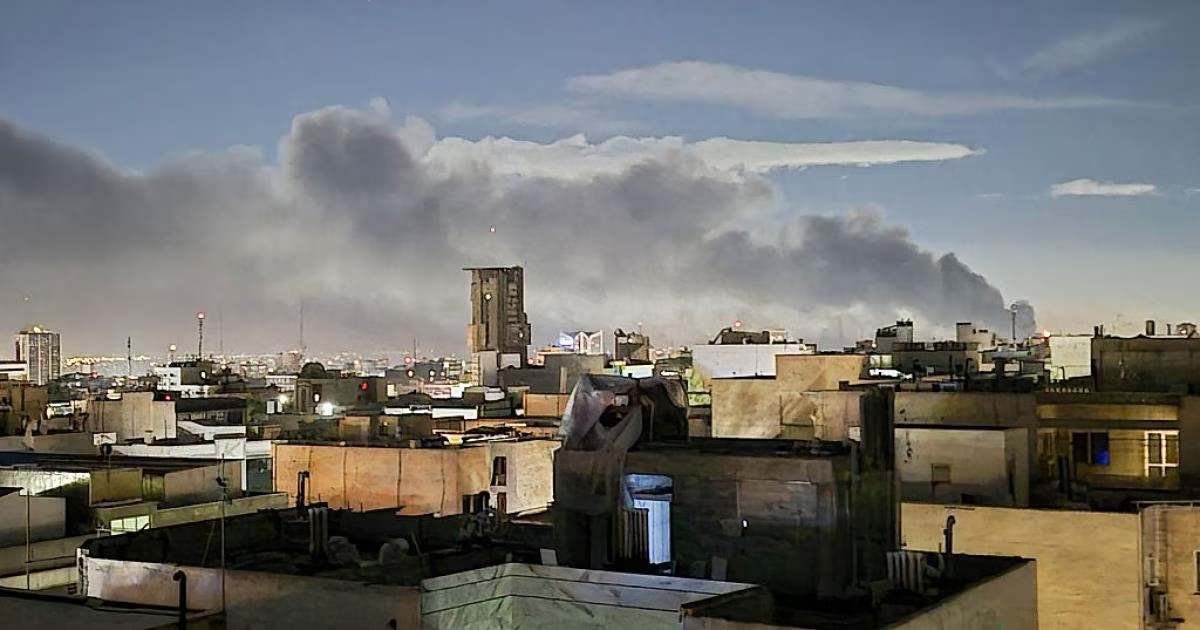







Since the early morning hours of Tuesday, Iranian territories have witnessed a violent wave of joint airstrikes carried out by Israeli and American aircraft, targeting vital centers and energy facilities in various regions. Field sources reported hearing massive explosions shaking the strategic Kharg Island, coinciding with concentrated strikes on the city of Karaj, west of the capital Tehran, leading to widespread power outages in residential and industrial neighborhoods.
The scope of the targeting expanded to include transportation infrastructure, with shelling hitting major bridges and railways in the heart of the country. Local authorities in Qom province confirmed that a vital bridge outside the city was directly hit, while the city of Mashhad announced a complete suspension of train movement due to security threats and damage to the national transportation network.
In a significant escalation, Isfahan province was subjected to airstrikes targeting the Yahya Abad railway bridge, which resulted in casualties among civilians and workers at the site. These attacks come after explicit warnings issued by the Israeli army to Iranian citizens to stay away from train stations and railway networks, in a prior indication of expanding the scope of military operations.
The capital Tehran was not spared from the attacks, as local sources reported successive explosions in the Shahriar area, in addition to an airstrike targeting the Pardis area. According to preliminary information, the strike on Pardis led to the death of six people, including three children, as well as extensive destruction to residential buildings surrounding the bombing site.
In another bloody toll, Alborz province announced the death of 18 people and the injury of 24 others due to targeting populated areas, raising the number of civilian casualties in this wave of escalation. Medical sources described the condition of some of the injured as critical, amidst a large mobilization of rescue and ambulance teams in various cities affected by the aerial bombardment.
These attacks recorded a precedent by targeting a Jewish synagogue in the capital Tehran, which observers considered a dangerous shift in the nature of the chosen targets. This shelling coincided with a state of intense anticipation prevailing in the Iranian street, amid the continued intensive flight of warplanes and drones over sovereign and military facilities.
For its part, the Israeli army issued a statement claiming the destruction of a petrochemical complex in the city of Shiraz, southwest of the country, claiming that the facility was used to manufacture materials used in the production of ballistic missiles. The statement indicated that the operation aims to undermine Iranian military capabilities and prevent the launch of long-range missiles that threaten regional security.
On the economic front, official Iranian media confirmed severe damage to petrochemical production facilities belonging to the Pars Economic Zone in the city of Asaluyeh. This region is considered one of the most important pillars of the Iranian economy, and targeting it represents a strong blow to the energy sector and oil exports in the country, which is already suffering from international pressures.
These rapid field developments come just hours before the deadline set by the American president for the Iranian administration to reach a political agreement and open the Strait of Hormuz to international navigation. It appears that the failure to reach diplomatic understandings has pushed towards a direct military option in which the United States is openly participating alongside Israel.
In the center of the country, the city of Kashan was subjected to strikes targeting railway lines, leading to a complete halt of transportation and shipping in this vital artery. Reports from various Iranian provinces continue to monitor the extent of the destruction left by the raids, amidst official silence from the political leadership regarding the nature of the expected response to this widespread aggression.
The attack aimed to expand strikes on Iranian military capabilities, including ballistic missile system sites used to launch missiles towards Israel.


Share your opinion
Widespread Israeli-American Aggression Targets Energy Facilities and Infrastructure in Iran