






Washington – Said Arikat – 7/4/2026
News Analysis
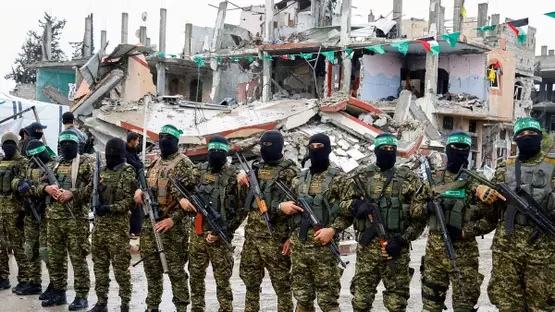
With the "Peace Council" proposing the disarmament of the Hamas movement within a ninety-day period, efforts to solidify the ceasefire in Gaza are entering a more sensitive and complex phase. The initiative, pushed by the administration of President Donald Trump, appears on the surface to be an attempt to establish a long-term calm, but at its core, it reveals a network of structural contradictions that make its realization on the ground extremely difficult, if not fraught with the risks of re-producing the crisis.
At its essence, this demand reflects a clear absence of balance between the obligations imposed on the parties. Hamas is asked to dismantle its military structure, hand over maps of its tunnels, and abandon the deterrent tools it has accumulated over years, while these steps are not accompanied by binding and equivalent guarantees from the Israeli side, whether regarding a complete cessation of military operations or a comprehensive withdrawal from the Strip. This disparity not only weakens the foundations of trust but also reinforces the impression that the entire process is being managed as a political dictate rather than an equitable negotiated settlement.
According to experts, this imbalance cannot be separated from the broader context of the conflict, where Hamas's weapons, from within its political environment, are viewed as an extension of the idea of "deterrence" in the face of occupation, not as a separate military tool that can be abandoned by a technical decision. Hence, demanding its disarmament without addressing the roots of the crisis, including the blockade, sovereignty, and freedom of movement, seems like an approach that reduces the conflict to its armed manifestations, ignoring its structural causes. In this sense, any security vacuum that might arise from disarmament will not necessarily lead to stability, but may open the door to new forms of tension.
This complexity increases with the time factor, as the deadline set by the proposal—despite being relatively longer—reflects a desire to achieve a political accomplishment within a specific timeframe. However, settlements of this kind are not built under the pressure of timelines but require a cumulative process based on building trust and gradual commitments. Consequently, the time factor transforms from a regulatory tool into an element that could threaten to undermine the negotiation process, as it pushes the parties towards more rigid positions instead of engaging in deliberate concessions.
In a parallel context, another equally important imbalance emerges concerning the "Peace Council's" commitment to its financial pledges, which directly reflects on the credibility of the entire proposal. So far, the promises announced on February 19 have not translated into practical steps, despite the United States pledging ten billion dollars, along with seven billion from the other participants. In response to a question from Al-Quds correspondent, an official in Donald Trump's administration admitted that he did not have updated information beyond what had been previously announced, especially given Washington's preoccupation with its war with Iran, which reinforces doubts about the seriousness of the commitments.
Meanwhile, the linkage between the reconstruction of Gaza and disarmament stands out as one of the most controversial elements of the plan. While reconstruction represents an urgent humanitarian need for the residents of the Strip, using it as a political leverage puts civilians in a vulnerable position, where their basic rights become conditional on the outcomes of negotiations. This intertwining of the humanitarian and political not only raises ethical questions but also threatens to weaken any potential legitimacy of the agreement, as it fosters a feeling that aid is being used as a tool of blackmail rather than a legal and humanitarian obligation.
Benjamin Netanyahu's stance, hinting at the possibility of imposing disarmament by force, adds another dimension of complexity. Instead of creating an encouraging negotiating environment, this rhetoric reinforces a climate of distrust and pushes Hamas to cling to its positions. Amidst ongoing military operations, even during periods of calm, the movement's conviction grows that any strategic concession on the issue of weapons might expose it to a double loss: security and political.
Furthermore, the gap between the pledges regarding the entry of aid into Gaza and what is actually achieved on the ground constitutes an additional factor in weakening the chances of progress. The figures reflecting a limited flow of trucks compared to what previous agreements stipulated give Hamas a justification to question the seriousness of international commitments and reduce its incentives to engage in long-term arrangements that may not be honored.
In light of this, it becomes clear that the demand for Hamas's disarmament, in its current form, cannot be separated from deeper imbalances in the structure of the political process itself. Instead of being part of an integrated path that addresses the roots of the conflict, it is presented as a precondition that rearranges the balance of power without providing sufficient guarantees. While the United States and Israel seek to impose a new security reality, Hamas insists on linking any strategic shift to tangible changes in the terms of the conflict.
Experts believe that any viable approach must transcend the logic of political coercion towards building a gradual negotiating framework based on mutual commitments, clear guarantees, and a relative separation between humanitarian and political tracks. Without this, disarmament will remain a theoretical goal that clashes with a complex reality, and the risk of sliding into a new round of escalation will persist, in an environment where questions of sovereignty, security, and justice have not yet been resolved.
Share your opinion
Hamas Disarmament: Between Political Coercion and Settlement Imbalances