






Well-informed sources from within the White House revealed that US President Donald Trump is currently considering an extensive cabinet reshuffle, including sovereign portfolios, amid growing frustration over the political and economic repercussions of the ongoing war on Iran. These moves come after the dismissal of Attorney General Pam Bondi last week, reflecting the administration's desire to reset its political course before the anticipated midterm elections next November.
Sources reported that the war, now in its fifth week, has led to a significant jump in fuel prices and a noticeable decline in President Trump's popularity, which has caused deep concern within the Republican Party. Observers believe that any potential reshuffle would be an attempt to absorb public anger and demonstrate control over the escalating situation due to the military conflict that began in late February.
Reports indicate that the list of officials threatened with dismissal includes prominent names, most notably Director of National Intelligence Tulsi Gabbard and Secretary of Commerce Howard Lutnick. Trump has expressed dissatisfaction with Gabbard's performance in recent months, and has already begun sounding out allies about potential replacements to lead US intelligence agencies at this sensitive stage.
In contrast, Secretary of Commerce Howard Lutnick faces increasing pressure from senior Trump allies for his dismissal, not only because of his trade policies but also due to the emergence of new details about his past relationships. Recent documents have revealed meetings between Lutnick and the late businessman Jeffrey Epstein on his private island in 2012, which has put him under renewed political scrutiny despite his denial of the depth of that relationship.
Despite these leaks, White House spokesman Davis Engel affirmed that the President still places his full trust in Gabbard and Lutnick, praising their achievements in international and trade matters. Engel considered the current administration to be the most talented and influential, highlighting Gabbard's role in foreign affairs and Lutnick's role in securing major investment deals for the American people.
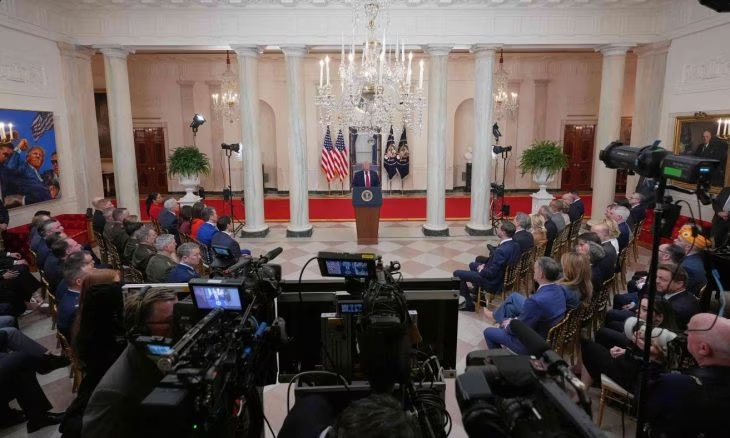
However, there is a feeling within the administration that Trump's recent address to the nation did not achieve its desired goals in calming public fears. A senior official described the speech as disappointing, as it failed to provide a clear vision for ending the war or addressing the economic crises directly affecting American citizens, especially concerning energy prices.
Recent polls showed a sharp decline in approval of Trump's performance, reaching only 36%, the lowest since he took office in the current term. The poll also revealed that 60% of Americans oppose direct military intervention against Iran, putting the White House in direct confrontation with public opinion that rejects the continuation of armed conflict and its exorbitant costs.
Sources indicate that Trump is extremely angry about what he describes as biased and unfair media coverage regarding the course of the war in the Middle East. Despite his desire to see more positive news reports, he has not yet shown any intention to change his media or military strategy, content with seeking changes in the political faces around him.
Some advisors believe that hesitation in carrying out cabinet reshuffles may carry political risks equivalent to the risks of change itself, especially since voters are more influenced by tangible results on the ground than by ideological messages. Officials confirm that the direct impact of fuel prices on people's daily lives has become the primary driver of public discontent that threatens the future of Republicans in the upcoming elections.
Tulsi Gabbard had previously angered the White House by criticizing foreign military interventions, which created a trust gap between her and the more hawkish wing of the administration. Despite her ability to hold her position for a period, current leaks suggest that her patience and the President's patience have reached a dead end amid the complexities of the current war.
As for the Department of Commerce, Lutnick has faced criticism since last year for imposing widespread tariffs that confused international allies and sparked widespread economic debate. Those calling for his departure believe that the time has come to inject new blood capable of dealing with the economic challenges resulting from sanctions and trade wars associated with the conflict with Iran.
Senior officials believe that Trump prefers to make these major changes now rather than waiting until closer to the elections, to avoid the administration appearing in a state of chaos later. Bondi's dismissal is seen as the beginning of a series of decisions aimed at reorganizing the internal house to confront what is described as the toughest political challenge Trump has faced since his election.
In the absence of a clear plan to end the conflict that began on February 28, the prevailing public impression remains that the war may be prolonged without a specific timeframe. The President's statement that economic hardship would be short-lived increased uncertainty, especially with all blame being placed on Tehran without offering practical solutions to alleviate the cost of living pressures on voters.
In conclusion, sources confirm that Bondi will not be the last on the list of departures, and that the coming days may see official announcements of changes in other high-level positions. The question remains in Washington whether these personnel changes will be followed by policy changes, or if they are merely an attempt to improve the administration's public image in the face of its sharp decline in popularity.
Making changes to show movement isn't a bad thing, is it?
Share your opinion
Pressures of Iran War Drive Trump to Consider Extensive Cabinet Reshuffle in White House