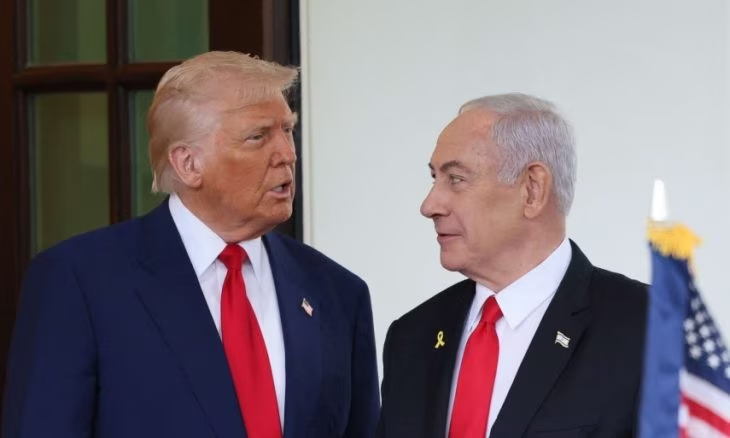







Military analyst Alon Ben-David, in the Maariv newspaper, reviewed the historical roots of US President Trump's crisis management style, likening his current reliance on the US military to his old style in Manhattan when he relied on the fierce lawyer Roy Cohn. The writer believes that Trump always seeks an absolute victory that leads to the surrender of the other party, without looking for compromises that ensure everyone wins.
The analysis indicates that Trump today faces an adversary fundamentally different from the mobsters or real estate moguls he used to confront in New York and Atlantic City. Iranians, as descendants of an ancient civilization, possess a strategic vision that differs from concepts of time and victory, which has enabled them to absorb military blows and stand on their feet again despite continuous bombardment.
The current confrontation has proven that Tehran possesses a strategic weapon no less dangerous than a nuclear bomb: the ability to close the vital Strait of Hormuz. This threat puts the entire world in a state of economic pain and makes it difficult for Washington to seize this weapon without engaging in a large-scale naval confrontation requiring capabilities similar to those used in World War II.
Iran's control over the waterways has pulled the rug out from under any American attempt to end the war with a unilateral ceasefire decision. If fighting stops without a comprehensive agreement, Tehran can keep the strait closed to impose its own conditions, placing it in a strong negotiating position against any future diplomatic initiative from the White House.
Trump now finds himself facing choices where the best is bitter. He can either pursue a path of reconciliation and appease the Iranians to ensure the strait's opening, which might harm his political image and legacy as a strong man. The second option is to resort to asymmetric or even unconventional military force in an attempt to bring the regime to its knees, a path fraught with risks and exorbitant costs.
From an Israeli perspective, any scenario ending in an agreement between Washington and Tehran is a catastrophic outcome, as it necessarily means legitimizing the regime's survival and injecting financial liquidity into its coffers. This would allow Iran to rebuild its damaged military capabilities, forcing Israel to confront it again in the near future under potentially less favorable conditions.
Concerns are growing in Tel Aviv about losing the freedom of military action it currently enjoys under the Trump administration, especially since previous wars ended with international pressure affecting the final results. But in this war, the final decision seems to be solely in Trump's hands, who views the current conflict as a personal battle related to himself and his political legacy.
Although Trump listens carefully to Netanyahu, the analysis warns that the Israeli Prime Minister's influence on White House decisions ultimately remains limited. The US President will not hesitate to blame Netanyahu for dragging the United States into a futile war if he feels it serves his domestic political interests or protects his image among voters.
The issue of enriched uranium stands out as one of the strategic goals Trump might seek to achieve to declare victory, as Iran possesses about 440 kilograms distributed across sites in Isfahan, Fordow, and Natanz. If a military operation succeeds in destroying or removing half of this quantity, Trump might consider it a sufficient achievement to withdraw from direct confrontation or move to negotiations from a position of strength.
Destroying nuclear capabilities, even partially, will not necessarily lead to the fall of the Iranian regime or the automatic reopening of the Strait of Hormuz. However, analysts believe that such an achievement could give the US administration the necessary pretext to continue the war through other economic and political means ultimately aimed at changing the regime's behavior or structurally weakening it.
Ultimately, the regional arena appears to be facing a difficult labor, where the ambitions of great powers intertwine with the resilience of regional powers. While Israel awaits the results of this confrontation, the question remains about Trump's ability to balance his desire for quick victory with the complexities of a civilization that does not measure success by the standards of fleeting real estate deals.
Iran is not Manhattan real estate moguls, but a 3,000-year-old civilization with different concepts of time and victory.



Share your opinion
Hebrew Analysis: Trump Faces a Persian Civilization That Does Not Yield to the Logic of Real Estate Deals