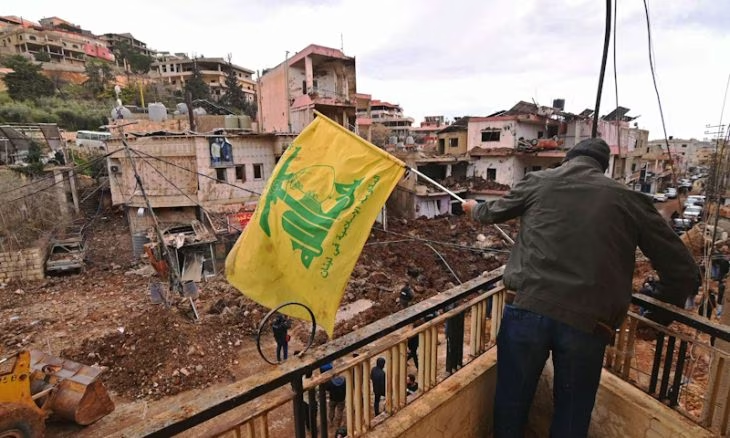







Former Israeli National Security Advisor, Reserve General Giora Eiland, considered opening a wide military front with Hezbollah in Lebanon concurrently with managing a complex conflict against Iran to be a grave strategic error. Eiland explained in radio statements that official Israeli claims that Hezbollah fell into a 'trap' are not accurate, and that the reality might be quite the opposite given the attrition of military capabilities.
Eiland pointed out that Israel should have exercised greater patience and chosen the appropriate timing instead of the current military rush. He believed that establishing a security zone in southern Lebanon by demolishing villages and evacuating residents is an application of lessons learned from the war in the Gaza Strip, but he stressed that this step would not radically end the missile threat.
The former security official emphasized that the fundamental dilemma lies in the fact that Hezbollah's missiles are launched from areas north of the Litani River, which means that ground operations in border villages will not stop the missile barrages. He added that Israel finds itself investing enormous resources in Lebanon without any real and tangible change in the security reality experienced by the residents of the north.
Eiland criticized what he described as the 'Israeli rush' to exploit the opportunity to open the northern front immediately after Hezbollah's 'symbolic' response following recent assassinations. He described this move as if someone found a treasure without studying the long-term consequences, questioning the feasibility of waging an ambitious war of this magnitude without knowing its time limit or its expected end.
The retired general expressed deep concern about the overextension suffered by the Israeli army as a result of fighting on several fronts and arenas simultaneously. He warned that this pressure could lead to the complete collapse of the Israeli system, noting that the real suffering experienced by the residents of the northern settlements reflects the extent of the failure to achieve a quick decisive outcome.
Regarding the strategy adopted, Eiland believes that controlling areas with hostile populations has proven ineffective, which justifies the scorched-earth policy in southern Lebanon. However, he noted that reducing the capabilities of the 'Radwan Force' and preventing its infiltration does not necessarily eliminate the missile threat, in which the party possesses an almost unlimited stockpile.
Eiland touched upon the American and Iranian roles in the conflict, indicating that Washington and Tel Aviv entered this confrontation without an accurate assessment of Tehran's true capabilities. He expressed concern about a scenario in which Iran closes the Strait of Hormuz, or continues to drain Israel by launching daily missiles that paralyze public life for long periods.
He also questioned the wisdom of not waiting for the results of attacks on Iran and assessing their repercussions before dramatically expanding the scope of the confrontation in Lebanon. He considered the prevailing Israeli belief that all political goals can be achieved through pure military force to be a very costly belief, both in human and economic terms.
In the context of his criticisms, Eiland indicated that the burden placed on reserve soldiers and the regular army has reached dangerous levels that may not be sustainable for long. He explained that there are limits to the ability of any army, no matter how powerful, to deploy effectively and operate with high efficiency on multiple and geographically distant fronts.
The former official also expressed doubts about the strategic utility of military presence in some other arenas such as Syria, considering that clinging to geographical areas merely for control might be an additional burden. He called for a comprehensive reassessment of military objectives in line with actual capabilities and the changing field reality.
Eiland concluded that the gap is widening between the optimistic political discourse promoted by leaders in Tel Aviv and the difficult realities on the ground. He warned that the continued human and material bleeding without a clear political horizon will lead to catastrophic results, emphasizing that the current path is characterized by difficulty and exorbitant costs that were not expected.
I am not sure that we did not make a strategic mistake; we are now discovering how difficult, long, and costly this path is.



Share your opinion
Former Israeli National Security Advisor: Opening Lebanon Front Concurrently with Confronting Iran is a 'Strategic Blunder'