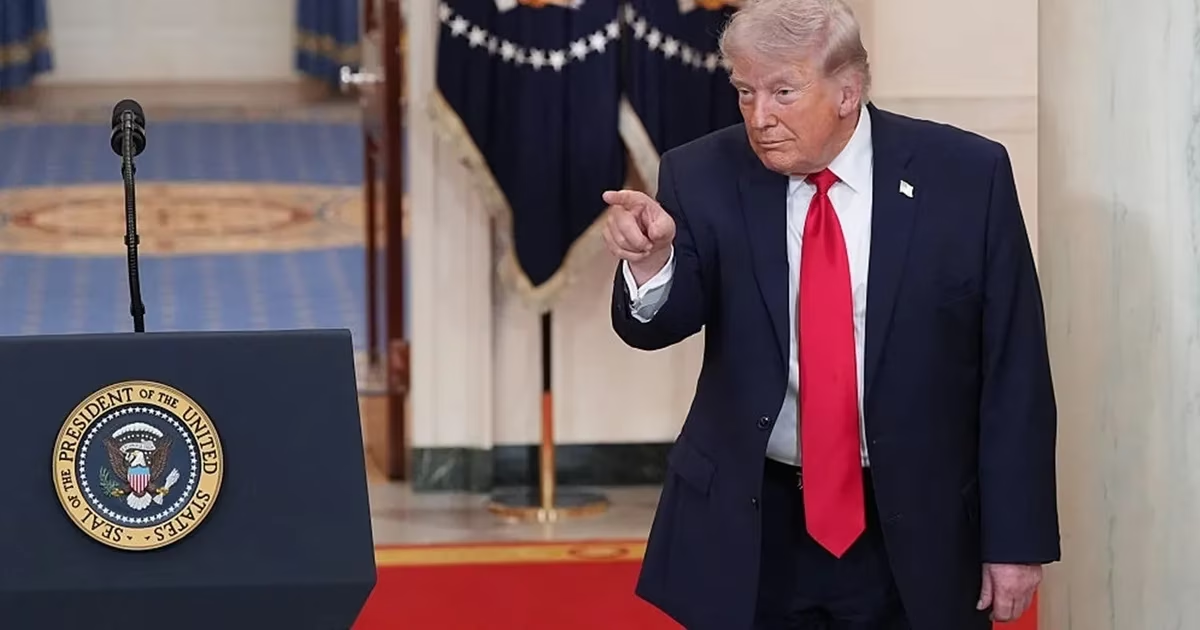







The military confrontation led by the United States with Israeli support against Iran enters its sixth week, amidst a state of international anticipation regarding the outcomes of this escalation. Widespread disappointment prevailed following the recent speech by US President Donald Trump, which was confused and offered no clear vision for exiting the quagmire of the raging war.
Current data indicates an unprecedented decline in President Trump's popularity within the United States, with his approval ratings dropping to about 17 percent. This figure reflects a state of public discontent with the foreign policies pursued by the White House, which a large segment of Americans view as a drain on the country's resources.
Meanwhile, major American cities witnessed a massive wave of protests, with nearly eight million demonstrators taking to the streets to express their rejection of the continued war. These crowds demand an immediate halt to military operations and a focus on resolving internal crises that have begun to exhaust American society.
Economically, American citizens have begun to feel the direct effects of the war through a wave of exorbitant price increases affecting basic goods and services. A state of chaos also prevailed in the air transport sector, manifested in the cancellation and delay of thousands of flights, which further increased public dissatisfaction with the current administration.
The crisis was not limited to the streets but extended to the corridors of power in Washington, where sharp divisions emerged within both the Republican and Democratic parties. Even within the 'MAGA' movement supporting Trump, voices began to rise, rejecting involvement in a war they describe as serving Netanyahu's interests more than American interests.
Observers believe that Trump's speech on April 2nd did not reflect the extent of the internal losses suffered by his administration. Despite increasing pressure, the President did not lean towards de-escalation, raising questions about the true motives behind this insistence on continuing military escalation.
Some analyses suggest that Trump may be subject to blackmail related to sensitive files, including documents linked to the 'Epstein' case. These files contain serious accusations that could end his political future, placing him in a defensive position from which he tries to escape through escalation on external fronts.
Internationally, the United States is experiencing increasing isolation as a result of its confrontational policies with major powers and international organizations. The closure of vital waterways such as the Strait of Hormuz has paralyzed global trade, angering countries dependent on energy supplies from the region.
The diplomatic crisis with European allies is escalating in a way that threatens the collapse of NATO due to the American administration's arrogant dealings with its partners. European leaders believe that Trump's current policy ignores the strategic interests of the old continent and pushes the world towards the brink of disaster.
American disregard for the European role in global politics could cost Washington dearly in the long run, especially in light of current geopolitical shifts. Dealing with traditional allies with contempt weakens the Western front and gives US adversaries opportunities to strengthen their influence at the expense of American decline.
Trump's April speech was supposed to be a turning point to end the war, which has become a heavy burden on the American state. However, the absence of political vision and adherence to the military option may lead the country to a strategic defeat whose effects will be difficult to remedy in the near future.
International fears are escalating regarding the possibility of the American administration resorting to the use of unconventional weapons, including tactical nuclear weapons, if military options are exhausted. Experts believe that such a step would face comprehensive global rejection and lead to catastrophic consequences for those who decide to use them.
In contrast, the Iranian side shows resilience in the face of military and economic pressures, complicating American and Israeli calculations on the ground. The refusal to surrender to nuclear threats places Trump and Netanyahu in a historical dilemma, where the destructive weapon turns into a tool of political suicide for its user.
In conclusion, it appears that the sixth week of the war represents a crucial crossroads for American leadership, which finds itself trapped between domestic anger and external isolation. Continuing this aggressive approach may not only lead to losing the war but also to fundamentally changing the international political map.
What Trump faces domestically in the US is the primary pressure factor for him to stop the war and not delve deeper into it.
Share your opinion
American Leadership Crisis in the Sixth Week of the War Against Iran: Trump Between Public Pressure and Allied Isolation