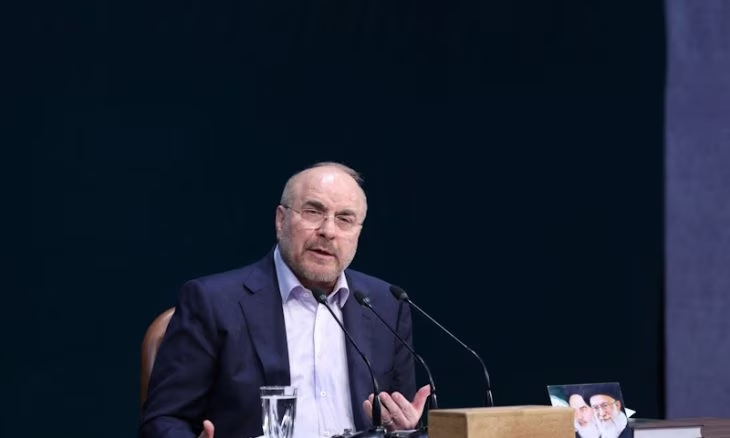







International press reports indicate that Iran's political landscape is undergoing a broad reshaping of its ruling core, with Mohammad Bagher Ghalibaf, the current Speaker of Parliament, emerging as one of the most prominent figures in the power structure. This rise follows a series of assassinations targeting senior regime leaders, pushing second-tier figures to the forefront of political and diplomatic events.
Despite Ghalibaf's extensive appearances on official television screens, informed sources confirm that actual power remains confined within the Supreme Leader's office, known as the 'House of Leadership,' and in close coordination with intelligence agencies. Ghalibaf is seen as a potential communication channel, especially after American hints about the possibility of dealing with different figures within Tehran.
Ghalibaf has a solid military background, having been one of the youngest commanders of the Revolutionary Guard during the Iran-Iraq War, and later commanded the Aerospace Force. Observers believe that his current assignment may include overseeing the war effort and defense strategy, benefiting from being one of the last hardline figures known to Western circles.
In the context of diplomatic moves, sources revealed a temporary exclusion of Ghalibaf's name and Foreign Minister Abbas Araghchi from direct targeting lists. However, this protection remains linked to the extent of Tehran's response to the specified deadlines for negotiations, amid the complexities of the current regional and international scene.
On the political front, Tehran officially rejected a 15-point American proposal aimed at completely dismantling Iran's nuclear program. The proposal included handing over enriched uranium and imposing strict restrictions on the missile system, in exchange for lifting economic sanctions, which Iran considered an infringement on its national sovereignty.
Ghalibaf, 64, has a controversial history linked to the suppression of student protests in 1999 and allegations of administrative corruption during his tenure as mayor of Tehran. Analysts believe that his prominence as a facade for the regime may reflect a desire to protect real power centers by placing coordinating figures on the front lines.
Reports indicate that the actual decision-making center is managed by Ali Asghar Hejazi within the Supreme Leader's office, a figure deeply connected to security agencies. This shift comes after the absence of influential historical figures such as Ali Larijani, who combined military, bureaucratic, and religious influence before his killing in an Israeli raid.
Despite Ghalibaf's repeated attempts to reach the presidency and his failure to do so, his current position as Speaker of Parliament grants him a vital coordinating role. However, his political weight remains contingent on his alignment with the directives of the Revolutionary Guard and the Supreme Leader's office, without possessing an independent power base.
Researchers emphasize that the Revolutionary Guard acts as an ideological army serving the institution of 'Guardianship of the Jurist' as an idea transcending individuals, meaning the absence of any leader does not fundamentally affect the continuity of the system. The regime relies on a 'martyrdom' strategy to strengthen the power of blocs associated with leaders lost in confrontations.
In a notable development, the name Ahmad Vahidi emerged as the new commander of the Revolutionary Guard, reflecting a trend towards strengthening the grip of security agencies. Vahidi, who contributed to establishing regional arms of the regime, represents the generation that combines intelligence work and field operations at this critical stage.
Internally, the Iranian regime has begun to intensify security measures within major cities in preparation for confronting any potential popular unrest. Sources reported movements by the Basij militia involving the storage of equipment and weapons in civilian facilities such as schools, as a precautionary measure to confront protest scenarios.
It appears that the competition for the succession of the Leader has entered a new phase with the strengthening of Mojtaba Khamenei's position, despite ongoing debate about his health and internal opposition. Circles surrounding the Leader are working to ensure a smooth transition of power that preserves the regime's ideological cover amidst external threats.
In conclusion, Iranian politics remains governed by delicate balances between the military establishment and the Supreme Leader's political office, where roles are carefully distributed. While Ghalibaf leads the diplomatic scene, major strategic decisions remain hostage to closed rooms managed by senior security leaders.
Real power in Iran is concentrated in the Supreme Leader's office and intelligence agencies, while Ghalibaf emerges as a coordinating facade between institutions.

Share your opinion
Reshaping Iran's Ruling Core: Ghalibaf as a Facade, Power Struggle Shifts to the 'House of Leadership'