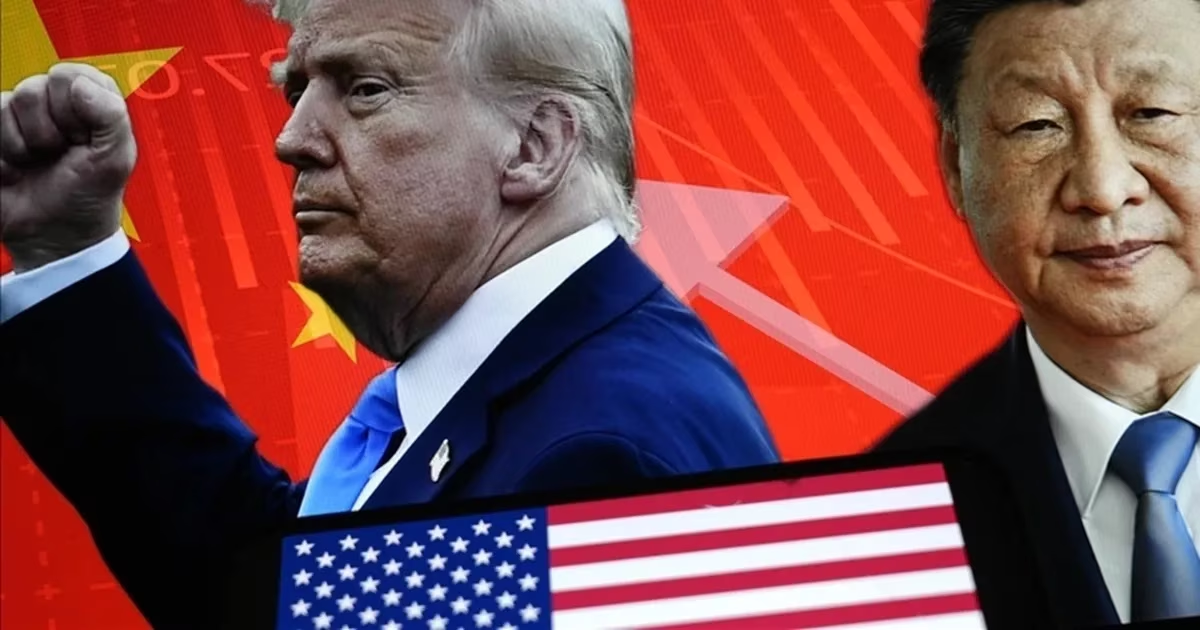







The political leadership in Beijing is closely watching the military escalation led by the United States against Iran, viewing this conflict as a strategic window to enhance its presence on the international stage. Chinese political circles believe that Washington's involvement in a long-term conflict could open the door for exploiting diplomatic and economic vulnerabilities that the American administration might leave behind.
According to recent international press reports, Beijing is betting that the current war will inevitably lead to a shift in the balance of power in the Middle East in a way that does not serve traditional American interests. While Washington's operations aim to undermine the Iranian regime and curb its nuclear ambitions, China believes that these moves may reveal the limits of actual American power in protecting its regional allies.
Analytical readings indicate that China is adopting a strategy based on careful observation and calm, far from any direct military involvement in the conflict. This vision relies on a historical Chinese principle that advocates letting the adversary drown in their mistakes without interruption, giving Beijing an opportunity to reposition itself as a rational and balanced superpower in the face of what it describes as American impulsiveness.
Energy is one of the fundamental pillars in Chinese calculations, with Beijing carefully monitoring the war's effects on international shipping lanes and oil and gas flows. Since the global economy is closely linked to the stability of energy shipments, any disruption in this sector could give China new leverage to expand its economic influence by offering commercial and diplomatic alternatives to affected countries.
Beijing is currently seeking to intensify its contacts with Asian and European capitals that are concerned about the repercussions of military escalation in the region. These diplomatic moves aim to build new alliances based on mutual interests and present the Chinese model as a reliable and more stable partner compared to American policies characterized by volatility and reliance on hard power.
The weakness that may appear in the United States' ability to secure its allies in the region represents, from a Chinese perspective, a golden opportunity to strengthen its own deterrent power. This ambition is not limited to political influence but extends to technological and economic hegemony, as Beijing tries to fill the vacuum that Washington's preoccupation with exhausting regional wars might leave.
Amidst this intense competition, China emerges as a player skilled in the art of waiting, betting that American attrition in the Middle East will inevitably lead to a decline in focus on the Indo-Pacific region. This strategic shift is what Beijing aspires to establish itself as the sole pole in Asia, and then move towards leading the new global order.
Sources confirm that the Chinese leadership carefully studies every American military step and analyzes international reactions to it to draw lessons. For Beijing, the war against Iran is not just a military confrontation, but a real test of the resilience of American hegemony in the face of complex geopolitical challenges posed by rising powers.
Economic diplomacy also plays a pivotal role in the Chinese plan, with massive infrastructure investments being utilized to link countries affected by the conflict to the Chinese economic system. This linkage creates a kind of soft dependence that Beijing prefers over direct military confrontations, thereby strengthening its soft power in the long run.
On another note, analysts believe that China benefits from the dispersion of American efforts across multiple fronts, which weakens Washington's ability to impose effective economic sanctions against Beijing. This dispersion gives Chinese companies greater room for maneuver and growth in global markets that were previously under absolute American dominance.
The current Chinese stance reflects a deep desire to reshape international rules in line with its aspirations as a great power. By observing the course of the war in Iran, Beijing hopes to prove that the American model of crisis management is outdated, and that the world needs new leadership that provides security and prosperity without constant recourse to arms.
Reports indicate that Beijing has already begun to strengthen its presence in international institutions, taking advantage of the global division over the American war. This move aims to pull the rug out from under Washington's feet in UN organizations and shift the compass of international decision-making towards a vision more aligned with Chinese, Russian, and their allies' orientations.
Ultimately, the American war against Iran remains a catalyst that may accelerate the transition to a multipolar international system. China, with its characteristic strategic patience, seems ready to inherit global influence should American steps falter, relying on a solid economic base and a long-term political vision that transcends the limits of immediate conflicts.
The question remains in the corridors of global research centers about Washington's ability to avert these risks before it's too late. While American cannons are engaged on battlefronts, Chinese minds continue to draw new maps of influence, relying on a quiet strategy that may change the face of the world in the coming decades.
Never interrupt your enemy when he is making a mistake; this is the rule Beijing follows in observing American blunders in the Middle East.

Share your opinion
The Strategy of Patience: How Beijing Plans to Seize Global Hegemony from Washington Through the Iranian Conflict?