







Washington - Said Arikat - 1/4/2026
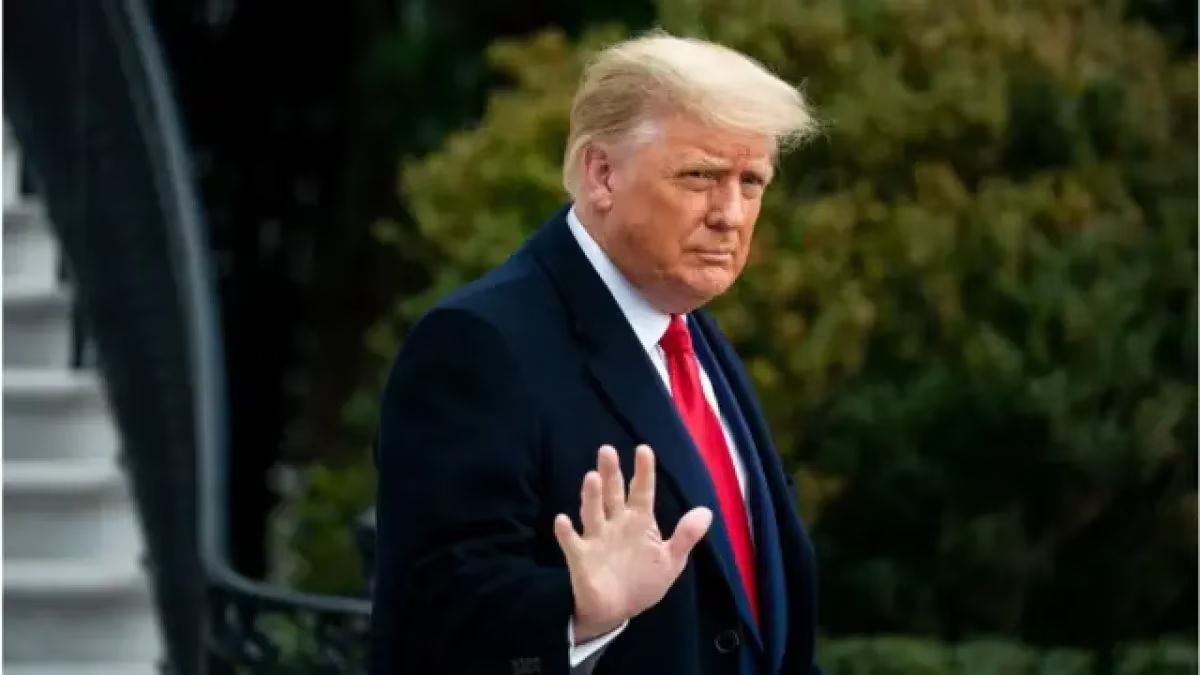
Former US President Donald Trump sparked widespread controversy after hinting at the possibility of the United States withdrawing from the North Atlantic Treaty Organization (NATO), in statements he made to a British newspaper. These hints came in the context of his repeated criticisms of what he described as the weak support of member states during the military escalation with Iran, reflecting escalating tension in the relationship between Washington and its traditional allies.
In an interview with the British newspaper "The Telegraph" on Wednesday, Trump not only questioned the usefulness of the alliance, but went further, describing it as a "paper tiger," considering that Russian President Vladimir Putin recognizes its fragility. These statements reflect an old stance of Trump, who has long criticized what he considers an imbalance in burden-sharing within the alliance, and accused European countries of over-reliance on American military capabilities.
Trump's statements came at a time when NATO countries showed reluctance to engage militarily to reopen the Strait of Hormuz, which Iran closed in response to US-Israeli attacks. The strait is a vital artery for global energy supplies, which puts the alliance to a difficult test between avoiding military escalation and protecting economic interests.
In a series of statements and posts on the "Truth Social" platform, Trump escalated his rhetoric, calling on European countries to "learn to fight for themselves," and indicating that the United States may not be willing to continue playing the traditional security guarantor role. This discourse weakens the principle of "collective defense" on which the alliance is based, especially Article Five, which historically was only activated after the September 11, 2001 attacks.
Despite the allies, including British Prime Minister Keir Starmer, emphasizing the importance of NATO as "the most effective military alliance in history," differences clearly emerged in positions on the war with Iran. Britain initially refused to use its bases for launching attacks, before later engaging in defensive operations after its assets in the region were targeted.
London also did not escape Trump's criticism, who mocked its naval capabilities and the clean energy policies adopted by the British government, in statements reflecting increasing personal and political tension between the two sides.
Trump's statements reflect a deeper shift in the American vision of its global role, as there is a growing trend towards reducing external military commitments in favor of focusing on direct national interests. This trend, if translated into actual policies, could reshape the international security system established after World War II. It also puts European allies before a strategic dilemma regarding their ability to fill the potential vacuum if the American role declines, both in terms of military capabilities and collective political will.
On the other hand, European reluctance to engage in a direct confrontation with Iran reveals a persistent gap across the Atlantic in assessing threats and national security priorities. While Washington sees military action as a means of deterrence, European capitals tend to avoid escalation, fearing its economic and security repercussions. This disparity is not limited to the current crisis, but reflects a recurring pattern in international crisis management, which weakens the cohesion of the alliance in the long run.
As for bilateral relations, Trump's direct targeting of Britain and its prime minister highlights the decline of what was known as the "special relationship" between the two countries. Instead of close coordination, the relationship has witnessed public tensions reflecting differences in visions on issues of security, energy, and sovereignty. If this trend continues, London may find itself forced to re-evaluate its position between Washington and Brussels, in an attempt to achieve a delicate balance between traditional alliances and national interests.
Share your opinion
Trump threatens to withdraw from NATO amid rising tensions with allies