







Washington – Saeed Erikat – 3/31/2026
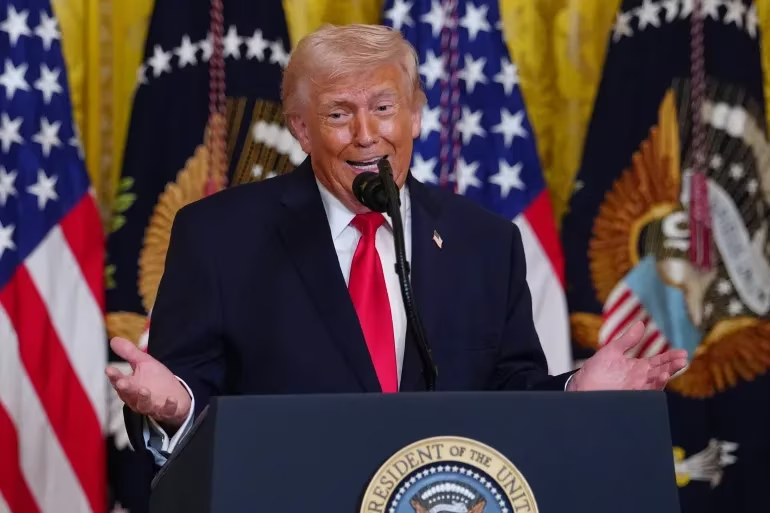
US President Donald Trump on Tuesday called on a number of allied countries to head to the Strait of Hormuz and “simply take it,” in a statement that raised widespread questions about its realism and strategic implications. This call came in the context of Trump's criticism of countries that did not participate in the coordinated strikes against Iran, considering that they are now bearing the consequences of their inability to secure energy supplies, especially jet fuel.
In a post on the “Truth Social” platform, Trump suggested to those countries – such as the United Kingdom, which he said refused to participate in the war – two options: buy oil from the United States, or move militarily towards the strait to ensure the flow of supplies themselves. He went further when he called on these countries to “learn to fight in self-defense,” indicating that Washington might not be prepared in the future to provide support as before. He also considered that “Iran has been crushed,” a description that reflects a simplistic view of a highly complex conflict.
The Strait of Hormuz is one of the most important maritime passages in the world, as about one-fifth of the world's daily oil supplies pass through it. Iran controls a long coast on the northern side of the strait, while the Sultanate of Oman oversees the southern side, which makes any attempt to control it militarily fraught with enormous geopolitical and military risks. Historically, the strait has been a constant point of tension, especially during the “Tanker War” in the 1980s, as well as in repeated crises between Tehran and Washington.
The difficulty of controlling the strait stems from its narrow geographical nature, as its width in some areas does not exceed 33 kilometers, with specific navigation lanes not exceeding a few kilometers in each direction. This reality gives Iran a tactical advantage through the use of fast boats, naval mines, and coastal missiles, which are tools capable of disrupting navigation without the need for a large-scale conventional confrontation. Any military escalation in this region will likely lead to global disruption in energy markets and a sharp rise in prices, which will directly affect the international economy.
Trump's statements reflect a shift in American discourse from leading international alliances to adopting a more individualistic approach based on burden-sharing or even abandonment. This shift is not limited to the military dimension, but extends to redefining the role of the United States as a guarantor of global security. In this context, the call to “take” the Strait of Hormuz appears to be an attempt to redistribute responsibilities by force, but at the same time, it reveals a decline in the traditional American commitment to protecting international trade routes.
From a military perspective, the Strait of Hormuz is a classic example of “choke point warfare,” where asymmetric strategies outweigh conventional power. Even major naval powers will find it difficult to fully secure navigation in the face of low-cost, high-impact threats. This means that any attempt to “control” the strait will not be a decisive and quick operation, but will turn into a long-term attrition, raising the chances of sliding into a wider regional confrontation involving multiple parties.
Politically, the discourse carries implications beyond the current moment, as it reflects a trend towards legitimizing the use of force outside international legal frameworks. The call to control an international waterway without clear legal cover represents a dangerous precedent, which may open the door for other powers to adopt similar behavior in different regions of the world. Instead of promoting stability, this could undermine what remains of a rules-based international order, and replace it with the logic of influence and the ability to impose.
Trump's statements reveal a deep gap between political rhetoric and geostrategic reality. The Strait of Hormuz is not just a passage that can be “simply taken,” but a complex node where geography intertwines with international interests, and any attempt to deal with it with the logic of direct force may open doors that are difficult to close.
Share your opinion
Trump calls on affected countries to control the Strait of Hormuz by force