







Washington – Said Arikat – 3/30/2026
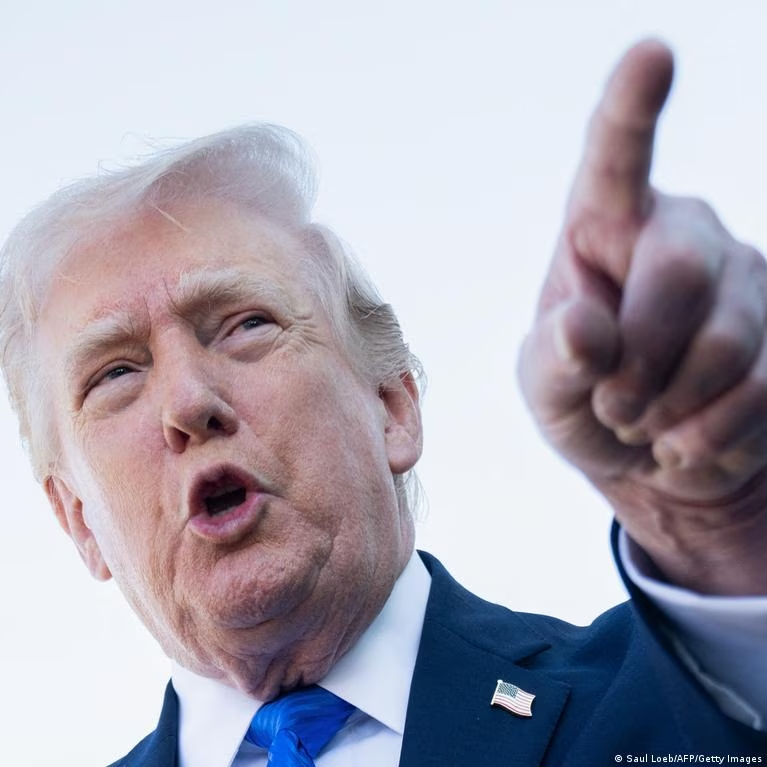
The escalation between US President Donald Trump and Iran is witnessing an unprecedented turn, with the language of threat coming from President Trump shifting from traditional deterrence to hinting at the comprehensive destruction of vital infrastructure. In a Monday morning post on the "Truth Social" platform, Trump vowed to "wipe out" power plants, oil wells, and Iran's Kharg Island if the Strait of Hormuz is not immediately reopened. This threat comes in the context of an ongoing war and stalled peace negotiations, raising international concern about the situation sliding towards a broader confrontation.
Trump wrote in his post: "Significant progress has been made, but if an agreement is not reached soon for any reason, which is likely to happen, and if the Strait of Hormuz is not 'opened' immediately, we will end our beautiful 'stay' in Iran by blowing up all power plants, oil wells, and Kharg Island, and completely wiping them out."
This escalation cannot be separated from the broader context of US-Iranian relations, which have been characterized for decades by chronic tension and oscillation between indirect confrontation and cautious de-escalation. However, the current tone reflects a higher degree of political urgency, and perhaps an attempt to impose new realities on the ground before any potential settlement. Furthermore, the use of social media platforms as a channel for issuing threats of this magnitude adds an unconventional character to crisis management, where messages directed at domestic public opinion are mixed with strategic messages for abroad, in a scene that reflects a shift in the tools of contemporary political discourse.
The danger of these developments lies in the strategic importance of the Strait of Hormuz, through which about 20% of the world's oil passes. Iran's closure of the strait to most shipping traffic has led to severe disruptions in energy markets and a significant rise in prices. This reality puts the global economy to a harsh test, as geopolitical interests intersect with energy security at a very sensitive moment, especially given the reliance of major countries in Asia and Europe on a stable flow of Gulf oil, making any long-term disruption a threat to international economic stability.
The ultimatum issued by Trump reflects a gradual escalation; it was preceded by a 48-hour threat to target power stations, starting with the “largest first.” Reports also indicate that Washington is considering the option of a ground intervention to seize Kharg Island, the main center for Iranian oil exports, as leverage to force Tehran to make concessions. In response, Iran was quick to retaliate, threatening to target US and allied energy and desalination facilities in the region, signaling an escalating scenario open to dangerous possibilities.
In their coverage of this crisis, international media outlets such as CBS News, Newsweek, and others are following the details of this escalating tension, with a focus on its economic and military implications.
This escalation reflects a shift in American doctrine from a policy of containment to a policy of direct coercion, where the goal is no longer merely to deter Iran, but to impose conditions by force. However, this approach carries serious strategic risks, as it may push Tehran to adopt more radical options, including expanding the scope of the conflict regionally. Furthermore, targeting civilian infrastructure may provoke sharp international criticism and place Washington in a legal and moral confrontation with the international community.
Closing the Strait of Hormuz represents an ultimate bargaining chip for Iran, but it is also a double-edged sword. While it gives Tehran negotiating leverage, it threatens to isolate it economically and justifies international military responses. In this context, the crisis appears closer to a game of brinkmanship, where each side seeks to extract concessions without sliding into an all-out war, but the margin of error in such strategies remains very narrow.
The threat of a ground invasion of Kharg Island opens the door to more complex scenarios, as any such intervention could turn into a long-term confrontation, especially given the nature of Iranian geography and the complexities of the regional environment. Furthermore, such a move could prompt other international powers to intervene, either directly or indirectly, threatening to transform the crisis into a multilateral international conflict whose repercussions extend beyond the Middle East.
Share your opinion
Trump Threatens Iran Again with Destruction of All Energy Centers and Oil Wells