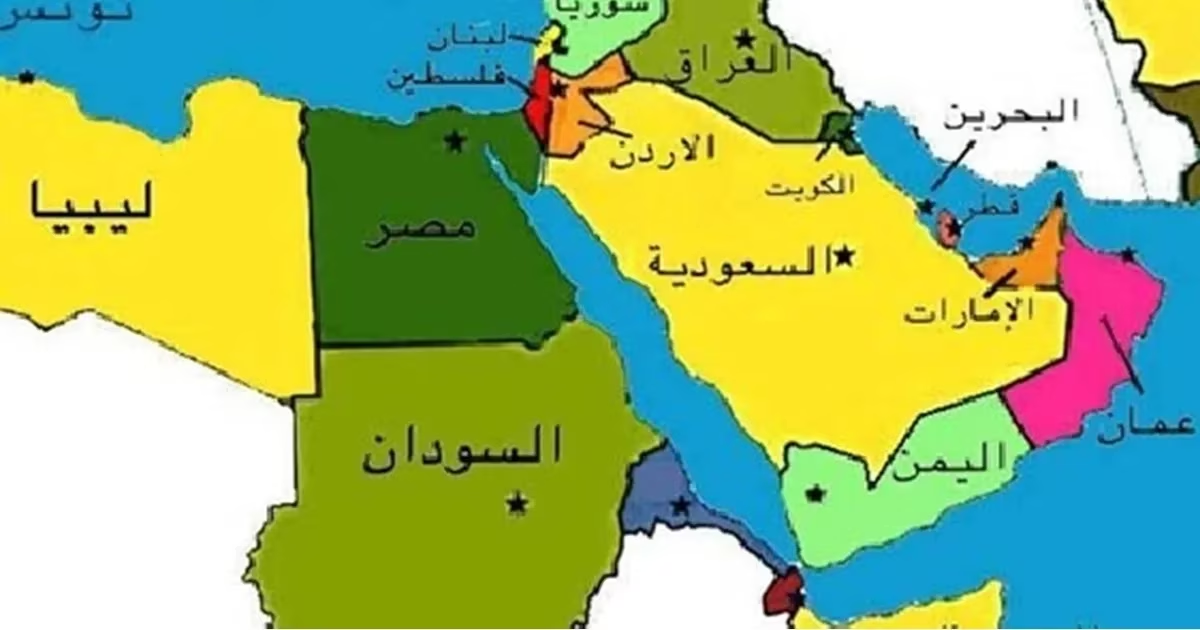







International and regional attempts to reshape the Middle East region according to the interests of external powers continue, while there is a striking absence of the indigenous people in shaping their own destiny. The projects that are put forward from time to time, whether European, American, or Israeli, aim essentially to re-engineer influence and suppress independent Arab will.
Throughout the last century, the Arab region experienced diverse renaissance movements, beginning with the nationalist current that called for unity, then socialist propositions, leading to Islamic awakening movements. However, these paths ended in faltering outcomes, leaving the Arab arena in a state of shocking intellectual and political vacuum that threatens the existence of states and the future of their peoples.
The state of paralysis suffered by joint Arab institutions, foremost among them the League of Arab States and the Arab Maghreb Union, reflects the depth of the current predicament. This institutional vacuum is what tempts regional and international powers to dominate, and pushes some of them to revive expansionist dreams such as the 'Greater Israel' project or to strengthen Iranian and international hegemony.
The current historical moment is considered the most dangerous for the region since the end of World War II, as a deep internal predicament converges with a real external threat. Arab elites, whether in power or opposition, bear the greatest responsibility for this comprehensive decline that has made the region an arena for settling scores between major powers.
Today, there is an urgent need to revive a new Arab project characterized by wisdom and realism, and responsive to the aspirations of rising generations who are looking for a clear compass. This required revival demands political imagination that rebels against the state of frustration and defeat, and formulates a vision that inspires peoples and motivates them towards common construction, away from ideological polarization.
Arab elites must transcend traditional conflicts and engage in a comprehensive de-escalation strategy aimed at creating an environment for building a 'national community' based on citizenship and pluralism. This move is not an intellectual luxury, but a national duty imposed by the existential threats lurking over Arab states in their entity and stability.
The absence of a guiding idea for Arab societies leaves individuals in a state of bewilderment and loss, which facilitates the dismantling of Arab political cohesion and the collapse of defensive immunity. This vacuum is the most dangerous recipe for handing over future generations to marginal cultures that lose their connection to their fateful issues and civilizational identity.
Despite the gloom, inspiring models of steadfastness and resistance emerge, as in the Gaza Strip, where the Palestinian people provide a living example of adherence to rights. However, this model still needs a broader Arab context that links the culture of resistance with the culture of construction and comprehensive advancement to ensure the sustainability of its impact.
Many voices demand the necessity of conducting comprehensive critical reviews of the paths of political and social forces that dominated the scene in past decades. Liberating oneself from the illusions of the past and rehashing its events is the first step towards formulating a renaissance project capable of emulating the complex reality and its accelerating challenges.
It is no longer acceptable for Arab elites to remain dependent on old visions formed under different temporal circumstances and no longer capable of providing solutions to today's crises. The acceleration of international transformations requires renewed minds that understand the intertwining elements of power in the modern world and are skilled in maneuvering to protect supreme Arab interests.
Squandering the region's resources and history for the benefit of the greedy represents a crime against future generations who deserve to live in a stable and sovereign region. It cannot be accepted that the Arab map remains merely an area for redistributing influence among international powers seeking to consolidate their strategic superiority at the expense of our peoples.
The new international system currently forming, with its multilateral characteristics and balance of power, offers a golden opportunity for Arabs to reposition themselves outside traditional axes. Political intelligence requires investing in these transformations to forge broader horizons that guarantee Arabs a place under the sun in a world that respects only the strong and organized.
Arab regimes and peoples face a decisive moment that requires courage in decision-making and clarity in defining strategic goals for the next stage. Active engagement in shaping the future is the only way out of the cycle of dependency that has lasted for long decades and exhausted the foundations of advancement.
In conclusion, Arabs must realize that they possess all the human and geographical components to be an active part of international negotiations on the future of the global system. The choice today is between being partners in drawing the new map, or remaining merely a meal on the table of negotiating powers that only consider their own interests.
It is not the destiny of this region to be, once again, a century after the first division, a map for the division and redistribution of influence among external powers.
Share your opinion
Towards a Renewed Arab Vision: Elites and the Responsibility of Confronting External Hegemony Projects