







Washington – Said Arikat – 26/3/2026
News Analysis
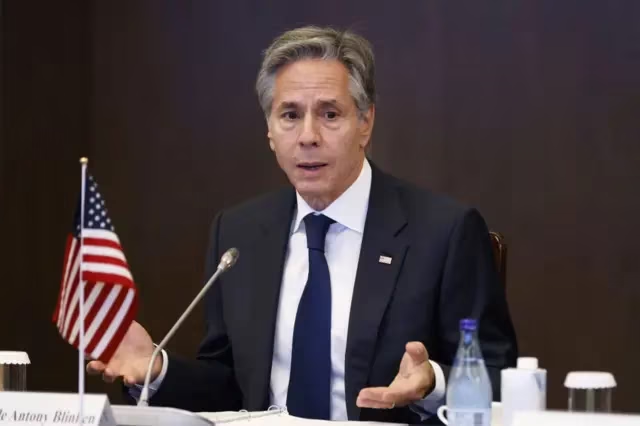
In a scene that reflects the confusion of legacy more than the clarity of review, Antony Blinken returned to the forefront from Harvard University, where he was asked the question that has haunted him for months: What if Washington had acted differently in Gaza?
It is noteworthy that the one who brought this conversation back into the spotlight was not a major media institution, but rather the journalist Jonathan Guyer, who published a summary of the discussion on the "X" platform, reminding that the issue has not been closed, and that the legacy account is still open.
In that conversation at the Harvard Kennedy School, moderated by New York Times journalist David Sanger, Blinken was confronted with a harsh description: Gaza as the "weakest point" in his career. The description was not an exaggeration, but rather reflected a growing realization that American policy there had not only failed to limit the catastrophe, but had contributed to its perpetuation.
Blinken, for his part, did not deny the tragedy. He spoke of "immense human suffering" and "horrific losses," and admitted that the question "could something have been done differently?" would continue to haunt him. But this acknowledgment, despite its human weight, seemed devoid of any political commitment to an actual review. How can an official admit the possibility of error, and then continue to defend the very policies that produced it?
The most intense confrontation came from a student who cited reports from the United States Agency for International Development (USAID) that indicated obstruction of aid delivery, contradicting Blinken's statements before Congress. The question was direct: Why did Washington continue to arm Israel despite all the indicators? And why were expert assessments ignored?
Blinken's answer—"Perhaps yes"—reduced the tragedy to a possibility, not a responsibility.
The former Secretary defended himself by speaking of "daily pressures" to bring in aid. But this defense, in essence, is an indirect indictment: If Washington was able to pressure for more trucks, why was it unable—or did not try—to pressure for a halt to the bombing? And why did American policy remain confined to managing the consequences of the catastrophe, not preventing it?
The most problematic aspect is his justification that Israel would have continued the war regardless of the American position, and that stopping arms supplies could lead to regional escalation. This argument does not justify the decision, but rather empties it of its content. It presupposes the failure of pressure to justify not exercising it. That is, it transforms American influence from a tool of impact into a pretext for abstention.
Despite his references to Hamas's role, Blinken's speech seemed closer to redistributing blame than to confronting the core question: What did the United States do when it had the power to influence? Rather, what did it choose not to do?
Blinken made eight visits to Israel during the war—a number reflecting unprecedented diplomatic intensity—but in the end, they did not produce a clear American demand for a ceasefire at critical moments. These were visits to manage the crisis, not to end it. Presence without pressure, and action without decisive results.
Here the contradiction intensifies: diplomacy active in form, limited in effect. Repeated moral acknowledgment, met with striking political steadfastness. The result is that Blinken is not being held accountable today for what he did not know, but for what he knew and did not change.
In the end, the problem is not that the former Secretary of State did not see the tragedy in Gaza, but that he saw it—and acknowledged it—and then chose to continue on the same path. This, more than anything else, is what will define his legacy.
The text clearly shows the gap between moral acknowledgment and political action, a gap that is not new in American behavior, but in the case of Gaza, it appeared sharper and more exposed. The acknowledgment of a tragedy only acquires its meaning if it is accompanied by a tangible change in tools and policies. What is striking here is that Blinken did not lack information or warnings, but rather the political will to employ American influence differently. This reinforces the impression that Washington preferred to manage the crisis instead of solving it, to avoid the cost of confrontation with a strategic ally.
The article raises a deeper question related to the nature of decision-making in American foreign policy, where strategic considerations are often prioritized over stated principles. The argument of fearing regional escalation appears, in this context, closer to a post-hoc justification than to an accurate proactive assessment. The failure to actually test pressure tools undermines the credibility of this assessment. Moreover, ignoring reports from government institutions such as USAID reflects a defect in the mechanism of information absorption within the administration, and raises questions about the independence of humanitarian assessments versus political calculations.
Also noteworthy is the dimension related to "legacy management," where the discussion shifts from accountability for policies to an attempt to frame them narratively after they have occurred. Blinken's return to answer these questions in an academic setting reflects a belated recognition of the importance of elite public opinion in shaping historical judgment. However, limiting oneself to acknowledgment without practical review may deepen criticism instead of containing it. Political history is not written only by what was said later, but by what was done—or not done—at decisive moments, which leaves this file open to more rigorous future evaluations.
Share your opinion
Blinken and Gaza: A Belated Acknowledgment… and an Unchanged Policy