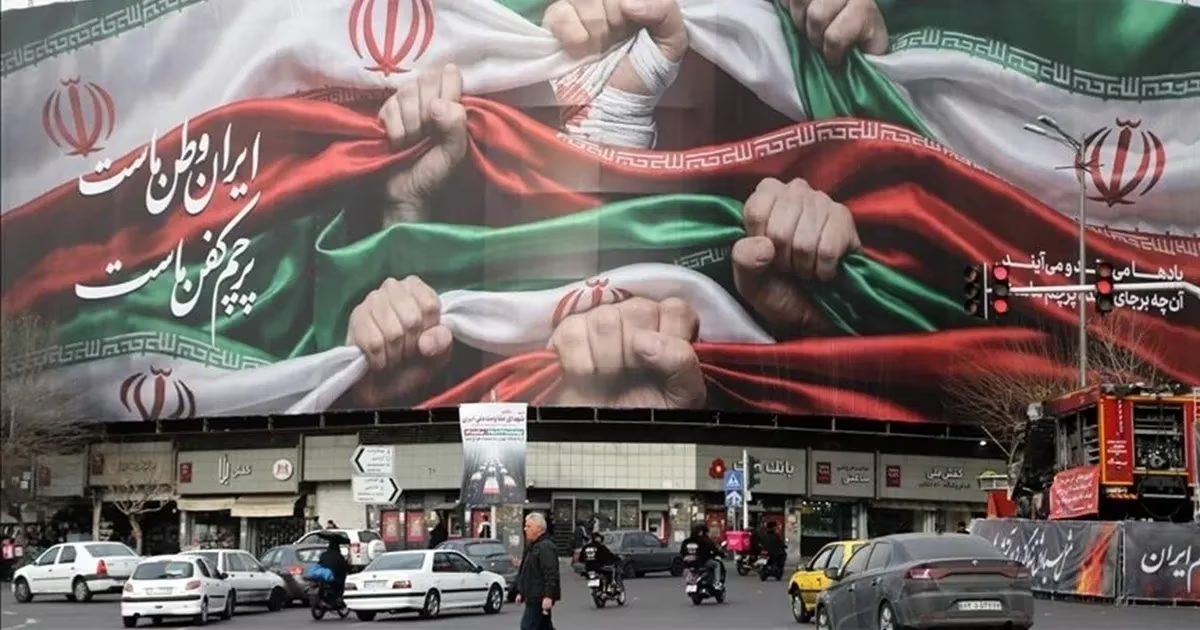







Questions are escalating in Israeli political and security circles regarding the final outcomes of the direct military confrontation with Iran, which began on February 28th. These readings coincide with leaks indicating active negotiation channels between Washington and Tehran aimed at reaching a formula that ensures a ceasefire.
Hebrew press reports warned against the security establishment falling into the trap of underestimating Iranian will, noting that Tehran has proven its ability to withstand and achieve qualitative accomplishments during recent rounds of escalation. It appears that initial assessments aimed at regime change have begun to recede in favor of more realistic goals.
Current data indicates that Israel and the United States have effectively begun to lower their expectations regarding the results of this military campaign. After comprehensive military decisive action was discussed, the focus is now on how to exit the confrontation with the least strategic losses.
Analysts believe that the most likely scenario is a quick political deal, marketed by all concerned parties as a historic achievement. This outcome will allow Americans, Israelis, and Iranians alike to claim that they have achieved their main objectives from this round.
This vision is based on the principle of sharing gains and losses, as everyone realizes that no party can achieve an overwhelming victory that definitively ends the conflict. Parties usually reach this conviction when the cost of continuing military operations exceeds the desired benefits of continuing them.
In this context, questions arise about who will be able to extract the best terms in the final moments before signing. The real battle now is no longer about breaking bones, but about improving negotiating positions to ensure a better strategic situation in the post-war phase.
A state of concern prevails within the Israeli defense establishment that ending the campaign at the present time may be premature. Security leaders believe that the army needs more time to inflict substantial damage on Iran's military infrastructure to ensure it does not recover quickly.
The biggest fear is that stopping military operations before achieving their full objectives will give Tehran a golden opportunity to rehabilitate its capabilities. The Iranian side is expected to have a greater incentive than ever before to proceed with the nuclear bomb project to provide future immunity for its regime.
Reports emphasize the necessity for Washington and Tel Aviv to insist on addressing the enriched uranium file, as Iran currently possesses about 440 kilograms at an enrichment level of up to 60%. This quantity, distributed across several secret sites, is considered a red line that cannot be overlooked in any future agreement.
Despite the decline in rhetoric about overthrowing the Iranian regime as an immediate goal, security sources confirm that this option has not been completely dropped from strategic calculations. However, the prevailing term currently in decision-making circles indicates that this path may take many years and will not be a direct result of the current campaign.
Informed sources believe that international and economic pressures will play a decisive role in shaping the final agreement. Iran seeks to lift sanctions and alleviate isolation, while Israel seeks to ensure the removal of the missile and nuclear threat from its borders for a long period.
It appears that the US administration is pushing for a diplomatic solution that prevents the region from sliding into a comprehensive regional war whose outcomes cannot be predicted. This American approach forces decision-makers in Tel Aviv to balance their military ambitions with the requirements of the strategic alliance with Washington.
Any upcoming deal will be a temporary truce to reposition forces in the Middle East, not an end to the existential conflict between the two parties. Recent history proves that direct confrontations often end with fragile understandings that are broken by successive field developments and regional expansion ambitions.
Ultimately, the field remains the judge in determining the ceiling of demands, as Israel tries to intensify its strikes in the final hours to impose a new reality. While everyone awaits the announcement of the deal's details, eyes remain fixed on Iran's nuclear facilities, which constitute the core of the conflict and the driver of escalation.
The most likely end to this confrontation is a quick deal, which everyone will present as a victory, as there will be no decisive victory for any of the parties.



Share your opinion
Scenarios for the End of the Confrontation with Iran: A Reading of Israeli and American Calculations