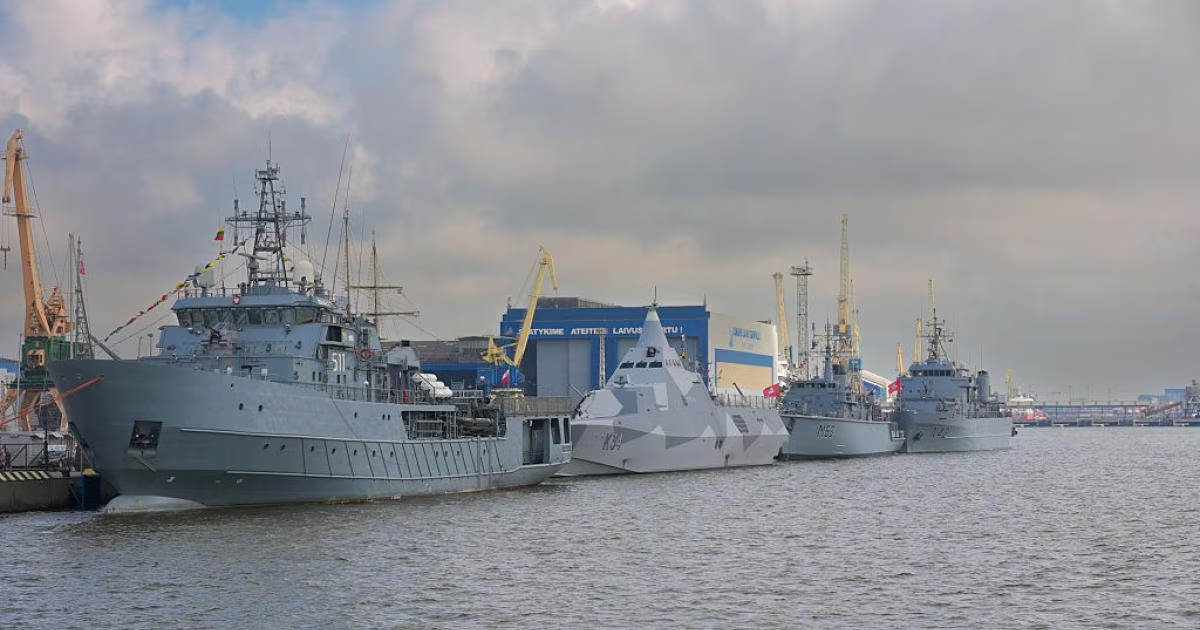







Naval mine-sweepers have returned to the forefront of global military attention, coinciding with escalating tensions in strategic waterways. These vessels are considered the first and primary line of defense for securing international navigation from the invisible threats posed by naval mines, which could paralyze global trade in moments.
In this context, Iranian threats have emerged as a catalyst for this attention, as the Iranian Defense Council warned that any aggression against the country's islands would be met with the planting of mines in waterways, sea lanes, and coasts. Tehran affirmed that coordination with it is the only way to ensure the passage of ships belonging to non-hostile countries through the vital Strait of Hormuz.
Military estimates indicate that Iran possesses a massive stockpile of naval mines, totaling approximately 6,000 mines, posing significant challenges to international powers. This large stockpile makes naval clearance operations a complex task requiring advanced technologies and a long time to ensure the safety of passing ships.
Mine-sweepers are known as specialized naval units that detect underwater explosive objects using advanced sonar systems. These vessels accurately locate mines and classify their types before beginning the process of dealing with them, either by in-situ detonation or deactivation using robotic technology.
The missions of these ships vary among three main types. The first is 'sweepers,' which drag mechanical or magnetic equipment to trigger and detonate mines. The second type is 'hunters,' which rely on precise searching and individual dismantling of each mine, leading to modern systems that use naval drones.
In terms of power balances, Russia tops the list of countries with the largest number of these ships, with a fleet ranging between 45 and 47 mine-sweepers. China comes in second with approximately 36 ships, reflecting the Eastern powers' interest in securing their coasts and vital areas from naval blockade.
In the Western camp, Poland has a strong fleet of 29 ships, followed by France with 19 ships, while Finland and Japan each have 18 ships. Although the United States and the United Kingdom do not top the list in terms of numbers, they possess the most advanced technology in this field.
The North Atlantic Treaty Organization (NATO) enhances its collective capabilities by possessing more than 100 ships dedicated to mine clearance and sea security missions. Western powers are increasingly relying on integrating unmanned systems and specialized helicopters to reduce human risks during complex clearance operations.
In conclusion, experts agree that naval mine clearance operations remain among the slowest and most sensitive military tasks in complex environments. These vessels stand out as an indispensable strategic tool for protecting maritime infrastructure and ensuring the continuous flow of energy and trade in times of peace and war alike.
The only way for non-hostile countries to pass through the Strait of Hormuz is prior coordination with Tehran.




Share your opinion
Underwater Arms Race: Who Controls Naval Mine-Sweeping Fleets?