







Washington - Said Arikat - 21/3/2026
News Analysis
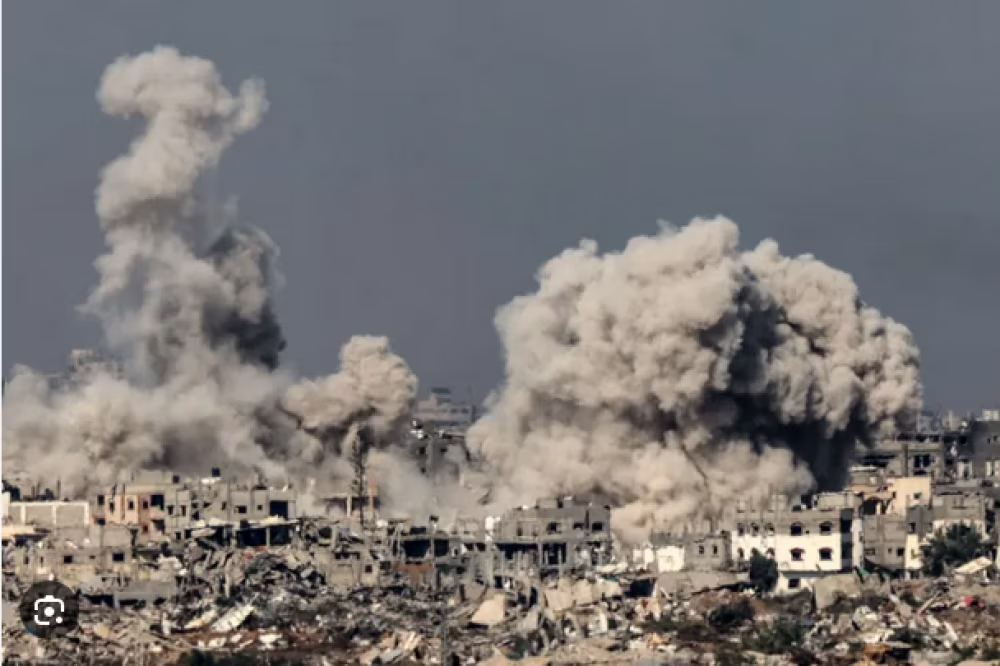
Amidst rapid regional transformations, the Gaza Strip appears to be gradually receding from the forefront of international attention, despite the ongoing and unprecedented humanitarian tragedy its residents are enduring. In this context, a new proposal has emerged, presented by the so-called "Peace Council" in cooperation with regional mediators to Hamas, which stipulates setting a timeline for its gradual disarmament. However, this proposal, which has received Israeli approval, raises profound questions about the priorities of international actors, especially the United States, for whom it has become clear that Gaza is no longer among its political priorities, but rather a deferred issue amidst broader strategic concerns.
The proposed framework suggests a process extending over six months, beginning with the dismantling of heavy weapons such as rockets, launchers, and tunnels, before moving on to light weapons, with the deployment of a new Palestinian police force in areas that are "cleared" of weapons. The proposal also includes security guarantees for Hamas members who agree to surrender their weapons, with the exception of those suspected of involvement in previous attacks. This approach seems to aim at creating a new security reality in the Strip, paving the way for reconstruction and the return of some form of stability, albeit gradually and conditionally.
However, a critical reading of this proposal reveals a clear imbalance in the balance of priorities. While the focus is on disarmament as a prerequisite for reconstruction, the catastrophic humanitarian conditions experienced by Gaza's residents, who face severe shortages of food, water, and healthcare, are being ignored. Furthermore, linking reconstruction to complete disarmament holds civilians hostage to a complex political process that may take a long time, without real guarantees of success, or clear mechanisms to protect civilians during this transitional phase.
This approach reflects a narrow security understanding of the crisis in Gaza, where the problem is reduced to the presence of weapons, ignoring the political and humanitarian roots of the conflict. Focusing on disarming Hamas without providing a clear political horizon for Palestinians reproduces the same conditions that led to the current explosion. Moreover, the absence of real pressure from mediating countries, especially Qatar and Turkey, weakens the chances of the initiative's success, making it closer to an attempt to manage the crisis rather than resolve it, which perpetuates the stalemate instead of overcoming it.
In the same context, a legal and administrative problem arises regarding the mechanism for implementing this proposal, especially concerning the introduction of a new Palestinian police force without clarity on its legal authority or its relationship with the Palestinian Authority. The proposal largely ignores the existing legal structure in Gaza, raising questions about the legitimacy of these arrangements and their ability to endure in a complex and divided political environment. Furthermore, any new security force may face challenges in popular acceptance and field effectiveness.
On the other hand, the absence of actual funding for reconstruction plans reveals a significant gap between political rhetoric and practical reality. Despite American statements about mobilizing billions of dollars, financial resources remain unavailable, reflecting international reluctance to invest in Gaza before strict security conditions are met. This approach not only prolongs suffering but also reinforces the local population's loss of confidence in the utility of any political process, and fuels feelings of frustration and uncertainty.
These developments come at a time when major powers, especially the United States, are preoccupied with other regional issues, such as tensions with Iran, which explains the decline in interest in Gaza. The US administration appears to prefer managing the crisis through mediators, rather than direct involvement, which is reflected in the weak political and financial pressure to push the parties towards a comprehensive solution. Furthermore, Washington's strategic priorities have shifted towards more pressing issues from its global security perspective.
The decline in Gaza's priority in American policy is not merely a tactical matter, but reflects a broader strategic shift in global priorities. Amidst competition with major powers and Washington's focus on international security issues, chronic humanitarian crises become less prominent in decision-making circles. This shift leaves a political vacuum that regional powers may fill in ways that do not necessarily serve the stability of the region or the interests of the local population, threatening to prolong the crisis instead of containing it.
In light of the above, it can be said that the disarmament proposal, despite its promises of reconstruction and stability, lacks a comprehensive vision that addresses the roots of the crisis in Gaza. Moreover, ignoring the humanitarian dimension and linking aid to strict security conditions reflects an imbalance in the international community's approach, and confirms that the Strip is no longer at the forefront of global concerns. While negotiations continue in Cairo, the most important question remains: Can sustainable peace be achieved without a real address to the suffering of the population, or will these initiatives remain mere temporary attempts to manage a constantly escalating crisis, in the absence of a real political will for change?

Share your opinion
Between Disarmament and Reconstruction: Gaza Outside International Policy Priorities