







On the eve of the third Eid al-Fitr that passes over the Gaza Strip amidst the ongoing war, Yazan Abu Shanab finds himself sitting on a rough mat on a cold pavement next to a temporary dwelling his family made from old wood and worn fabrics in the Al-Mawasi area of Khan Yunis. This place, lacking the most basic necessities of life, does not resemble real tents; rather, it is more like a small shack trying to shelter family members who have lost everything.
On that pavement, Yazan and his sister play with an empty plastic box they found among the debris, turning it over in their hands as if it were a precious treasure, in the absence of the real toys and bicycles they were accustomed to in previous Eids. The child watches passersby in the narrow streets crowded with displaced people, while repeatedly opening and closing his plastic box in a scene that encapsulates the loss of Eid rituals and their transformation into mere distant memories.
With a broken tone, Yazan says that he used to look forward to Eid to buy new toys, but this year his family bought nothing due to his father losing his livelihood as a result of the ongoing war of extermination. The money that is barely available is only enough to secure essential sustenance, making buying clothes or toys a distant dream amidst the comprehensive economic collapse.
This bitter reality is not limited to Yazan alone but extends to thousands of children who have replaced the passion for choosing toys from markets with searching for primitive alternatives on pavements. As Eid approaches, Gaza appears burdened by years of siege and starvation, where manifestations of joy have disappeared, replaced by deep sorrow and mental distraction that dominates the faces of young and old alike.
In the sandy alleys of the camps, children are content with simple physical games after balls, bead guns, and dolls have disappeared from their reality. No one talks about 'Eidiya' (Eid money) anymore, which used to represent the peak of their happiness, as the top priority for displaced families has become securing a sip of water or a loaf of bread to sustain the little ones.
Local sources reported that the idea of buying new clothes is now classified as an 'impossible luxury' for many families living below the extreme poverty line. Bilal Badriya, a displaced family head, explains that the insane rise in prices has made buying the simplest vegetables a heavy burden, asking bitterly how to provide for Eid necessities amidst this exorbitant cost.
Away from Yazan's tent, Lina Al-Dahdouh stands in a long queue in front of a water distribution point, holding a small bucket instead of the Eid dress she dreamed of. Lina watches her father patiently filling plastic containers, realizing that her daily tasks in displacement have stolen her childhood and the sparkle of the days leading up to Eid.
Lina remembers how she used to accompany her mother to crowded markets to choose her new clothes, but today her main concern is filling jars from distant points and carrying them to the tent. The war has imposed a reality where securing basic needs is a daily battle that takes precedence over any desire to celebrate or rejoice.
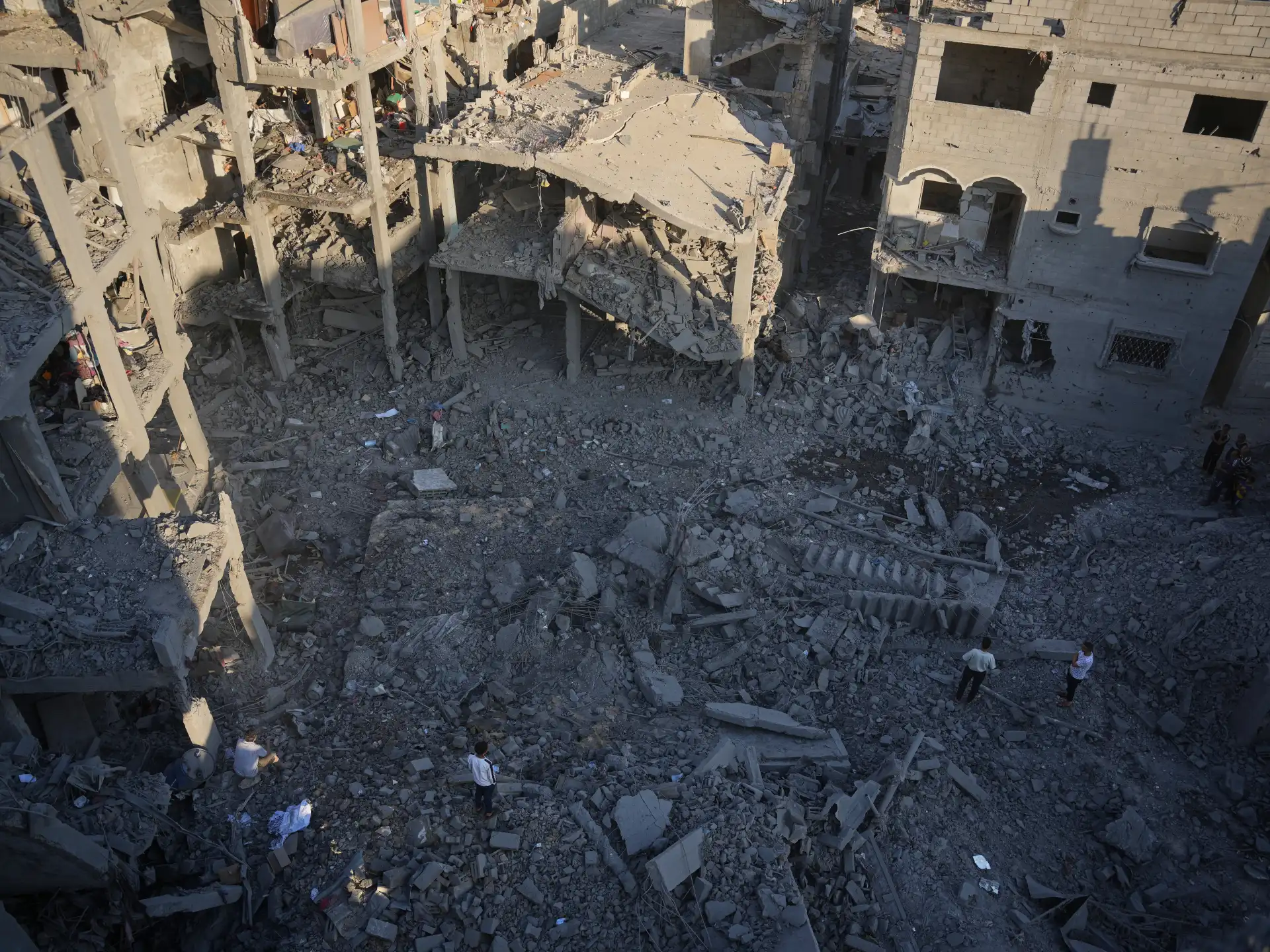
As for Adam Al-Salmi, he wanders among the tents with features covered in despair, asserting that 'Eid no longer exists' after the swings and playgrounds he used to frequent were destroyed. Adam bitterly points to Al-Yarmouk stadium and recreational areas that have turned into rubble, explaining that the absence of safe play areas has confined children to tents and destroyed areas.
In the few markets that are still operating, activity appears dull and lacks the usual Eid decorations, with sales focused only on essential food items. Traders confirmed to our sources that most citizens merely inquire about prices and then leave sadly, as purchasing power has completely vanished for the vast majority of the Strip's residents.
Even simple household traditions like preparing Eid cakes have disappeared from most homes and tents, due to the sharp rise in the prices of flour, sugar, and oil. The scent that used to characterize Gaza's alleys before Eid is absent this year, leaving room for the smells of firewood and destruction, which deepened children's sense of loss and deprivation.
For his part, Amjad Al-Shawa, director of the NGO Network, affirmed that this Eid is the most difficult ever, as children face unprecedented harsh humanitarian conditions. He pointed out that the widespread destruction of infrastructure and the economy has made families completely unable to bring smiles to their children's faces on this religious occasion.
Al-Shawa stressed that the suffering is not only material but also a loss of a healthy social environment, as schools have turned into overcrowded shelters and public parks have disappeared. This transformation has made Eid an additional reminder of the human and material losses suffered by Palestinians during the long months of war.
Children in Gaza remain stuck this Eid between beautiful memories of past Eids and a painful reality imposed by the siege and aggression, awaiting a time when their lives return to normal. Under these circumstances, the joy of Eid remains postponed in the Gaza Strip, awaiting a new dawn that ends the tragedy of displacement and restores children's right to play and safety.
This year's Eid will not be like previous ones; children in Gaza are learning early how to replace their toys with small things they find by chance on the pavements of displacement.
Share your opinion
Gaza's Children on Eid.. Stolen Childhood and Toys from the Rubble of Displacement