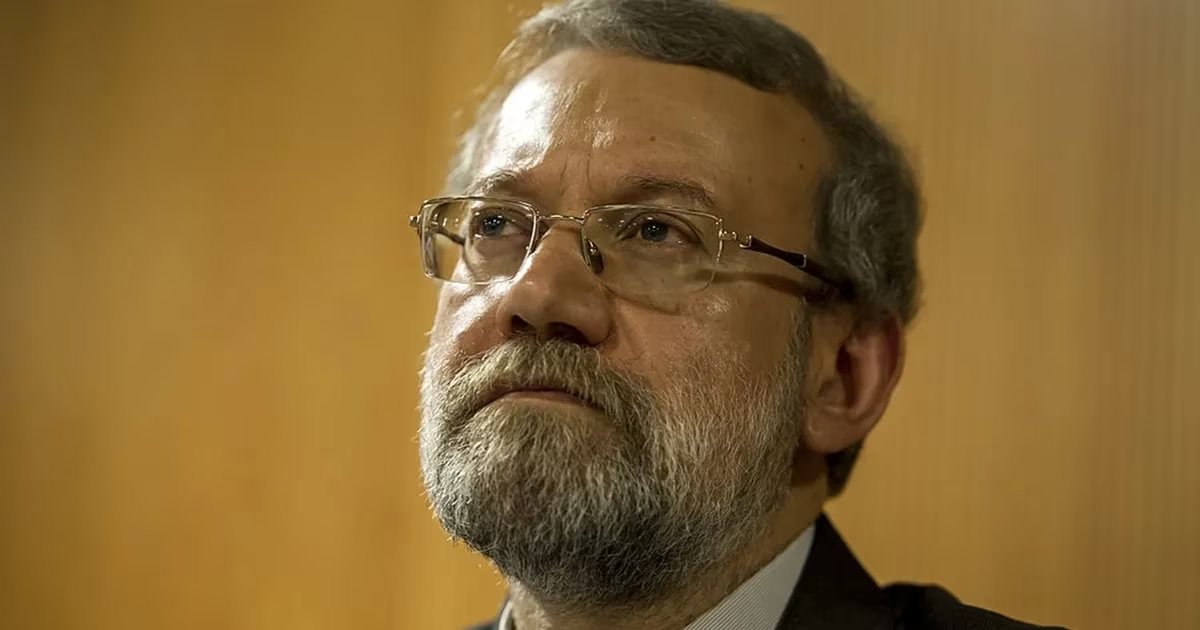







Israeli circles believe that the assassinations of political and security elites in Tehran aim to deepen divisions within the supreme leadership. However, there is concern that these strikes could backfire by strengthening the grip of the Iranian Revolutionary Guard Corps (IRGC) on state institutions, especially with its consolidating ties with the new Supreme Leader, Mojtaba Khamenei.
Raz Zimmt, director of the Iran program at the Institute for National Security Studies at Tel Aviv University, considered the assassination of Ali Larijani, Secretary of the Supreme National Security Council, and Basij commander Gholamreza Soleimani, as an escalation in the strategy aimed at destabilizing the regime. He pointed out that Larijani was not just an ordinary official, but a fundamental pillar in the governing structure for many years.
Larijani has a rich political history, having headed the Shura Council for eight years, handled the sensitive nuclear negotiations file, and led the Islamic Republic of Iran Broadcasting (IRIB). He is classified within the conservative current that recognized the necessity of adapting revolutionary thought to international changes and contemporary reality, making him a pivotal figure in internal balances.
During his presidency of parliament, Larijani supported the policies of former President Hassan Rouhani, which brought him widespread criticism from radical currents. Despite being excluded from running for presidential elections in two consecutive terms, his political role did not diminish; rather, he continued as one of the close associates of the high decision-making circles.
In late 2024, Larijani's role emerged as a high-level diplomat and special envoy for Supreme Leader Ali Khamenei to Syria and Lebanon before the fall of the Assad regime. He also led an official delegation to Moscow for talks with Russian President Vladimir Putin, reflecting the great trust he enjoyed in managing complex foreign affairs.
Following the June 2025 confrontations, known as the 12-day war, the Supreme Leader reappointed Larijani to the top of the government hierarchy to benefit from his long experience. This step came within the framework of the Iranian leadership's desire to involve seasoned politicians to confront the increasing security challenges and successive Israeli strikes that targeted the first line of leadership.
Sources reported that Larijani was one of the most prominent planners of the Iranian responses during the recent confrontations with Israel. He had expressed in previous statements his commitment to the strategic concepts that Tehran had drawn from that war, emphasizing the need to develop defensive capabilities to confront any future rounds of conflict.
Larijani focused his military vision on addressing the gaps that appeared in Iran's air defense systems during previous attacks. He believed that Iran's possession of strong missile capabilities forced adversaries to accept a ceasefire, calling for strengthening strong points and objectively correcting technical and field failures.
Analysts indicate that Larijani's departure will leave a significant void in the regime's ability to maintain administrative continuity and effective control. The danger of this absence is compounded by its timing, coming after the transfer of power to Mojtaba Khamenei, which could disrupt the command and control system at a critical moment in the Republic's history.
Larijani represented a realistic voice within the Iranian leadership despite his commitment to the principles of the Islamic Revolution. With his absence, observers fear the control of more extremist elements over the decision-making process, which could push Tehran towards adopting more radical policies regarding the nuclear program and regional ambitions.
Security assessments predict that the assassination of the most important political official in Tehran will strengthen the IRGC's influence unprecedentedly. The IRGC, which has close ties with the new Supreme Leader, may find the way paved to impose its hardline vision on the state's military and political doctrine in the coming phase.
The Israeli army described Larijani as the 'de facto guide of the terror regime,' referring to his weight in managing strategic operations. This operation is part of the 'decapitation' strategy adopted by Tel Aviv to disrupt the Iranian system and weaken its ability to coordinate with its allies in the region.
Reports confirm that the strike that targeted Larijani and Soleimani in the heart of Tehran was extremely precise and coincided with heavy shelling. These operations aim to send a clear message that the depth of the Iranian regime is no longer immune, and that the command and control structure is under continuous Israeli intelligence scrutiny.
In light of these developments, the question remains about Iran's ability to replace these leading cadres in a short time. While Tehran possesses pressure tools such as ballistic missiles and control over waterways, the loss of 'masterminds' like Larijani could change the course of the entire regional confrontation.
Larijani's assassination represents another stage in the ongoing efforts to undermine the regime's stability, but it may strengthen the IRGC's position in the absence of realistic figures.



Share your opinion
A Reading on the Repercussions of Larijani's Assassination: Will Israel Succeed in Undermining the Stability of the Iranian Regime?