







Washington – Said Arikat - 3/13/2026
News Analysis
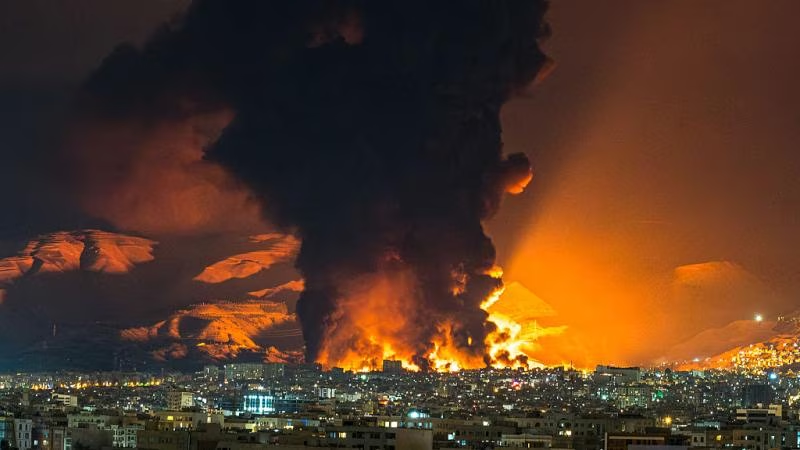
US President Donald Trump attempted to present the rise in oil prices, which followed the outbreak of the US-Israeli war against Iran, as a positive development for the American economy. In a comment he posted on Thursday on the Truth Social platform, he said that the United States “makes a lot of money” when oil prices rise, based on the fact that the United States has become the world's largest oil producer. However, this statement comes at a time when Americans are already paying significantly more to fill their car tanks, raising serious questions about the contradiction between the White House's rhetoric and the economic reality for citizens.
Trump wrote: "The United States is the largest oil producer in the world, by far; so, when oil prices go up, we make a lot of money." He added that what matters to him “much more as president” is preventing Iran, which he described as an “evil empire,” from possessing nuclear weapons or threatening the Middle East and the world. According to Trump, the ongoing war represents a strategic necessity to ensure global security, even if it comes with direct economic costs to citizens.
But the irony is that the US president himself, in the weeks and months leading up to the war, consistently repeated that low fuel prices were one of his most important economic achievements during his second term. He used the decline in prices as evidence of the success of his economic policies, citing figures in his election speeches and media statements.
Just one day before the war began, Trump was speaking in Corpus Christi, Texas, noting that the price of gasoline there was less than $2.30 per gallon. He said that two weeks earlier he had visited Iowa, where he found the price of gasoline at $1.99 (per gallon), and even $1.85 at another station. He added then: "It's really happening now," referring to what he considered a clear economic success.
However, the developments of the war quickly changed the equation. According to GasBuddy data, the national average price of gasoline in the United States was $2.94 per gallon on March 1, the first day of the war. Just 11 days later, the price rose to $3.61, an increase of nearly 23 percent, a rapid rise reflecting the fragility of the energy market to geopolitical shocks.
This rise is partly attributed to the escalation in the Gulf region, where Iran effectively closed the "Strait of Hormuz," the maritime passage through which about 20 percent of the world's seaborne oil passed in 2025. Iran's "Revolutionary Guard" forces announced that only ships with Iranian permits are allowed to pass, while oil tankers were subjected to drone targeting attempts while crossing the strait.
In fact, Trump's rhetoric about "benefiting" from rising oil prices reveals a deep contradiction in the economic policy logic of the war. While American energy companies may benefit from high prices, the American consumer bears the direct cost through increased fuel, transportation, and goods prices. Here lies the difference between the macroeconomic picture the administration talks about and the daily economy citizens experience. The profit Washington talks about does not appear in Americans' pockets, but in the budgets of large corporations.
The second contradiction lies in the way the war is politically exploited. Trump built a large part of his domestic rhetoric on low gasoline prices, presenting it as evidence of the success of his economic policies. But the war in which the United States participated alongside Israel turned this equation upside down in a few days. Here the question becomes legitimate: How can one boast about low prices as a political achievement, and then justify their rise as evidence of economic strength?
The third contradiction relates to the strategic logic of the war itself. The closure or threat to the Strait of Hormuz has always been the most anticipated scenario in any confrontation with Iran, something energy and security experts have warned about for years. Nevertheless, the US administration seems to have treated this possibility as a minor detail, even though it affects one of the most important arteries of the global economy. The result is that the decision to go to war not only created a regional crisis but also unleashed a series of economic shocks whose effects extend to every gas station in the United States.
Share your opinion
Trump's War Raises Oil Prices: Profits for Energy Companies, a Harsh Bill for Americans