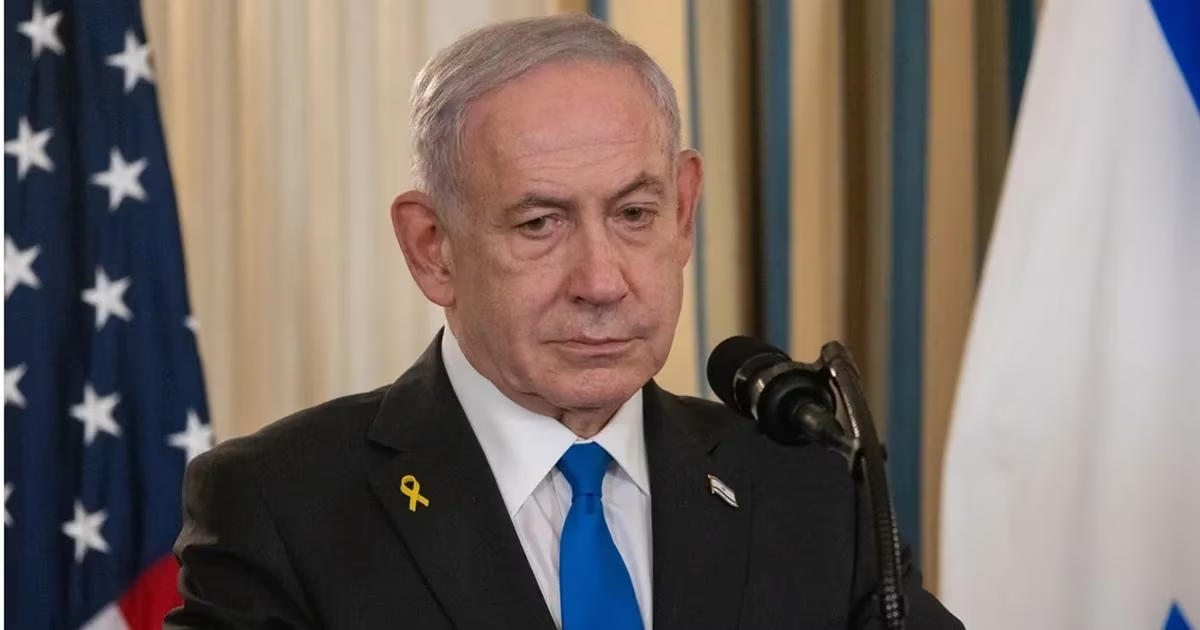







Israeli Prime Minister Benjamin Netanyahu's statements about forming a hexagonal alliance in the Middle East were not mere casual remarks, but rather a carefully prepared speech at the opening of a government session. Netanyahu deliberately formalized this future vision, coinciding with preparations for an upcoming visit by Indian Prime Minister Narendra Modi, reflecting an Israeli desire to expand media coverage of this project.
This proposal brings to mind the 'Periphery Theory' established by Ben-Gurion in the 1950s, which aimed to bypass the Arab confrontation states and build alliances with regional powers and ethnic minorities. Historically, this strategy seeks to weaken the Arab center by engaging it in side conflicts and tensions with neighboring countries such as Turkey, Iran, and Ethiopia, to ensure the depletion of the Arab environment away from confronting the occupation.
Observers believe that Netanyahu is now trying to compensate for the previous failure of this strategy, especially after the fall of the Shah's regime in Iran and the shift in Turkish policy. Despite Israel's success in normalizing relations with several central Arab countries, the need to 'tighten the periphery' has re-emerged as a tool for political pressure and ensuring absolute hegemony amid rapid regional changes.
These moves come at a time when the region lacks what is called the 'radical Sunni axis,' as the powers Netanyahu alludes to, such as Saudi Arabia, Pakistan, and Turkey, adopt moderate positions. Sources confirm that these countries have strategic relations with Washington and support the peaceful settlement process and the two-state solution, which makes Netanyahu's claims about a radical threat an artificial situation for political purposes.
Israeli brutality and the war of annihilation in the Gaza Strip have raised the level of concern among regional regimes, including those that have pursued normalization. These countries are now questioning the feasibility of building relations with a political system that relies on the 'big stick' to impose its hegemony, and seeks to transform the supposed partnership into a relationship between an Israeli 'master' and an Arab 'subordinate.'
American behavior during the Trump era increases the fears of Washington's allies in the region, given his pragmatic mindset that sanctifies power and interest and disregards international laws. This climate of uncertainty has pushed countries like Saudi Arabia and Egypt to try to diversify their arms sources and slow down normalization processes, which has triggered a 'red light' for the Israeli leadership that rejects any margin of Arab independence.
Netanyahu aims, by announcing this axis, which includes India, Greece, Cyprus, and Ethiopia, to present himself to the Israeli public as a strategic leader capable of breaking international isolation. Through this vision, he tries to repair his image, which was damaged after the Al-Aqsa Flood events, demonstrating his ability to form regional alliances that isolate potential external risks and ensure his continued stay in power.
The fabrication of an 'imaginary enemy' reflects Netanyahu's continuous need to ensure internal tension within Israeli society and justify aggressive policies. This behavior also aims to find permanent justifications for rejecting the political path or making any real sacrifices related to the two-state solution, by claiming that Israel faces existential threats on multiple fronts.
Israel's existential anxiety after the Al-Aqsa Flood was manifested in the shift of security theory from 'deterrence by threat' to 'deterrence by total destruction.' The occupation is currently seeking to strike risks at their roots and prevent them from growing, while attempting to reshape the Middle East according to purely Israeli security standards, without regard for the reality of the region or the interests of its peoples.
Statements by US Ambassador Huckaby, in which he considered Egypt and Jordan potential fronts due to the presence of Islamist currents, caused confusion in diplomatic circles. Despite these countries' commitment to the settlement path, the current Israeli mindset has become hostile even to normalized parties, revealing a desire to exert political blackmail that prevents any independent movement from the American-Israeli will.
Netanyahu's behavior contains a self-contradiction that could lead to counterproductive results, as alienating potential partners increases their fears and shows Israel as an untrustworthy party. Instead of breaking isolation, these policies may expand the circle of hostility against the Zionist project, even among regimes that were described as the most moderate and closest to the West.
In conclusion, it appears that the hexagonal axis project faces significant realistic obstacles, given the intersection of the interests of the countries nominated for membership with the Arab and Islamic environment. It is unlikely that countries like India or Greece will fully mortgage their policies to the Israeli will, which makes Netanyahu's words fall within the framework of political exaggerations and personal wishes to strengthen his internal position.
Calls remain for Arab regimes to review the feasibility of settlement and normalization projects in light of this expansionist Israeli mindset. Current developments necessitate a reconsideration of Arab national security priorities, and considering the steadfastness of the Palestinian people and their resistance as the essential and strategic line of defense that protects the region from Zionist hegemonic ambitions.
Netanyahu's attempt to revive 'tightening the periphery' by pitting India against Pakistan, and Ethiopia against Egypt, reflects a desire to fuel regional conflicts. However, the growing awareness of the dangers of this project requires counter-Arab and Islamic coordination that protects common interests and prevents Israel from turning the region into an arena for its security and political experiments.
Netanyahu is trying to adapt the Middle East to Israeli standards, instead of adapting Israel to the realistic environment of the region.




Share your opinion
Netanyahu's Hexagonal Axis: An Attempt to Revive the 'Periphery Strategy' and Encircle the Region