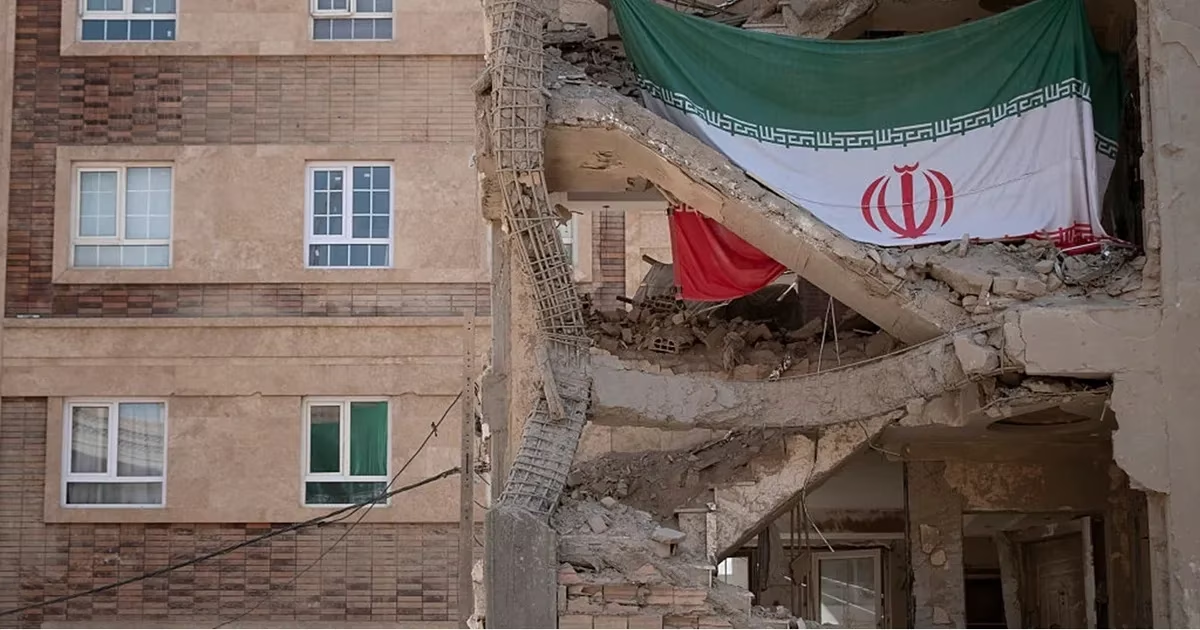







Statements from military officials in the United States are escalating regarding achieving field successes against Iranian capabilities, with reports indicating a significant decrease in missile launches, recently reaching 90%. However, observers believe that this American optimism may not reflect the reality of the long-term conflict that Tehran is managing according to a strategic vision completely different from traditional calculations.
The Iranian leadership recognizes the enormous gap in conventional military power balances, as the US defense budget is approximately $886 billion, which is many times the Iranian budget, which does not exceed $25 billion. Based on these figures, Tehran adopts the principle of 'asymmetric warfare' that does not seek direct military victory, but rather aims to undermine the pillars upon which American influence globally rests.
Iran's strategy involves targeting three fundamental pillars of the international system: energy flows, maritime navigation routes, and the global financial system. By pressuring these sensitive nerves, Tehran seeks to generate immense economic and political pressures that will ultimately force Washington to reconsider its military options and end the state of conflict.
The Strait of Hormuz stands out as the most important strategic card in Iran's hand, as about one-fifth of the world's oil production and one-third of liquefied natural gas trade pass through it. Iranian control here does not necessarily require destroying ships; rather, creating a state of security uncertainty is sufficient to prompt insurance companies to raise their fees or cease coverage, leading to navigation paralysis and a crazy rise in energy prices.
In the technological dimension, Iran relies on low-cost drone aircraft, valued between $20,000 and $50,000 per unit. These drones pose a significant attritional challenge, as defense systems are forced to use interceptor missiles, each costing up to $2 million, making the defense process a financial burden that far exceeds the cost of the attack.
Iranian objectives extend beyond merely striking military bases to include causing disruptions in regional oil production, which immediately reflects on global supply chains from Asia to Europe. This type of economic pressure is described as 'more deadly than missiles,' as it directly affects the stability of global markets and the economic growth of major countries.
Tehran also benefits from what is known in international relations as the 'alliance trap,' where the United States finds itself compelled to defend multiple allies across vast geographical areas. This excessive strategic overextension exhausts American resources and makes forces deployed in regional bases vulnerable to continuous attrition on different fronts simultaneously.
Estimates indicate that the daily cost of US military operations under current tensions could reach $1 billion, a figure that does not include indirect consequences on the macroeconomy. This financial attrition represents the core of the Iranian gamble, where the confrontation is shifted from the battlefield of bullets to the battlefield of budgets and financial endurance.
'Strategic patience' is considered the psychological cornerstone of this doctrine, as Iran bets on the time factor to generate popular and political pressure within Western countries due to rising living costs and fuel prices. The longer the conflict lasts, the greater the likelihood of cracks appearing in the international front supporting US military actions.
In conclusion, the battle between Washington and Tehran appears to be a conflict between excessive technological power and Iran's 'bee sting' strategy. While the United States boasts of its destructive capabilities, Iran continues to work to destabilize the financial and energy systems, believing that the bitter fruits of the 'tree of patience' will ultimately be in its favor.
Iran does not seek to defeat the United States on the battlefields; it is enough for it to defeat the global system that supports American power.

Share your opinion
The 'Tree of Patience' Strategy: How Iran Manages Its Asymmetric Conflict with Washington?