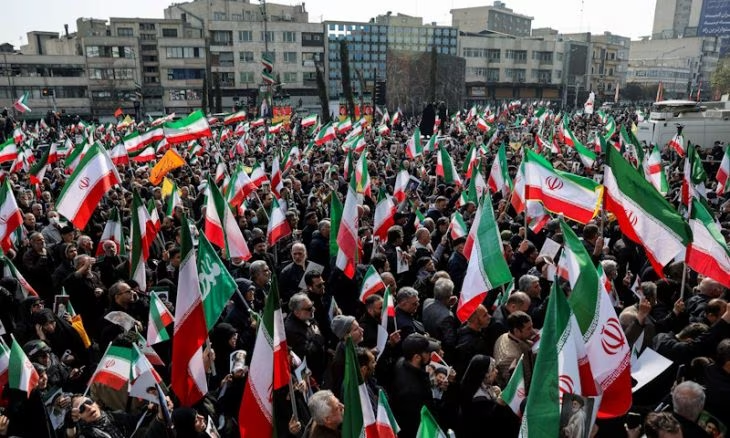







International press sources reported that Iran, in the eyes of external powers, has been stripped of a large part of its traditional military capabilities, yet it still maintains internal control despite losing a number of its most prominent political and military leaders. The rapid developments raise fundamental questions about the nature of 'the day after' if US President Donald Trump declares a final victory in his operation, which he dubbed 'Epic Rage'.
Through this operation, Trump seeks to achieve a historic accomplishment that changes the balance of power in the Middle East, something his predecessors did not dare to contemplate. The US President has set broad goals ranging from destroying Iran's military infrastructure to inciting the Iranian people to seize power and radically change the existing regime.
Reports indicate that a prolonged war faces internal obstacles in Washington, as military operations enjoy only limited support from the American public, not exceeding 30%. The rapid rise in energy prices and declining jobs are also pressuring the US administration as the midterm elections approach next November.
On the diplomatic front, the anticipated meeting between Trump and Chinese President Xi Jinping emerges as an additional pressure factor to end military operations. China, which has strategic and energy ties with Tehran, strongly criticized the American attack, which may push Washington to declare victory before the end of March to facilitate the bilateral summit.
The first scenario, promoted by some circles in Washington, is the spontaneous collapse of the regime under the pressure of external bombing and internal protests. In this case, the Revolutionary Guard and Basij may abandon fighting, paving the way for the return of the monarchy, represented by Reza Pahlavi, to manage a transitional phase leading to general elections.
The second scenario appears darker, as the regime may be shaken without completely falling, opening the door to widespread chaos. With internal opposition and escalating demands from ethnic minorities such as Arabs, Kurds, and Baloch for self-rule, the country may slide into a slow civil war amid the spread of weapons.
Mojtaba Khamenei, who was appointed Supreme Leader to succeed his father, emerges as a figure representing the hardline wing of the Iranian regime. However, questions are raised about his health status and leadership ability, especially with his disappearance from public view since his father's death last February and the loss of several family members in air attacks.
The third scenario proposes the 'Venezuelan model' as a possible solution, where the regime remains in place but strikes a secret deal with the United States. Under this agreement, Tehran permanently abandons its nuclear program and reduces its missile arsenal in exchange for a gradual lifting of the suffocating economic sanctions that are debilitating the state.
This diplomatic path requires a strong figure within the regime capable of negotiating with the West, and Ali Larijani's name is being circulated as a potential candidate for this role. However, the major obstacle remains the extent to which the hardline wing associated with the Revolutionary Guard would accept such fundamental concessions that touch the core of the regime's ideology.
Sources indicate a divergence of views between Washington and Tel Aviv on the ultimate goals of the war. While the US administration wishes to end military operations quickly to avoid economic repercussions, Israel seeks to exhaust the Iranian regime as much as possible to ensure it does not rise again.
Declaring victory in this war may be unilateral, unless Tehran explicitly admits defeat, which is unlikely given the regime's political culture. This ambiguity may keep the region in a state of constant tension even after direct air strikes on vital targets cease.
Analyses confirm that Iran will emerge from this confrontation weaker regionally, especially after the damage it sustained in previous confrontations in 2025. This external weakness may push the regime to tighten its internal security grip, making the regime an increasing threat to the Iranian people themselves.
Amid infrastructure destruction, Iran will face enormous challenges in rebuilding itself economically and politically in the post-war phase. Any future leadership will have to deal with a heavy legacy of destruction and debt, in addition to a society suffering from deep divisions between loyalists and opposition.
In conclusion, Iran's future remains suspended between Trump's ambitions to change the region's political map and a complex internal reality that refuses to fully comply with external dictates. The 'day after' that everyone talks about may not be as rosy as some imagine, but rather the beginning of a new chapter of conflicts in the heart of the Middle East.
Declaring victory, if it happens, will most likely be a unilateral declaration by the United States and perhaps Israel, unless Tehran admits defeat.
Share your opinion
Three Scenarios for Iran's Future: Will Trump Succeed in Imposing 'The Day After' Following 'Epic Rage'?