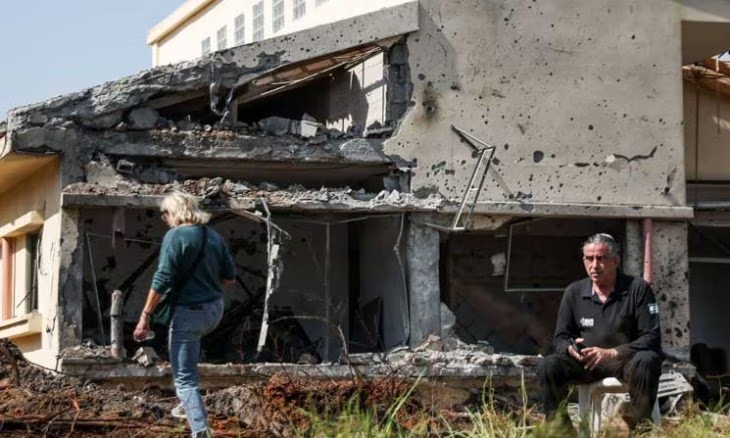







The Israeli army admitted today, Thursday, to committing a grave tactical and field error during Wednesday night, as it failed to issue prior warnings to residents about a large-scale rocket attack launched by Hezbollah from southern Lebanon. This admission came after a wave of widespread criticism directed at the security agencies following a night of terror experienced by settlers in the northern and central regions.
Official sources quoted the Northern Command of the occupation army as confirming that forces did not inform the public in a timely manner about the detection of unusual movements and deployment of Hezbollah fighters along the border. This shortcoming led to a state of severe confusion, especially with the start of the shelling, which amounted to about 200 rockets targeting various locations.
In the hours leading up to the attack, widespread rumors spread across social media platforms, causing panic among residents that lasted for many hours. Reports indicated that some mayors received initial updates about Hezbollah's preparations, but the absence of an official stance from the army increased the level of anxiety and tension.
Media sources indicated that the Israeli army's silence on Wednesday night was a wrong behavior, as it was necessary to inform the public about the nature of the expected threats. The Hebrew Broadcasting Corporation confirmed that this silence contributed to exacerbating the psychological crisis among settlers who found themselves under heavy fire without clear guidance.
On the ground, sirens sounded in more than 13 different locations within the occupied territories, where radars detected the launch of about 200 rockets from Lebanese territory. Despite the intensity of the shelling, there were no immediate reports of human casualties, but material damage and panic were widespread on the home front.
In a related context, the occupation army continued its aggression against Lebanon, as warplanes carried out a series of violent raids targeting the southern suburb of the capital Beirut. A military statement claimed that these attacks come as part of a response to the recent escalation and an attempt to reduce Hezbollah's missile capabilities targeting Israeli depth.
On the ground, the army announced that forces from the '810 Mountain Brigade' of the 210th Division are operating in strategic points in the Jabal Douf area in southern Lebanon. Military sources claimed that these operations aim to strengthen defensive lines and protect northern residents from any infiltration attempts or short-range missile attacks.
The occupation forces claimed to have found launch platforms and weapons depots belonging to Hezbollah during sweeping operations in the border areas. These seizures included mortar shells and other military equipment, which engineering units completely destroyed on site to ensure they would not be used again.
In the Beqaa region of eastern Lebanon, two Israeli raids targeted a residential building in the village of Qasr Naba, shortly after evacuation orders were issued to residents. Local sources reported that the first missile did not explode in the first raid, prompting warplanes to carry out a second raid to completely destroy the building.
Reports from the Lebanese National News Agency did not indicate any casualties in the Qasr Naba raid, but confirmed extensive material damage to surrounding properties. This shelling comes within the policy of 'pre-warnings' followed by the occupation to justify the destruction of civilian facilities under the pretext of their use by the resistance.
Observers believe that the Israeli army's admission of its mistake reflects the size of the gap between intelligence estimates and the explosive field reality on the northern front. This admission also puts the military leadership in the face of increasing popular pressure demanding better protection and more transparent communication with the public in times of emergency.
The border region has witnessed an unprecedented escalation for months, with both sides exchanging heavy shelling amid international fears of the situation sliding into an all-out war. Hezbollah confirms that its operations come in response to the ongoing Israeli aggression and in support of the Palestinian people in the Gaza Strip who are subjected to a war of extermination.
In light of these developments, questions are increasing within Israeli society about the effectiveness of ongoing military operations in securing calm for northern residents. Despite intensive raids, Hezbollah is still able to launch massive rocket barrages that reach distant areas and often bypass air defense systems.
In conclusion, the field situation remains prone to further escalation given the occupation's insistence on continuing its air raids and limited ground operations. Last night's events reveal that the Israeli home front still suffers from clear gaps in crisis management and warning of imminent threats.
The Northern Command admitted that the army made a mistake by not informing northern residents in a timely manner about Hezbollah's unusual deployment across the border.



Share your opinion
Israeli Army Admits 'Mistake' in Not Warning Settlers of Large-Scale Hezbollah Rocket Attack